Round 0
What the describer wrote about picture 0. These words, and nothing else, painted picture 1.
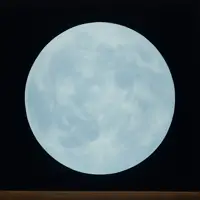
The image shows two dominant visual elements: a broad, gently undulating pale-gray surface that crosses the lower part of the frame, and a small, bright, roughly hemispherical blue-and-white sphere that sits above that surface against a deep, featureless black field. The pale-gray surface is the largest element and occupies roughly the bottom fifth to quarter of the frame, stretching left to right and slightly upward toward the right edge. The blue-and-white sphere is the most eye-catching detail because it contrasts sharply in color and brightness with the surrounding black; it is positioned slightly right of center and a little below the vertical middle of the image.
Photographic in appearance and highly realistic, the image looks like a high-resolution photograph rather than a painting or drawing. Details are crisp where they are bright, while the darkest areas are pure, deep black with no visible grain. Nothing appears exaggerated or stylized; forms and textures read as if captured by a camera.
Color is dominated by three broad zones: the absolute black of the background, the pale gray-beige of the foreground surface, and the vivid blues and soft whites of the small sphere. The background is an intense, uniform black that creates strong contrast with both foreground elements. The broad surface is a muted, desaturated mix of gray, beige and faint greenish tints, with subtle variations and slightly warmer undertones near some lighter patches. The small sphere displays saturated cool blues in swirling patterns, interspersed with bright white and softer off-white shapes; these cool tones are the brightest colors in the image and draw immediate attention. Light appears to come from outside the frame, illuminating the visible faces of both the surface and the sphere; highlights on the sphere are brighter and the shaded side is still visibly lit, indicating a directional light source from the left or upper-left relative to the visible surfaces.
Lines and edges in the image vary by element. The horizon line where the pale surface meets the black background is slightly irregular and soft-edged, with a gentle, rolling contour rather than a straight line. The edges of the pale surface are smooth and continuous but not perfectly straight; they form a low, wavy silhouette. The blue-and-white sphere has a crisp, smooth circular contour against the black, with a clean separation between the sphere and the background. Internal markings on the sphere consist of curved, organic lines and swirls that are soft-edged and flowing rather than angular.
Texture differences are prominent. The pale surface in the foreground appears matte and slightly rough, with fine pitting, faint ridges and subtle tonal variations that suggest a granular or dusty material; small, shallow depressions and streaks across this surface are visible at close scale. The blue-and-white sphere’s visible face appears smooth and slightly glossy in spots where highlights occur, but its patterned areas also show soft, cloudlike textures—billowy, layered white shapes over smoother blue regions. The background contains no texture; it is an unbroken, velvety black.
Spatially, the composition is very open. The largest plane (the pale surface) occupies the foreground and cuts across the lower edge of the frame, forming a clear foreground band. The small sphere sits in the middle distance above that band, isolated in the vast negative space of the black background, which serves as the deep background. There are no additional objects crowding the frame; negative space is dominant and emphasizes the separation between the foreground plane and the isolated sphere.
Compositionally, split down the vertical center, the right half contains the bright sphere and a portion of the foreground plane, while the left half is mostly empty black space with the foreground plane continuing across. Split horizontally, the lower portion is occupied by the textured surface band, while the upper larger portion is the empty black field punctuated only by the small sphere near the lower middle. The composition feels unbalanced toward the right because the small sphere sits slightly off-center to the right; the left side is largely empty. The horizon formed by the pale surface is low in the frame, about one quarter up from the bottom, and slopes gently upward from left to right. The viewpoint is from a vantage slightly above the foreground surface looking outward and upward toward the isolated sphere; the perspective makes the surface appear close to the viewer while the sphere reads as distant.
Scale is suggestive rather than precise: the foreground plane appears expansive and covers the full width of the image, while the sphere is small relative to the overall frame—roughly one fifteenth to one twentieth the width of the image—but appears large enough in its context to show surface detail. The relationship of the two elements implies depth: the foreground is close and extends beyond the left and right edges, while the sphere is set back against the black field. No human figures, text, or manufactured objects are visible. The overall mood of the visual arrangement is defined by stark contrasts of light and dark, a broad open emptiness in the background, and the crisp isolation of the small, brightly colored spherical form above the textured foreground plane.