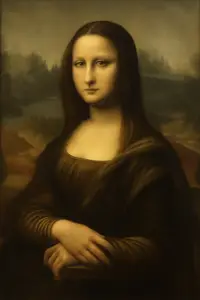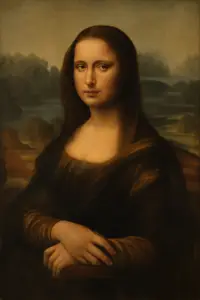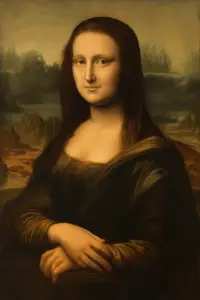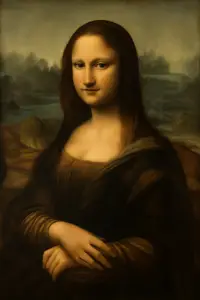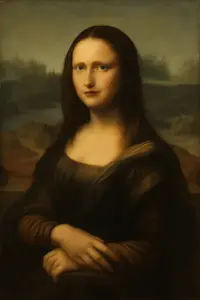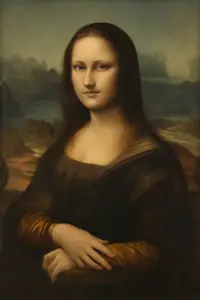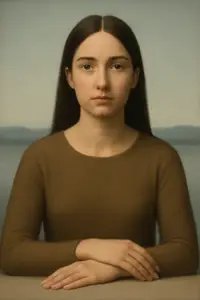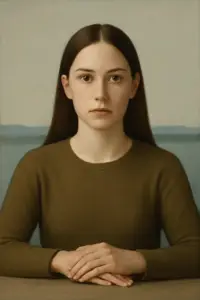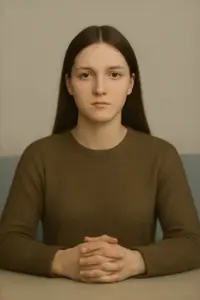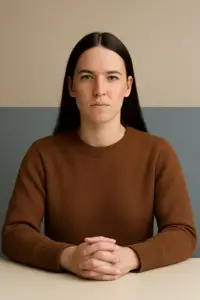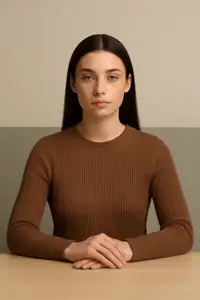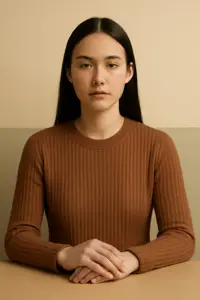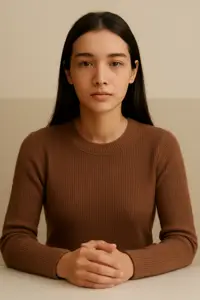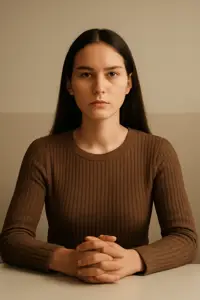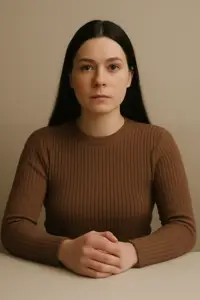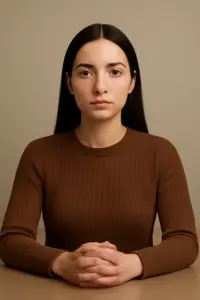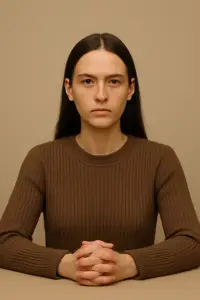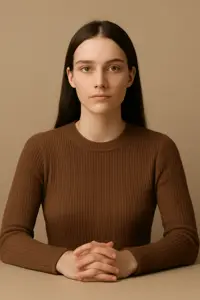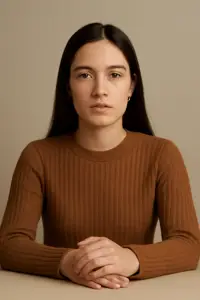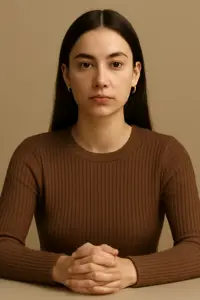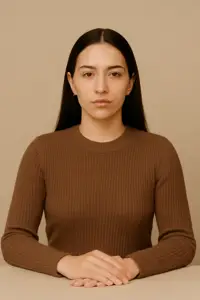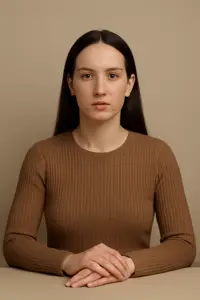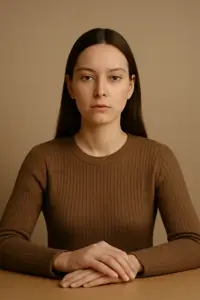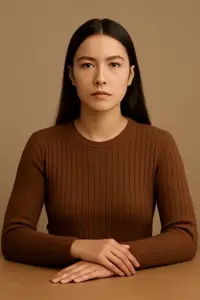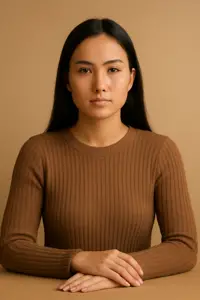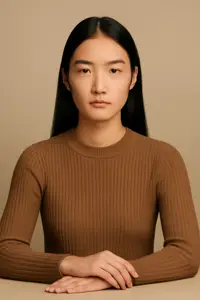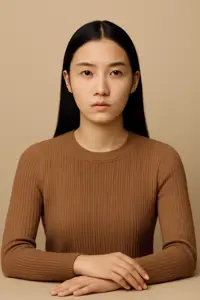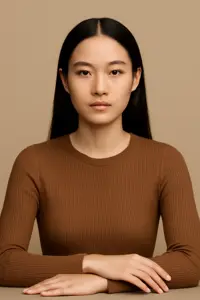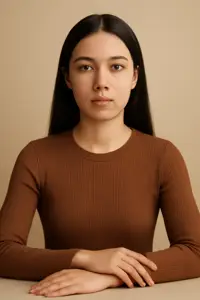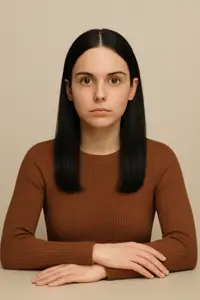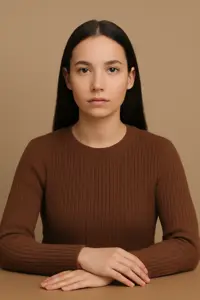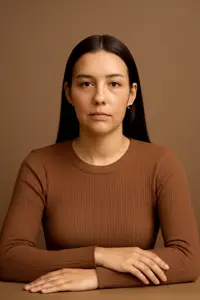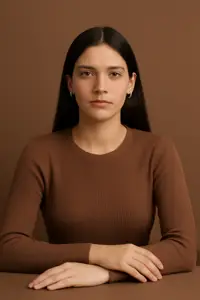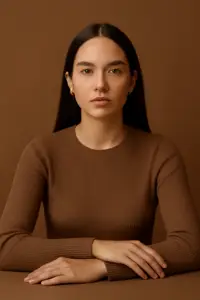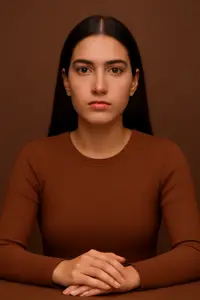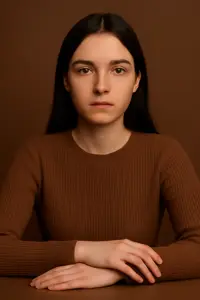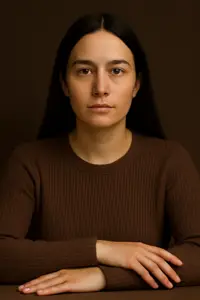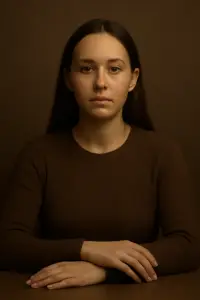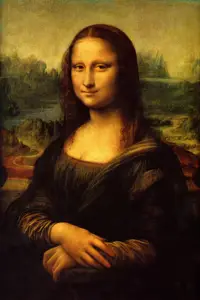
Mona Lisa

Round by round

One model describes the picture. A second model paints a new picture from that text alone. Below is every description, word for word.

What the describer is told

Each round the describer gets the latest picture and this instruction, nothing else. Its answer goes to the painter unchanged, as the prompt for the next picture. The painter never sees a picture, and nobody tells the describer what the first picture was.

You are describing an image so precisely that someone who has never seen it could recreate it from your words alone. Practise pure observation: describe only what is visible. Do not interpret, do not guess meaning or symbolism, do not judge, and do not name any artist, artwork, brand, real person or specific place, even if you recognise them. Describe what they look like instead.

Start with the subject: list everything you see, the largest and most important things first, then the smaller details. Say what draws the eye first and why (its size, contrast, position).

Then describe, saying where in the frame each thing is:
– Style: photographic, realistic, or stylised? Which medium does it look like (photo, oil paint, watercolour, pencil, digital render)? Where is it exaggerated or simplified?
– Color: the main colors, warm or cool, bright or muted, how many, and where the contrasts are, both between colors and between light and dark. Where does the light come from?
– Line: the quality of edges and contours: smooth or angular, sharp or soft, thick or thin, curved or straight.
– Texture: the surfaces shown (fur, fabric, metal, skin, foliage) and how rough, glossy or soft they look.
– Space: crowded or open? Flat or deep? What is in the foreground, middle ground and background? What is cut off by the edges?
– Composition: imagine the frame split into left and right halves, then top and bottom. What sits in each, and is it balanced? Where is the horizon, and what is the viewpoint (eye level, from above, from below, close-up, wide)?
– Scale: how big things are relative to each other and to the frame.

Write it as continuous, plain prose, as long as completeness requires but no longer than about 1000 words. Don't pad. Your text will go directly to an image generator as its prompt.

Where the start was lost

the woman
the smile
the landscape behind her

A filled cell means that round's description mentions it. Point at a column to see the picture.

Every round

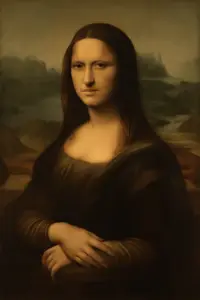
Picture 0

Round 0

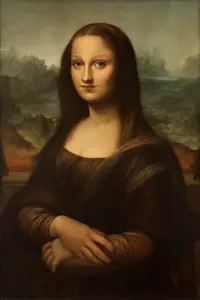
What the describer wrote about picture 0. These words, and nothing else, painted picture 1.

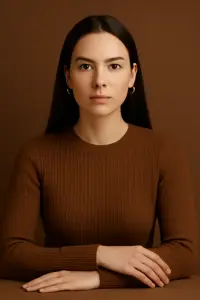
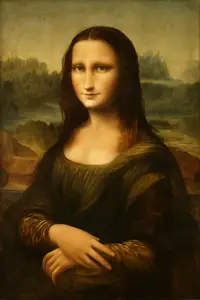
A single seated, three-quarter–facing female figure fills most of the vertical space, centered slightly to the right. The torso and head are the largest and most prominent elements; the folded hands rest near the lower center and draw secondary attention because they break the dark mass of clothing with lighter skin tones. The face is the focal point: it sits near the upper-middle of the frame and draws the eye first because it is the brightest area, with warm, smooth skin tones and subtle highlights on the forehead, nose and cheeks set against darker hair and clothing.

Starting at the subject and moving outward: the figure’s head is turned slightly to her left (viewer’s right) and held straight on the shoulders. Hair is long, dark brown to almost black, parted in the center and falling in loose waves down past the shoulders; thin, translucent strands close to the face are visible. The eyes look forward and are set in a softly modeled face with a faint, closed-lip smile. The neck and upper chest are exposed to about the collarbone, showing warm, even skin tones. The clothing is dark and layered: an outer cloak or drape of a deep, almost black brown wraps around the shoulders and upper arms, while the visible bodice beneath is a muted greenish-brown with a narrow decorative band along the neckline. Sleeves are gathered with subtle pleating and show lighter, slightly golden-beige fabric beneath the outer dark layers.

The hands rest one atop the other on a low support at the lower center of the image. They are depicted with smooth, rounded forms and warm highlights; fingernails and knuckles are suggested with gentle shading rather than sharp lines. A narrow straight edge of the support is visible under the hands.

The background is a wide, horizontal landscape that extends across the entire upper half of the frame. It contains a sequence of receding forms: nearest are low rocky outcrops and a sinuous, reddish-brown road or riverbed that curves from the left midground toward the center; behind these are darker, more vertical rock formations and then softer, distant hills and a flat watery plane. Further back the landscape becomes misty, with pale blue-gray and green tones that fade into a light, warm-yellowish sky at the very top. The background shows clear atmospheric perspective: nearer objects are darker and more detailed; distant forms are lighter, cooler and blurrier.

Style and medium: the image looks like a painted work on a panel or canvas, executed in a realistic representational manner. Brushwork is generally smooth and blended, especially on the skin, with visible fine craquelure and a slightly glossy varnished surface suggesting age. Some areas—particularly the distant landscape and edges of the dark clothing—are more softly handled and slightly blurred; the hands and face are more carefully modeled and defined.

Color: the palette is predominantly warm, muted earth tones and greens. The skin and the topmost highlight areas carry warm yellow-gold and peach tones. Clothing is dark brown to green-black, with the bodice showing a dull green-brown and inner sleeves a muted beige-gold. The landscape contains desaturated greens, bluish-greens, and brownish-reds; the sky is a pale, warm yellow-cream. Overall contrast is moderate: the brightest values are the face and hands, the darkest are the cloak and some foreground rocks. Light appears to come from the front-left (viewer’s left), producing soft highlights on the left side of the face, the left shoulder and the tops of the hands, with gentle shadows on the right side of the face and under the chin.

Line and edges: contours are mostly soft and rounded. Edges around the face and hands are smoother and more precise; edges between dark clothing and background are soft and sometimes merge into shadow. Landscape shapes are defined by softer, more textured edges; distant forms dissolve into misty outlines. There are no hard geometric lines; curves dominate—curved jawline, rounded shoulders, the sinuous curve of the distant river/road.

Texture: surfaces are varied. Skin is shown smooth and slightly luminous. Hair appears slightly glossy but with fine, soft texture. The clothing looks like layered, matte fabric with delicate folds and slight sheen on the inner sleeves. The background rocks have a rougher, granular texture implied by darker brushwork. The entire painting surface shows fine cracking in the varnish (craquelure), giving an overall slightly cracked texture across highlights and shadows alike.

Space and depth: the image presents a clear foreground/middleground/background separation. Foreground: hands and the lower torso, sitting near the picture plane. Middleground: the shoulders and upper torso of the figure and the closest rocks and winding ground to either side of her. Background: the receding landscape of rocks, water and distant hills under a pale sky, rendered with progressive atmospheric fading to indicate depth. The spatial arrangement feels deep rather than flat; small distant details and softened color shifts create the sense of considerable distance behind the figure. The left and right edges of the frame crop some of the cloak and the far left portion of the landscape; the top crops the sky above the head by a small margin.

Composition and balance: the figure is central but slightly shifted to the right of exact center, with the left half of the frame showing more visible landscape and a darker mass at the far left edge that counterbalances the figure visually. Vertically, the head sits just above the horizontal midline; the horizon in the landscape lies roughly across the upper third of the frame. The viewpoint is near eye level with the seated figure and relatively close—showing the subject from about the waist upward; the scale makes the figure dominate the scene while still allowing a broad landscape to be visible behind.

Scale relationships: the head and torso occupy roughly two-thirds of the frame height; the hands are proportionate to the body and positioned close to the lower edge. The distant landscape elements are small relative to the figure, reinforcing the figure’s dominance in the composition.

Overall, the image presents a centrally placed, realistically rendered seated female figure in three-quarter view, with carefully modeled face and hands, dark layered clothing, and a softly receding, atmospheric landscape behind, painted in warm, muted earth and green tones with smooth blending, soft edges and a varnished, cracked surface texture.
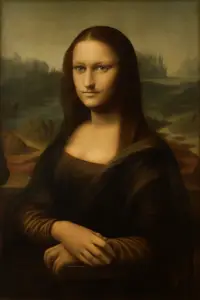
From round 1 on, the descriptions no longer mention the smile.

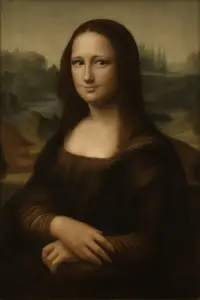
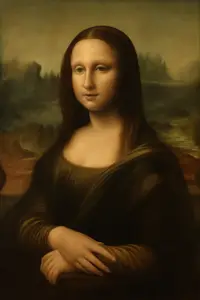
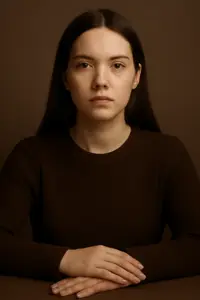
Picture 1

Round 1

What the describer wrote about picture 1. These words, and nothing else, painted picture 2.

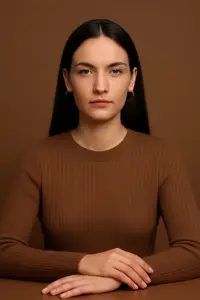
A three-quarter-length portrait of a seated woman fills most of the frame; her head and upper torso occupy the central vertical axis and draw the eye first because of the bright, evenly lit face set against darker clothing and a softer, dimmer landscape. The woman faces slightly toward the viewer’s right, with her shoulders turned three-quarters and her hands crossed and resting on a ledge or armrest in the lower center of the image.

The subject: a single female figure with pale, smooth skin, long straight dark brown hair that falls over her shoulders, a rounded forehead with a narrow center part, and large almond-shaped eyes set horizontally near the vertical midpoint of the face. Her lips form a small, closed, subtle curve. She wears a dark, rounded-neck dress or gown with a soft, loose draped shawl or outer garment over the shoulders; the garment has fur- or feather-like trimming at the cuffs and across the upper sleeve near the shoulder. Her hands are visible in the lower center, left hand crossing over the right, fingers relaxed and slender. The background is a distant, hazy natural landscape with low rolling hills, jagged rock formations, a river or water body snaking between elevations, and a layered horizon line that sits roughly at the upper third of the frame. The lighting highlights the face and the front of the torso more than the background or peripheral areas.

Style and medium: The image appears realistic and painterly, resembling an oil painting executed with soft blending and layered glazing. Transitions between tones are smooth and gradual; faces and cloth are modeled with delicate gradations rather than sharp brush marks. Small brushwork is implied in the textured fabric and hair, but the overall finish is refined and even. Some features are slightly idealized—edges softened and details smoothed—while other elements (hands, fabric folds) retain clearer, careful rendering.

Color: The palette is muted and warm overall. Skin tones are pale, warm beige with subtle rosy and golden highlights. Hair and clothing are dark brown to near-black, with warm brown highlights on raised surfaces. The background uses cool, desaturated greens, blues, and grayish browns, creating a gentle contrast with the warmer foreground. Light and dark contrast is moderate: the face and chest are the brightest areas, mid-tones on the hands and dress, and the deepest darks in the hair and the lower corners of the frame. Light appears to come from slightly left-of-center and slightly above the subject, producing soft highlights on the left side of the face and subtle shadows on the right.

Line and edges: Contours are predominantly soft and rounded. Facial features are defined with smooth contours rather than sharp lines; the eyelids and mouth edges are gently delineated. The transition from face to shadow is feathered. The hands and drapery show more distinct edges and subtle linear accents where folds occur, but no hard, graphic outlines dominate.

Texture: Skin looks smooth and matte. Hair reads as fine and slightly glossy, with individual strands suggested but not rigidly detailed. The garments look velvety or woven, with a soft nap indicated at the cuffs and along the shoulder where fur- or feather-like textures are suggested by short, directional strokes. The landscape in the background is atmospheric and slightly grainy, giving a distant, softened texture to hills and water.

Space and depth: The image has a clear foreground, middle ground, and background. Foreground: the woman’s hands and lower torso near the bottom center. Middle ground: her torso, head, and hair occupying most of the frame. Background: the hazy landscape that recedes to a distant horizon high in the frame. Depth is emphasized by atmospheric perspective: distant forms are less saturated, cooler, and softer-edged than the warm, more defined foreground figure. The composition uses a centered vertical axis for the figure, leaving negative space on both left and right where the landscape shows through.

Composition and balance: The subject is nearly centrally placed, slightly offset to the viewer’s right by the body angle; this gives mild asymmetry. Split the frame vertically: left half contains part of the subject’s left shoulder and hair and a stretch of landscape with a steep rock formation; right half contains the subject’s right shoulder and a softer, more receded stretch of hills and water. Horizontally, the upper third is dominated by the head and the distant horizon; the lower third contains the crossed hands and the darker mass of the garment. The horizon line sits above the shoulders, near the top third, and runs roughly horizontal but broken by hilltops. The viewpoint is at eye level with the seated subject, relatively close—showing head and torso but not full body—so the perspective is intimate but not extreme.

Scale: The woman is large relative to the frame, occupying roughly two-thirds of the vertical space and most of the center horizontally. Background elements are small and receded in comparison; rocks and waterways appear miniature relative to the figure due to distance and atmospheric compression.

Additional visible details: The neckline of the dress is rounded and moderately low, revealing the upper chest and collarbones. The shawl or outer garment shows thin, parallel highlights that suggest fine fibers or pleats across the chest area. The hands show pale knuckles and fingernails suggested by subtle tonal changes rather than by distinct lines. The overall finish is luminous, with the brightest highlights on the forehead, nose bridge, cheeks, and the top of the hands. The corners and edges of the image are darker, framing the central illuminated figure.

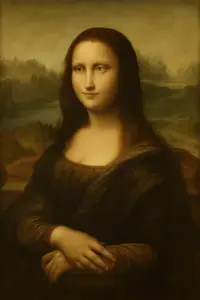
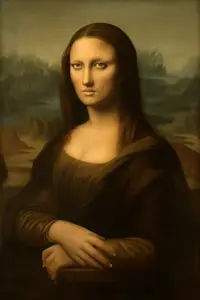
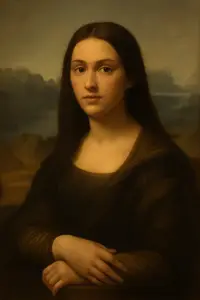
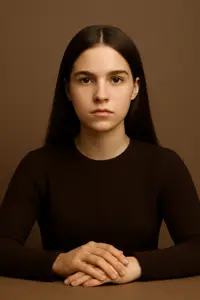
Picture 2

Round 2

What the describer wrote about picture 2. These words, and nothing else, painted picture 3.

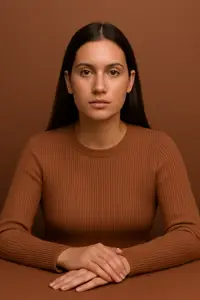
Subject: A seated woman shown from about the chest up occupies the central and largest area of the image. Her face and upper torso draw the eye first because they are centrally placed, occupy the most space, and are illuminated more brightly than the surrounding areas. Her head is slightly turned to her left (viewer’s right) while her eyes look forward. She has long, straight dark hair parted in the middle that falls down over her shoulders. Her skin is smooth and pale with soft, gradual modeling of light and shadow. She wears a dark, draped garment with visible folds and a low, rounded neckline that reveals the top of her chest. Both of her forearms and hands are visible and rest in the lower center of the frame, one hand gently crossed over the other. Behind her is a broad, distant landscape with indistinct hills, a body of water, and clumps of vegetation; these background elements are much less detailed and darker than the figure.

Where things sit in the frame and what catches the eye: The woman’s head is nearly centered horizontally and placed slightly above the vertical midpoint. Her face is the brightest area and therefore the initial focal point. Below her face, at the lower central part of the image, her hands form a secondary focal cluster. The landscape fills the entire horizontal span behind her, receding toward the top edges of the frame.

Style and medium appearance: The image appears realistic and rendered like a carefully worked oil painting rather than a photograph—brushwork is subtle and surfaces are smoothly blended rather than textured with visible grain or photographic detail. Edges around the figure are softly modeled; transitions of tone are gradual. Facial features and hands are rendered with fine control and realistic proportions; the landscape is more simplified and hazy compared with the highly finished treatment of the face and hands.

Color: The palette is dominated by warm, muted earth tones—soft ochres, warm browns, deep umbers—and cool, muted greens and blues in the background. Skin tones are warm and creamy with gentle yellow-beige highlights. The clothing is dark brown to almost black with warm brown highlights on the folded sleeves. The background landscape contains desaturated greens and blue-greys, creating a cooler band behind the warm-toned figure. Overall values are low to mid; contrasts are gentle rather than stark. The brightest values are the highlights on the subject’s forehead, nose, collarbone, and the tops of the hands. The light appears to come from the viewer’s left and slightly above the subject, illuminating the left side of the face and creating soft shadow toward the subject’s right side.

Line and edges: Contours throughout the image are predominantly soft and curved. Facial features are defined by smooth, delicate edges rather than sharp lines. The hairline and jawline are softly graduated into shadow. The folds of fabric show flowing curved lines; sleeve creases are rounded. The background horizon and distant ridgelines are more diffuse and blurred, lacking hard edges.

Texture: Skin appears smooth and matte with a velvety softness. Hair looks fine and straight with minimal individual strand detail—more suggested mass than sharply textured fibers. Fabric of the garment appears soft and slightly heavy, with subtle sheen on some raised folds that suggests a dense woven cloth. The distant landscape has a misty, atmospheric texture—blurred, soft, and smooth without crisp surface detail. The hands have a slightly more tactile, realistic quality than the clothing, with visible subtly modeled knuckles and nails but still a soft overall texture.

Space and depth: The scene has a sense of depth created by clear separation between foreground (the hands and torso), middle ground (the seated figure), and background (the receding landscape). The background is atmospheric: details fade and cool in color with distance, producing depth. The foreground and figure are detailed and warm, pushed visually forward. The composition is not crowded; there is moderate negative space above the head and around the shoulders, allowing the figure to dominate without filling every part of the frame.

Composition details and framing: If the frame is split left/right, the figure is centered, so both halves contain near-symmetric portions of the figure; the left half shows more of the subject’s left shoulder and the right half shows more of the hair falling over the right side and part of the background landscape. If split top/bottom, the upper half contains head and background sky; the lower half contains chest, crossed hands, and darker folds of clothing. The horizon of the background sits in the upper third of the frame, running roughly behind the subject’s shoulders and head area and slightly higher on the right. The viewpoint is at approximately eye level with the subject—neither from above nor below—and at a moderate distance that allows clear facial detail while including torso and hands (a three-quarter portrait scale).

Scale relationships: The figure occupies roughly two-thirds of the vertical dimension of the frame, with the head and torso scaled proportionally to natural human dimensions. Hands are scaled realistically relative to the head and torso and are positioned near the bottom center, taking up a small fraction of the total area but visually prominent due to contrast and placement. Background elements are much smaller in perceived scale and diminished by atmospheric perspective.

Other visible specifics: The subject’s eyebrows are thin and gently arched. The lips are closed with a narrow mouth, rendered with soft shading. The eyes are symmetrically placed and have clear irises with a subtle reflective highlight. The neckline of the garment is scooped and edged by a faint band or fold of fabric. Sleeves are slightly gathered with horizontal rhythmic folds near the wrists. There are no visible accessories, jewelry, or patterns on the clothing. The overall mood of the color and lighting is restrained and calm due to muted tones and soft transitions. The image edges crop slightly into the outer edges of the subject’s hair and sleeves at the far left and right, and the lower cropping cuts off just below the hands, leaving the rest of the seated posture implied rather than shown.

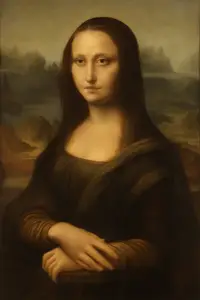
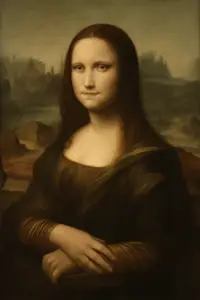
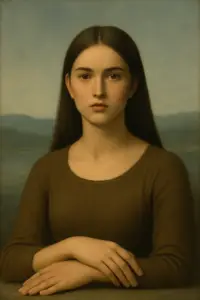
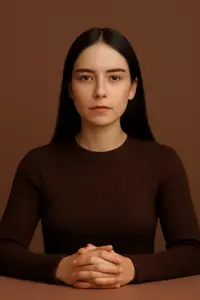
Picture 3

Round 3

What the describer wrote about picture 3. These words, and nothing else, painted picture 4.

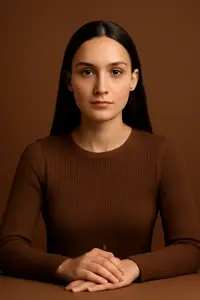
A single seated female figure fills most of the frame. The head and chest dominate the upper and central portions; the crossed hands rest near the lower center. Behind her is a wide, distant landscape with a river or body of water winding between low, rocky landforms and misty hills.

The element that draws the eye first is the face: it is centered near the vertical middle of the image, lit more brightly than surrounding areas, smooth in tone, and contrasted against darker hair and garments. The face is oval, turned slightly to the viewer’s left, with a calm, neutral expression, a straight nose, closed lips, and eyes that look forward. The hair is dark, long, and smooth, falling past the shoulders on both sides. The neckline and upper chest are exposed and softly illuminated, creating a pale oval of skin against darker clothing. The hands are pale and positioned one atop the other, fingers long and relaxed; they rest on a support that is barely visible at the bottom edge.

Style and medium: the image looks like a realistic oil painting executed with controlled, fine brushwork. Edges and transitions are softened, suggesting layered glazing or a blending technique rather than visible, painterly brushstrokes; the overall finish is smooth and refined. Small details such as the hair strands and fabric folds are rendered realistically but without rough texture; areas merge gently, producing a soft, hazy effect especially in the background.

Color: the palette is muted and warm overall, dominated by browns, ochres, and soft golden skin tones, balanced by deep, cool greens and bluish-grays in the distant landscape. The figure’s skin is pale, warm-toned, and stands out against very dark brown to nearly black clothing. The background contains desaturated greens and bluish-gray mist that recede into cool tones, creating contrast between the warm foreground and cool background. Light and dark contrast is moderate: the brightest values are on the face and chest, the darkest values are in the hair and folds of the clothing. The light appears to come from slightly above and in front of the figure, illuminating the face and upper chest while casting gentle shadow under the chin and along the neck.

Line and edges: contours throughout are soft and rounded rather than angular. Facial features are defined with delicate, soft lines; eyelids and lips are outlined subtly. The outline of the figure against the background is softly feathered, not sharply cut; hair edges blend gradually into the darker areas. The clothing is described with curved, flowing lines indicating fabric folds; the hands show smooth, curved contours.

Texture: skin appears smooth and velvety with no visible pores or roughness. Hair looks glossy but flattened, with long, soft strands suggested rather than individually rendered. The clothing has a matte, dense fabric appearance; folds are shown as broad, soft ridges rather than fine texture. The background landscape is misty and soft-focused, with distant rocky forms and water surfaces appearing blurred and atmospheric rather than detailed.

Space and depth: the image gives a clear sense of depth. Foreground: the hands and the lower edge of the torso occupy the nearest plane. Middle ground: the bust and shoulders of the seated figure sit between foreground and background. Background: a receding landscape of river or water, rocky outcrops, and low hills extends to the horizon. Atmospheric perspective is used: colors cool and desaturate with distance, edges soften, and forms become less distinct the farther they are from the figure. The scene is not crowded; there is open space in the background that contrasts with the solid presence of the seated figure.

Composition and framing: the figure is vertical and centered, occupying roughly the central third of the frame width and the middle two-thirds of the height. Left and right halves are balanced by the symmetrical placement of shoulders and hair, though the head is turned slightly to the viewer’s left, introducing a minor asymmetry. Top half: the head reaches into the upper third of the image, with negative space above and a sliver of sky and distant hills behind. Bottom half: the crossed hands and lower sleeves sit near the lower third. The horizon of the landscape lies behind the figure’s shoulders, approximately at the upper third of the frame, and runs roughly horizontal but with irregular, undulating landforms. The viewpoint is at eye level with the seated figure, a medium-close portrait distance that shows head, shoulders, and hands.

Scale: the figure is large relative to the frame, occupying the majority of the picture area; the hands are proportionate to the figure and appear life-sized within the composition. Background elements are small by comparison and distant, scaled down to emphasize depth.

Additional visible details: the clothing consists of dark, layered garments with a draped outer layer and gathered sleeves; the sleeves show horizontal, closely spaced bands or folds near the forearms. There is a gentle sheen on some fabric folds where light catches. The support under the hands is a narrow horizontal element with a wood-like tone visible at the bottom edge; only a small portion is shown before the frame cuts it off. The distant landscape includes a winding water channel that catches a little light, rocky promontories, and a pair of taller vertical shapes in the far right background that are softened by atmospheric haze. There are no other figures, objects, text, or ornamentation visible.

Picture 4

Round 4

What the describer wrote about picture 4. These words, and nothing else, painted picture 5.

Subject — a seated woman shown from the waist up centered in the frame; her folded hands rest on a narrow ledge at the bottom of the image; long straight hair that falls past her shoulders; an oval face with a faint, closed-mouth expression; a smooth, bare neck and upper chest; a simple dark dress with a rounded neckline and draped outer garment; a soft, distant landscape stretching behind her.

What draws the eye first is the woman's face because it is centrally positioned, well lit compared with the surrounding areas, and framed by darker hair and clothing that create contrast. The second focal area is the pair of hands in the lower-center foreground because they are lighter in tone and clearly defined against the darker ledge and sleeves.

A single human figure occupies the central vertical axis. The image appears to be a realistic representational rendering in a painted medium, resembling oil on canvas: soft blending of tones, smooth gradations, and slightly visible texture that suggests brushwork rather than photographic crispness. Exaggeration or simplification is minimal; contours are softened, creating a gentle, slightly idealized realism.

Color is muted and warm overall. The palette is dominated by warm browns, muted ochres, soft creams for skin tones, and deep, desaturated browns and blacks for clothing and hair. The background landscape contains cool, desaturated greens and gray-blues, but these are subdued and appear misty. Highlights are restrained: the brightest areas are the forehead, the bridge of the nose, the cheeks, the throat, and the tops of the hands, which catch a warm, diffuse light. Shadows are soft and gradual rather than stark. The primary contrast is tonal — light skin against darker hair and garments — rather than bold color contrasts. The light appears to come from a diffuse source slightly above and to the left of center (the subject’s right), producing gentle modeling on the face and hands and subtle shadowing under the chin and along the left side of the nose.

Lines and edges are predominantly soft and curved. The face is defined by smooth, rounded contours: oval jawline, softly arched eyebrows, and almond-shaped eyes. The mouth and eyelids have delicate, thin lines. The edges where hair meets skin and where garments fold are gently blurred rather than sharply delineated. The hands show slightly more defined edge work, but even there the transitions are smooth. Vertical and horizontal lines are minimal; the composition favors flowing curves.

Textures are rendered to suggest smooth skin, fine, silk-like hair, and soft, heavy fabric. The skin appears matte and velvety with barely perceptible pores or brush texture. Hair is depicted in broad, soft strokes that imply smoothness and a slight sheen. The dark outer garment looks like a dense, slightly coarse fabric with soft folds; the sleeves beneath show fine, closely spaced linear ridges that suggest a pleated or gathered material. The distant landscape is misty and soft with indistinct, feathery textures for trees and rock forms.

Space is open and shallowly deep. Foreground: the woman’s folded hands and the narrow ledge or armrest they rest on occupy the immediate foreground at the lower center. Middle ground: the torso, shoulders, and head of the figure dominate the middle ground and occupy most of the frame. Background: a receding landscape with rolling hills, a meandering watercourse, scattered low rocks or cliffs, and clusters of trees fades into a hazy distance. The background is blurred and atmospheric, enhancing the sense of shallow depth rather than deep cinematic perspective. The image is not crowded; negative space around the figure, especially to either side of the upper torso and above the head, leaves the subject isolated and prominent. The edges of the frame cut off the figure roughly at the upper thigh level and leave space above the head; the left and right edges crop part of the outer garment and background but do not intersect the face.

Composition: split mentally into left and right halves, the figure sits almost exactly centered but leans a hair toward the viewer’s left, creating a subtle asymmetry. The left half contains more visible landscape detail just beyond the shoulder; the right half shows a continuation of distant hills and a slightly more open sky. Top and bottom division: the upper half is dominated by the head and background horizon; the lower half shows torso, folded arms, and hands resting on a ledge. The horizon line of the landscape sits low in the upper third of the frame, behind the shoulders, producing an eye-level viewpoint. The viewpoint is roughly at the same height as the subject’s face — a straight-on, eye-level portrait seen from a moderate distance that includes torso and hands; neither a close-up nor a full-body shot.

Scale relationships are straightforward: the head is proportionally large relative to the frame, occupying about one-fifth of the vertical dimension, making it the dominant element. Hands are rendered slightly larger than life in the immediate foreground relative to the torso but remain natural in proportion to the figure. Background elements (trees, hills, water) are much smaller and blurred, indicating distance; they are scaled to support the sense of environment without competing with the figure.

Overall, the visual presentation is calm, balanced, and centered around a single seated figure with softly modeled features, warm muted tones, delicate handling of light, smooth curved lines, and a shallow, hazy landscape receding behind her.

Picture 5

Round 5

What the describer wrote about picture 5. These words, and nothing else, painted picture 6.

A single seated woman fills most of the vertical frame, shown from about the waist upward in a three-quarter pose facing slightly to the viewer’s left. What draws the eye first is her oval face and the gentle, even lighting on it: the face sits near the upper third of the image, centered horizontally, and is the brightest area against a darker, more muted background. Her expressionless mouth and half-closed eyes form the next focal area, connected visually to her softly lit hands crossed at the lower center of the picture.

The figure: a young adult female torso and head, hair parted at the center and falling long and straight to about shoulder level on both sides. Her hair is dark brown and frames the face in a smooth curtain, with subtle highlights that catch the light. The skin of her face, neck and chest is smooth and pale with a warm, yellow-beige glow. Her eyebrows are faint, thin and follow a gentle curved line above the eyes. The eyes look slightly to the viewer’s left; the irises are mid-tone and the whites are softly shaded. The nose is straight and softly modeled by gradual shadowing on one side. The mouth is small, the lips closed with a faint upward curve at the corners. There are no visible teeth. The chin and jawline are softly rounded.

Clothing and hands: she wears a dark, loose garment with a rounded neckline that reveals the upper chest and collarbones. A semi-translucent, slightly lighter shawl or drapery crosses from her left shoulder diagonally toward the right side of her chest and back, creating a layered effect. Sleeves are gathered and show subtle folds; the forearms are covered but the hands are exposed. Her hands are folded one over the other at the lower center of the frame, resting on a narrow ledge or armrest. The fingers are long, gently tapered, and rendered with smooth shading; nails are short and unadorned.

Background: a hazy, undulating landscape fills the background behind the figure, stretching across the top half of the frame. Low hills, river-like shapes, and suggested distant rock or tree formations recede into mist; edges are softened and indistinct. The horizon sits roughly at the midline of the frame, slightly above the woman’s shoulders, and separates the darker lower midground from a paler sky. The sky is muted and uniform, without distinct clouds, fading from warm beige near the horizon to a slightly cooler tone above.

Style and medium: the image looks like a realistic oil painting executed with smooth, blended brushwork. Transitions between light and shadow are gradual, with few visible brushstrokes; edges are softened, producing a smoky, blended effect around contours. The style emphasizes subtle gradations rather than crisp detail; facial features and hands are carefully modeled but simplified in texture.

Color and light: overall color is warm and muted, dominated by sepia and brown tones with warm yellows on skin and neutral, desaturated greens and blues in the landscape. Contrasts are low to moderate: the brightest highlights are on the face, chest and the top surfaces of the hands; the darkest areas are the hair, the drapery, and the shadowed folds of clothing. Light appears diffuse and coming broadly from the viewer’s left, producing gentle highlights on the left side of the face and soft shadows on the right.

Lines and edges: contours are mostly smooth and curved; there are few angular forms. Facial outlines, hair edges and the curves of the sleeves are softly defined. Lines around the hands and fingers are slightly sharper than the background but still rounded and delicate.

Texture: skin appears smooth and matte; hair is silky with soft sheen; fabric looks like fine, soft cloth with layered folds but little surface texture; the background landscape is painterly and blurred, giving a misty, softened texture.

Space and depth: the composition has clear depth: the figure occupies the foreground, the ledge and folded hands occupy the immediate foreground plane, the torso and shoulders the middle plane, and the distant, atmospheric landscape forms a deep background. The blurred background recedes gradually, creating a sense of spatial depth rather than flatness.

Composition and balance: divided vertically, the figure is centered but slightly shifted toward the right half by the diagonal sweep of the shawl and the turn of the head toward the left; visually the left side contains more negative space in the landscape while the right has more of the drapery and hair. Horizontally, the face sits near the center; vertically, the face occupies the upper third, hands the lower third. The viewpoint is at eye level, at a close-to-medium distance that lets the viewer see both facial detail and folded hands.

Scale: the figure is large relative to the frame—approximately three-quarters of the height—while the landscape elements are small and distant in scale, suggesting they are far behind the figure. Edges: the top of the head is close to the top edge but not cut off; the lower forearms and hands are near the bottom edge, with the hands resting on a horizontal element that is cut by the lower frame.

Picture 6

Round 6

What the describer wrote about picture 6. These words, and nothing else, painted picture 7.

A woman-sized seated figure occupies nearly the entire vertical center of the frame; her head is near the top third and her folded hands rest near the lower third, drawing the eye first because of their central placement, the contrast between the lighter skin tones and the darker clothing and background, and the smooth, illuminated planes of face and hands against softer, shadowed surroundings. Her face is oval, pale with subtle gradations of warm beige and soft yellowish highlights on the forehead, nose bridge, cheeks and chin; her expression is neutral, eyes facing slightly toward the viewer but not fully centered, and a thin, closed mouth. Long, straight dark hair frames each side of her face and falls over her shoulders, showing a faint midline part at the top of the forehead. She wears a dark robe or dress with a scooped neckline that exposes the upper chest and collarbones; the garment has a shawl-like drape across the shoulders and chest with faint pleating or gathered fabric at the neckline and slightly lighter-toned bands or trim along the sleeves. Her forearms extend forward and cross at the wrists; both hands rest on an unseen horizontal surface near the bottom edge of the image, the fingers relaxed and overlapping, the skin rendered with smooth shading and soft highlights.

Background elements occupy the left and right thirds behind her head and shoulders: a low, hazy landscape made of receding rounded landforms and a winding body of water or river that appears darker near the left middle and fades into muted tones toward the horizon. Farther back, indistinct rocky or tree-like silhouettes rise and fall; the overall background has a smoky, soft-focus appearance with low contrast, creating a sense of depth behind the figure. The lighting appears to come from slightly above and in front of the figure, illuminating the face and hands more strongly than the clothing and background; the left side of the face (viewer’s right) receives marginally more light, producing gentle shadowing on the opposite cheek and under the chin.

Style: the visual effect is that of a realistic oil painting rather than a photograph; brushwork is refined and smoothed so that transitions between tones are soft and blended rather than visibly textured, although there are subtle indications of layered glazing typical of oil media. The rendering is detailed where it matters (facial planes, hands) and more simplified and diffused in the background and outer clothing edges.

Color: the palette is predominantly warm neutrals and muted earth tones—creamy beige and pale yellow for skin, warm brown and deep sepia for hair and clothing, and desaturated greens, blues and greys in the distant landscape. Contrast is moderate: the light skin and the slightly lighter area of the neckline and hands stand out against the darker, brown-black folds of the garment and the mid-tone, misty background. Overall colors are muted rather than bright, producing a soft, low-saturation atmosphere.

Line and edge quality: contours around the head, neck and hands are smooth and slightly softened rather than sharply outlined; facial features like the eyes, nose and mouth are defined with delicate, precise lines but without hard edges. The edges of the clothing and the hair are gently feathered into shadow. Background shapes are diffuse and blurred, with very soft edges that recede visually.

Texture: skin appears smooth and matte with subtle modeling; hair looks fine and slightly glossy in slender strands but is largely rendered as smooth masses with faint linear detail. The fabric of the clothing suggests soft, heavy cloth with fine, shallow folds and a velvety quality; the background landforms and water are soft and misted, lacking crisp texture.

Space and depth: the composition has clear foreground (the hands and lower torso), middle ground (the upper torso, shoulders and head), and background (the hazy landscape). The piece feels deep rather than flat because of atmospheric perspective—the distant landscape fades into paler, cooler tones and softer edges. The figure fills most of the middle plane and slightly overlaps the middle-ground landscape, reinforcing depth. The sides of the frame cut off portions of the garment and hair, implying the body continues beyond the picture edges.

Composition and balance: vertically, the image centers on the figure with the head roughly on the top third and hands near the bottom third; horizontally, the figure is centered but slightly shifted so that more of the left shoulder (viewer’s right) and hand are visible; the left and right halves are balanced by the symmetrical posture and the nearly symmetrical background formations on each side, though the landscape details differ on each side. If the frame is divided into quarters, the face sits near the upper central region, eyes near the horizontal centerline; the horizon in the background sits high in the upper third of the frame, well above the shoulders. The viewpoint is at about eye level with the seated figure and at a modest distance—close enough to show hands and torso but not the full armrests or the chair.

Scale: the figure is life-sized relative to the frame, occupying about 70–80% of the image height. Hands and head are proportionate to one another; background landforms are small by comparison and clearly distant.

Additional small details: the neckline of the garment shows fine vertical pleats or gather lines; the sleeves have lighter bands where the fabric is folded; there is a smooth, rounded object or surface under the hands that might be the top of a ledge or armrest, visible only at the very bottom edge. The overall finish is softly luminous with a gentle glow on the exposed skin, and there are no overt decorative patterns or bright colors anywhere in the image.

Picture 7

Round 7

What the describer wrote about picture 7. These words, and nothing else, painted picture 8.

A single seated female figure fills most of the frame; she is shown from about the chest up, facing the viewer with her torso turned slightly to her left. The first thing the eye is drawn to is her oval face near the vertical and horizontal center of the image: it is relatively large, evenly illuminated compared with the darker clothing, and bordered by long, straight dark hair that frames it on both sides, which increases the contrast and focus on her features.

Subject and details: A woman with smooth, pale skin and a calm, neutral facial expression occupies the central area. Her dark hair is long, straight, and parted in the middle, falling down each side of her head and over her shoulders. Her eyes are forward-facing and level with the midline of the composition. Her mouth is small and closed. She wears a low, rounded neckline and a dark, shawl-like draped garment with visible folds over her shoulders and arms. Both forearms are visible and rest on a ledge or armrest at the bottom of the picture; her right hand is crossed over her left and the fingers of each are relaxed, gently curved, and visible in the lower center. The shoulders and upper torso occupy the lower half of the central frame; the arms and hands extend to the very bottom edge and are partially cut by the lower margin. No other figures or objects are present.

Style and medium: The image reads as a realistic painted portrait rather than a photograph; the surfaces appear built up with smooth graduations of tone consistent with an oil-paint technique. Details are softly rendered rather than hard-edged, with subtle blending between light and shadow and minimal visible brush texture, giving a refined, polished finish.

Color and light: The overall palette is muted and warm, dominated by deep browns, ochres, and soft golden skin tones, with cooler, desaturated greens and blues in the background landscape. The highest contrast occurs between the pale face and hands and the dark clothing and hair. Light appears to come from slightly above and in front of the subject, softly illuminating the face, upper chest, and the tops of the hands; shadows fall beneath the chin, along the neck, on the inner sides of the arms, and in the folds of the drapery. Background colors are darker and more subdued, helping the figure stand out.

Line and edges: Edges throughout the image are soft and gently graduated rather than sharp or linear. Contours of the face and hands are smooth and rounded; lines in the drapery form curved, flowing folds. There are no harsh angular elements; the composition favors curved, organic shapes.

Texture: The facial skin and hands are rendered very smoothly, with little surface detail, suggesting a velvety skin texture. Hair appears fine and sleek, with subtle sheen but no coarse detail. The clothing looks like a heavy, soft fabric with gentle, layered folds; the drapery has a slightly matte appearance. The distant landscape is rendered with fine, misty textures that suggest atmospheric softness rather than crisp detail.

Space and depth: The composition has a clear foreground (the figure and the armrest), a shallow middle ground (the immediate area behind the figure’s shoulders), and a distant background (a low, receding landscape with undulating hills, a river or lake, and vague vegetation). The background is painted with softer focus and cooler, less saturated tones, creating perceived depth and atmospheric perspective. The horizon line sits roughly behind the subject’s head and just above shoulder height, dividing the upper and middle portions of the frame.

Composition and balance: The figure is centered and vertically dominant, creating a symmetrical, stable composition. If the frame is split left/right, the face and torso sit on the central axis with nearly mirror balance between left and right halves: the left side contains the left hair and arm, the right side the right hair and shoulder; both halves contain similar mass and visual weight. Top/bottom division places the head and upper torso in the top two-thirds and the clasped hands and armrest in the bottom third, anchoring the composition. The viewpoint is at eye level with the subject, at a relatively close range that emphasizes the upper body and hands without showing full-length anatomy.

Scale: The seated figure occupies roughly three-quarters of the vertical frame and most of the horizontal center area; the background landscape appears small by comparison and recedes into the distance. The hands are proportionate to the torso and serve as a secondary focal point because they are centered and softly lit.

Cutoffs and framing: The image is cropped just below the hands at the bottom, and there is narrow breathing space above the head; the shoulders are fully included but the lower arms extend to the bottom edge. No extraneous objects intersect the figure; the edges of the frame cut off any view of the subject’s lower body.

Picture 8

Round 8

What the describer wrote about picture 8. These words, and nothing else, painted picture 9.

A single seated figure fills most of the vertical frame, centered and occupying the middle third from left to right; the face and upper torso draw the eye first because the face is bright, smoothly lit, and positioned near the top center of the image against a darker, receding background. The figure’s head is oval, with straight, dark brown hair parted in the middle and falling to about shoulder length. The face is turned slightly to the viewer’s right (the image’s left), eyes looking gently toward the viewer’s right. The skin on the face and exposed neck and chest is a warm, pale beige with soft gradations of light and shadow. The figure’s thin eyebrows are subtle and lightly colored; the eyelids are smooth with small, rounded irises set in calm eyes. The mouth is closed with lips slightly curved and defined by soft shading. The chin is rounded; the jawline is soft.

The torso is clothed in a dark, draped garment with a low, rounded neckline that reveals the upper chest. The clothing appears to be layered: an inner dress with vertical, gently folded fabric across the chest and sleeves that are gathered at the forearms, and an outer, shawl-like fabric draped over the left shoulder (image right) and wrapping across the body. The fabrics are rendered with soft tonal shifts from deep blacks and olive-browns to muted golds and greens, with highlights that describe gentle folds and cloth weight.

The figure’s hands are in the lower central portion of the frame, resting on a narrow, horizontal ledge or armrest that crosses the bottom edge. The right hand lies over the left, fingers elongated and slightly tapered; knuckles and nails are subtly modeled, the skin tone matching the face but appearing warmer in the light. Sleeves extend to the wrists, showing fine parallel folds around the forearms.

The background occupies the full width behind the figure and reads as a distant, atmospheric landscape. It is low-contrast and softly blurred, creating a sense of depth behind the sharply modeled figure. On the left side of the background (image left) there are rock-like forms and a low, uneven shore that slopes into a body of water. In the middle distance toward the right, a winding river or channel cuts across the landscape, reflecting muted light. Farther back, gentle, rounded hills and a stand of vertical, tree-like forms rise and fade into a hazy, cool-toned sky. The horizon sits roughly at the level of the figure’s shoulders, slightly above the midpoint of the frame. The background colors are muted greens, earthy browns, and cool blue-grays, with the lightest tones concentrated near the distant water and sky.

Overall style appears photographic in realism but clearly made with a paint medium: smooth, layered brushwork with soft sfumato-like blending where transitions between light and shadow are seamless and edges around the face and hands are soft. The surface suggests oil paint on a fine ground because of the warm, glazed color depth and velvety transitions; textural detail is minimal and smoothed rather than heavily bristled. Edges are mostly soft and rounded—contours of the face, hair, and fabrics are defined by subtle tonal shifts rather than sharp lines. Where lines exist, they are gentle curves (the hairline, neckline, sleeve folds) and short, tapered strokes indicate creases in fabric.

Lighting comes from the viewer’s left and slightly above, illuminating the left side of the face and chest more strongly and casting faint shadows on the right side of the face and under the chin. Contrast is moderate: the figure’s illuminated skin and the lighter region of the neckline contrast with the darker garments and the dim background, creating a clear separation between figure and space. Color palette is limited and muted—predominantly warm skin tones, dark olive-browns and black for clothing, and cool, desaturated greens and blues in the distant landscape—so overall impression is warm in the foreground and cool in the background.

Space reads as deep rather than flat because of the blurred, atmospheric background receding behind the figure. The foreground is occupied by the hands and the armrest at the very bottom; the middle ground is the figure’s torso and head; the background is the landscape and sky. The composition is symmetrical in balance: the figure is centered, with shoulders and hands forming a stable triangular arrangement from chest to hands. Left and right halves contain similar visual weight—the left shoulder and draped fabric echo the right shoulder and sleeve—while the background shapes vary but remain low-contrast so they do not compete visually. The viewpoint is at approximately eye level and at a close-to-medium distance, showing the figure from about mid-torso upward. Scale is human-proportioned: the head-to-body ratio and hand sizes are naturalistic relative to the frame, with the figure occupying most of the central vertical space and leaving narrow margins of background at top and sides.

Picture 9

Round 9

What the describer wrote about picture 9. These words, and nothing else, painted picture 10.

Central in the image is a seated woman shown from about the waist up, occupying most of the vertical center of the frame. What draws the eye first is her face: it is lit more brightly than the rest of the scene, positioned slightly above center, with a smooth, oval shape and neutral expression that contrasts with the darker tones around it. Below the face, the subject’s crossed hands rest on a narrow ledge or armrest and are the next prominent feature because of their lighter skin tone against deep, shadowed clothing.

The subject: a single human figure facing forward with the torso angled slightly to the viewer’s right. Hair is long, straight, and dark brown, falling past the shoulders on both sides and framing the face. The forehead is broad and the eyebrows are faint. Eyes are almond-shaped and set level with each other; their irises are light in tone. The nose is straight and the lips are closed with a subdued expression. Neck and upper chest are visible, with a low, scooped neckline on the garment exposing the upper sternum and collarbones. Arms are bent at the elbows; hands are clasped, the right hand over the left, fingers relaxed and resting on a thin horizontal surface at the lower center of the image. Clothing is layered: the visible outer fabric is dark, draped over the shoulders and arms, with a lighter inner garment or panel at the chest. The garment has subtle, parallel folds along the sleeves and across the bust.

Background and environment: a hazy landscape fills the distance behind the figure. Immediately behind the shoulders and head, there are undulating forms suggesting hills, with softer, receding shapes toward the upper right and left. A winding, horizontal band of lighter tone crosses the mid-background, hinting at water or a distant plain. The far background rises to indistinct, misty ridgelines at the top third of the frame. The entire background palette is muted and desaturated compared with the subject’s face, producing a sense of atmospheric depth.

Style and medium: the image appears as a realistic painted portrait rendered in oil-paint-like tones. Brushwork is smoothed to produce soft gradients across skin and fabric rather than expressive or visible brushstrokes; edges are often feathered. Facial features and hands are modeled with gradual tonal transitions, while the background shows softer, blended shapes that lack sharp detail. Proportions are realistic and naturalistic; nothing is exaggerated anatomically.

Color: the overall color scheme is warm and muted, dominated by brown, ochre, deep olive and soft sienna tones. The face and hands have warm, creamy flesh tones with subtle peach and beige. Clothing is dark brown to near-black with slightly warmer brown highlights on folds. The background contains cooler, grey-green and slate-blue hues, especially in mid and distant planes, creating a low-contrast, atmospheric recession. Contrast between light and dark is moderate: the face and hands are the brightest elements, while the clothing and lower corners of the frame are the darkest. Light appears to come from slightly left of center and above the subject, softly illuminating the left side of the face and chest more than the right, producing gentle shadows along the right cheek, under the chin, and beneath the folded hands.

Line and edges: contours are predominantly soft and rounded. Facial contours, hairline, and shoulder lines are smooth and gently curved. The edges where figure meets background are delineated but diffused by soft shading, not hard outlines. The folds in sleeves and draping of fabric are indicated by curved, parallel shadow lines that are subtle rather than sharply edged. The horizon-like elements in the background are composed of soft, irregular silhouettes rather than straight lines.

Texture: skin appears smooth and matte, with a soft, almost velvety finish. Hair looks fine and straight with minimal visible strand detail, presenting as a smooth, dark mass catching slight highlights. Fabric surfaces read as soft, heavy cloth—possibly wool or thick linen—with gentle sheen in places where folds catch light. The distant landscape is misty and blurred, suggesting soft foliage or rock masses but without textual detail.

Space and depth: the composition uses shallow to moderate depth. The figure sits in the foreground and occupies most of the middle ground; the background recedes into a misty distance, creating a sense of depth through atmospheric perspective (dimming and cooling of tones with distance). Foreground is occupied by the hands and armrest at the bottom center; middle ground is taken by the figure from lower torso to head; background is the landscape behind and above the shoulders. The image is not crowded; there is negative space around the head and shoulders, particularly toward the upper left and right, emphasizing the central figure.

Composition and framing: the figure is centered horizontally and slightly above center vertically, creating a vertical axis through the face and hands. If the frame is mentally split into left and right halves, the right half (viewer’s right) contains more of the landscape’s distant ridges and a slightly darker portion of the shoulder and sleeve, while the left half shows more of the nearer slope and a lighter band of background. Top and bottom halves: the top half is dominated by the head and misty landscape; the bottom half contains the crossed hands, armrest, and the chest and upper torso. The balance feels symmetrical around the vertical center, with the face and hands forming two visual anchors. The horizon or implied horizon line lies roughly at the lower third to middle third of the image behind the figure, obscured in places by the subject’s shoulders. Viewpoint is at approximately eye level with the subject, neither looking up nor down, and the framing is mid-close—close enough to see facial detail and hands, but far enough to include some background.

Scale: the human figure fills most of the frame vertically, making the head and shoulders large relative to the overall image. Hands are proportionate to the body and are sizable in the lower center but do not overpower the face. Background elements are smaller in scale relative to the figure and are rendered as distant, reduced forms.

Cropped elements: the figure’s elbows and lower arms extend toward but do not reach the frame edges; the mid-forearms sit comfortably within the lower edge. The top of the head is fully visible with hair extending close to the top edge. No other objects, people, or textual elements appear in the visible frame.

Picture 10

Round 10

What the describer wrote about picture 10. These words, and nothing else, painted picture 11.

A single seated female figure fills the central vertical axis of the image, occupying most of the middle and lower portions of the frame. The viewer’s eye is drawn first to her face because it is the brightest element and placed near the upper center; the face is illuminated with soft, warm light and contrasts against darker hair and clothing. Below the face, her crossed hands rest on a narrow ledge or armrest in the lower center, creating a secondary focal point because of their clear placement and gentle highlights.

From top to bottom and left to right: At the very top of the frame is a muted, even sky that transitions into a distant, misty landscape. The landscape stretches across the entire horizontal background and contains irregular, softened silhouettes of rocky outcrops and low hills, mostly concentrated toward the left and right thirds, leaving a slightly more open plane behind the figure’s head. The horizon sits high in the composition, roughly in the upper third, and recedes into hazy depth.

The seated figure’s head is near the upper center. Her hair is long, dark, and straight, falling past her shoulders on both sides; it frames the face with soft transitions and no sharp outlines. Her face is rendered with smooth, blended modeling: a pale, warm complexion with subtle shadows under the eyes and along the sides of the nose. Her eyes look forward and are horizontally aligned, set about mid-face; they are softly defined, with gentle shading rather than sharp lines. Her mouth is small and closed, with a slight, ambiguous curve to the lips. The neck and upper chest are exposed in a modest neckline that creates a soft, curved light area below the face.

Her torso is clothed in a dark, draped garment with soft folds; the fabric appears heavy and matte, with subtle highlights where folds catch the light, particularly across the shoulders and upper arms. The sleeves of an undergarment or layered fabric are visible at the forearms as a series of narrow, horizontal bands or pleats in a warm golden-brown tone; these bands encircle the lower forearms and are more illuminated than the surrounding dark sleeve, producing contrast that draws attention to the hands.

Her hands are positioned in the lower center: the right hand rests over the left, fingers gently curved, the tips extending toward the lower right quadrant. The hands are depicted with smooth, rounded contours and soft tonal modeling; the knuckles and finger joints are suggested by gentle shading rather than hard lines. The left hand’s thumb and the base of the left wrist rest against a low, flat horizontal element — an armrest or ledge — that spans the bottom of the frame and is visible as a narrow dark band. The hands and forearms sit in the foreground relative to the torso and background.

Style and medium: The image resembles a realistic painted portrait, using a technique that emphasizes soft transitions between tones. The rendering is painterly rather than photographic: edges are often blurred or gently smudged, especially where flesh meets shadow and in the background landscape. Details are carefully controlled but not hyper-real; there are no visible brushmarks dominating the surface, and the overall finish is smooth, suggesting oil paint with fine blending or a digital emulation of that medium.

Color: The palette is limited and muted, dominated by warm browns, ochres, and soft flesh tones, balanced by deep, desaturated blacks and dark browns in the clothing and hair. The background landscape uses cooler, desaturated greens and grey-blues but remains subdued so the warm tones of the figure stand out. Light-dark contrast is moderate: the face and chest are the lightest values, while the hair, garments, and lower corners of the image are the darkest. Highlights are soft and diffuse, suggesting a single, gentle light source from slightly above and in front of the figure, possibly biased to the viewer’s left, which creates mild modeling shadows on the right side of the face and under the chin.

Line and edges: Contours are predominantly soft and rounded. Facial outlines, hairline, and transitions from cloth to background are feathered rather than crisply delineated. Curved lines dominate the composition: the oval of the face, the roundness of the shoulders, the arcs of the folded arms and fingers. There are few straight or angular lines; the only horizontal straightness is the narrow ledge at the bottom.

Texture: Skin appears smooth and slightly luminous. Hair looks fine and silky but rendered without high gloss; it reads as a uniform dark mass with subtle tonal variation. The clothing has a heavier, velvety or woolen look, suggested by deep, soft shadows and muted highlights along folds. The forearm bands present a slightly ribbed or pleated texture, lighter and more reflective than the outer garment. The background landscape is misty and indistinct, its rocky surfaces suggested rather than textured.

Space and depth: The image has clear depth: a shallow foreground containing the hands and ledge, a middle ground occupied by the seated torso and head, and a distant background of receding landscape and sky. Depth is created through atmospheric perspective—the background is paler and less detailed—and through overlapping forms (hands over ledge, torso in front of landscape).

Composition: The composition is centralized and symmetrical in feel: the figure sits almost exactly on the vertical centerline, with shoulders and arms forming a balanced shape across the horizontal center. Left and right halves mirror each other closely: hair falls on both sides, garments drape symmetrically, and the hands lie near the central axis. Top and bottom balance is achieved by the lighter head and chest area near the top center and the darker mass of clothing and hands at the bottom. The viewpoint is at roughly eye level, with the figure shown at about three-quarter length (head, torso, and hands visible) and occupying most of the frame; only a small margin of background appears around her.

Scale: The figure is life-sized relative to the frame, with the head and torso proportions appearing natural. The background elements are small and distant by comparison, reinforcing the figure’s dominance in scale within the composition. No other objects, text, or figures are present; the edges of the frame cut off part of the shoulders and the lower portion of the hands’ supporting ledge.

Picture 11

Round 11

What the describer wrote about picture 11. These words, and nothing else, painted picture 12.

A single seated female figure fills most of the vertical frame, centered slightly to the right of the middle. The face and upper torso are the largest and most prominent elements; the face draws the eye first because it is the brightest area in the image, placed near the upper third of the frame and surrounded by darker hair and clothing that increase its contrast. Two folded hands rest across a narrow armrest near the lower center of the image and are the next most visually significant elements because of their pale tone against the dark fabric. Behind the figure, a distant, softly lit landscape occupies the background across the full width of the frame; it contains low hills, water, and misty treelines but is small in scale and low in contrast compared with the figure. The hair of the sitter, the neckline and shoulders, the sleeves and the subtle drapery of the clothing, and the muted atmospheric details of the landscape are the remaining visible items.

The image looks like a realistic painted portrait rendered in oil-like tones and subtle blended brushwork; edges are softly modulated with fine gradations rather than crisp photographic sharpness. The medium qualities emphasize delicate tonal transitions on skin and fabric, with some slight softening around distant landscape features that suggests glazing or layered paint rather than photographic grain. Areas of greatest detail are the face and hands; the background is simplified and softened.

Color is muted and warm overall. The face and hands are rendered in warm, pale flesh tones with gentle golden highlights. Hair and clothing are deep brown to near-black, creating strong tonal contrast with the skin. The background landscape uses cool, desaturated blues and greens with grey-green mists and brownish landforms. Highlights on the skin and a faint sheen on the upper chest provide the brightest points; shadows fall into warm browns and deep umbers. The overall palette is restrained: mainly warm browns, soft flesh tones, and cool muted blues and greens in the background. The light appears to come from the viewer’s left-front, slightly above eye level, illuminating the sitter’s left cheek, forehead, and the top surfaces of the hands, and casting gentle shadow on the right side of the face and under the chin.

Lines and contours are predominantly soft and curved. Facial features are delineated by smooth, rounded edges rather than hard angular lines. Hairline and jawline are gently contoured; the transition between cheek and shadow is blended. The folds of the sleeves and the armrest have flowing curved lines; there are no harsh geometric shapes. The edges of distant landscape forms are mist-softened and irregular but remain rounded rather than jagged.

Textures are smooth and blended for skin, giving a satin-like, slightly matte appearance. Hair appears fine and lightly sheened but painted as soft masses rather than individual strands. Fabric of the clothing looks soft and heavy, with subtle visible folds and a velvet-like quality in the darker areas; highlights on the sleeves suggest a slightly smoother, satiny band or layered fabric. The background landscape reads as misty and soft, with diffuse water surfaces and indistinct foliage that lack crisp texture.

Space is deep rather than flat. The sitter occupies the immediate foreground and middle ground, with the torso and hands in front and the head slightly forward of the shoulders. The landscape recedes into the far middle ground and background, using atmospheric perspective—colors cool and contrast reduces with distance—to create depth. The foreground is occupied almost entirely by the figure; there is little empty space around her sides because dark clothing and shadow fill the lower corners. The upper portion of the frame includes the horizon line of the landscape roughly at the same vertical level as the sitter’s shoulders and mid-neck, creating a low horizon that sits in the middle third of the image.

Compositionally, the subject is centered but slightly shifted to the right of dead center; the face is very close to the central vertical axis. Left and right halves are visually balanced by symmetry of the torso and the landscape stretching across both sides. Top and bottom balance is weighted toward the middle: the top half contains the head and background sky, the bottom half contains the folded hands, armrest, and the bulk of the dark garment. The horizon in the landscape sits around the mid-height of the frame behind the figure’s shoulders; the viewpoint is at approximately eye level with the sitter, neither looking up nor down, and the framing is a close three-quarter portrait from about the waist up. The perspective is straight-on and intimate, with the figure occupying most of the vertical space.

Scale relationships are straightforward: the head and torso are the largest elements, hands are proportionate to the body and are roughly one quarter of the height of the visible figure, and the distant landscape is small in scale relative to the figure, making the person appear relatively close to the viewer. The edges of the frame crop close to the outer shoulders and the bottom cuts off below the hands and armrest, while the top edge is slightly above the crown of the head, leaving little negative space. Overall, the scene presents a single human subject, centered and prominent, set against a subdued, receding natural background, rendered with smooth painted surfaces, muted warm palette for flesh and garments, cooler muted tones for distant landscape, soft curved lines, and a calm, balanced composition.

Picture 12

Round 12

What the describer wrote about picture 12. These words, and nothing else, painted picture 13.

A seated woman fills most of the vertical frame, her torso and head centered and occupying the upper two-thirds of the image; her folded hands rest near the lower center and draw the eye secondarily. The face is the primary focal point because it sits near the vertical center, is illuminated more than surrounding tones, and has the highest contrast of smooth, pale skin against darker hair and garments. The hands are the secondary focus because they sit in the lower center, are lighter than the surrounding drapery, and are positioned in a neat, interlaced pose.

The figure is shown from about the waist up in a three-quarter pose turned slightly to the viewer’s left but with the face directed more toward the viewer. Hair is straight, dark brown, and falls down past the shoulders in two even masses framing the face. The forehead is high and unobstructed. Eyebrows are faint or absent; eyes are almond-shaped, evenly spaced, and gaze gently forward. The nose is straight and centered; the mouth is closed with a faint, small curve. The neck is visible and smooth, with the collarbones subtly suggested. Clothing consists of a dark, low-cut bodice with a scooped neckline revealing the upper chest and a shawl or outer drapery across the shoulders and upper arms. Sleeves beneath the outer drapery have a ribbed or gathered texture, lighter in color than the outer fabric. The hands are gently clasped, the right hand resting atop the left, fingers long and tapered; fingernails are visible and slightly highlighted.

Background landscape occupies the upper half behind the figure and stretches left and right to the image edges. It contains rolling, hazy landforms with distant, soft hills or cliffs and a body of water or river that winds left of center. Vegetation appears as suggestive, blurred masses—bushy or reed-like—mainly along the mid-background, especially on the left and right edges. Foreground surface beneath the hands is a flat horizontal plane or ledge that the hands rest upon; its texture is muted and shadowed.

Style: overall appearance is realistic and painterly, consistent with a traditional oil-on-canvas look. Brushwork is smoothed so transitions between tones are soft; edges around face, hands, and cloth are blended rather than sharply delineated. The background is more diffused, with softer, less-detailed strokes compared with the more refined modeling of the face and hands. There is subtle gradation of tone across curved forms (face, neck, hands) giving three-dimensional modeling. Some areas—particularly distant landscape elements—are simplified into blurred shapes without fine detail.

Color: palette is warm and muted overall. Skin tones are warm, pale beige with golden undertones. Hair and garments are deep brown to near-black. Outer drapery includes dark olive-brown with hints of lighter, warm highlights. Sleeves beneath are a warmer, golden-brown or ochre. Background landscape uses cool and muted blues and greens with a faint, smoky gray-green mist, creating cooler mid- and background tones that contrast with the warmer foreground skin and fabrics. Lighting is soft and diffuse from slightly above and front-left of the subject; highlights fall on the left side of the face, the upper chest, and the top surfaces of the hands, while gentle shadows fall to the right and beneath forms. Overall contrast is moderate: the face and hands are the brightest elements against a generally darker torso and background, producing focal contrast.

Line and contours: edges are predominantly soft and rounded. Facial contours, shoulders, and hands are defined by gradual tonal shifts rather than hard outlines. Where edges are slightly more defined—hands against the dark drapery, the neckline against skin—the lines are delicate and thin. The landscape in the background is composed of soft, undulating curves; no harsh angular lines appear in the composition.

Texture: skin appears smooth and velvety; hair looks fine and slightly glossy but painted with soft strokes that suggest a matte finish. Fabrics vary: the outer drapery has a soft, heavy cloth appearance with subdued highlights that suggest slight sheen; the inner sleeves show fine ribbing or gathered texture with subtle linear marks. The background terrain is misty and atmospheric with no distinct texture, while the ledge beneath the hands has a muted, slightly rough surface suggested by shadow and tone rather than crisp detail.

Space and depth: the image feels deep rather than flat. The sharply modeled figure occupies the foreground and middle ground, while the landscape recedes into atmospheric perspective—the farther elements are paler, bluer, and less distinct, creating a sense of distance. Foreground consists of the hands and the ledge; middle ground contains the torso and shoulders; background contains the distant landscape and water. The composition is not crowded; negative space exists around the figure, especially on either side where the background is visible.

Composition and balance: split vertically, the figure roughly straddles the central axis with slightly more mass on the right half (viewer’s right) because the outer drapery and shoulder extend there, while the left half shows more of the distant landscape and open space. Horizontally, the top half contains the head and upper background sky and landscape; the bottom half contains the torso, crossed hands, and ledge. The horizon or distant landscape line sits in the upper third to upper quarter of the frame, behind the shoulders and head. The viewpoint is at approximately eye level with the seated figure and at close range—close enough to show facial features and hand detail but far enough to include upper torso and some background. Scale: the human figure dominates the frame and is large relative to the image dimensions; background elements are much smaller in visual scale and recede into atmospheric depth.

Cropped edges: the image cuts off below the wrists except for the hands, and the figure’s hair and drapery extend nearly to the vertical edges on both sides. The very top of the frame leaves some vertical space above the head, and no other objects intrude into the scene.

Overall, the image is a centrally placed, three-quarter-posed seated woman rendered in a smooth, realistic oil-paint style, with warm, muted tones for skin and garments set against a cool, hazy landscape background, soft contours, and a clear focus on the illuminated face and clasped hands.

Picture 13

Round 13

What the describer wrote about picture 13. These words, and nothing else, painted picture 14.

A seated female figure viewed from the waist up fills the center of the frame. The most immediately arresting element is her face: oval, softly lit, and placed near the vertical and horizontal center so the eye is drawn there first because of its size, central position and the contrast between its warm, illuminated tones and the darker surrounding areas. Her hair is dark, long and smooth, framing the top and sides of her face and falling over her shoulders. Her torso is visible down to the waist; she wears a dark, heavy-looking garment with a low, rounded neckline that reveals the upper chest. Her forearms cross at the lower center of the image, hands resting one on top of the other, pale against the darker fabric. Behind and around her is a distant, misted landscape that recedes to the horizon.

Style and medium: the image has the look of a realistic oil painting. Surfaces are blended and modeled, with edges softened in many places rather than outlined sharply; shading is gradual, producing a smooth, painterly finish. Details of the face and hands are rendered more precisely than the surrounding environment, which is handled with softer, more diffused brushwork. Features and forms are realistic in proportion and anatomy; the treatment of light and shadow is subtle, with transitions that suggest layering of thin paint.

Color: the palette is predominantly warm and muted. The figure’s skin tones are warm creams and soft ochres, set against deep browns and umbers of the clothing and hair. The fabric and outer areas contain darker, nearly black brown tones. The background introduces desaturated cool blues and green-blues—faded, smoky tones that contrast gently with the warm foreground. Overall the image is low in saturation; contrasts are more about light versus shadow than bright colors. The primary light appears to come from slightly left of center and somewhat above the subject, illuminating the left side of the face and the upper chest more strongly than the right, and casting very soft, barely perceptible shadows on the right side and beneath the hands.

Line and edges: contours are predominantly soft and rounded. The outlines of the face, shoulders and hands are smooth and curved rather than angular. Edges around the facial features — eyelids, cheeks, lips — are delicately modeled with subtle transitions rather than hard lines. Where the figure meets the background, edges are softened, producing a hazy boundary that contributes to depth. The only relatively crisper lines are the faint folds and seams in the sleeves and the slim outline of the hands.

Texture: skin appears smooth and almost matte, with a velvety finish and little surface texture. Hair is depicted as a soft mass with fine, subtle striations suggesting individual strands but without strong highlights — it reads as silky and somewhat heavy. The clothing looks like layered, heavy fabric with gentle folds and a slightly fibrous texture; some parts of the garment appear smoother and more satiny, others more matte. The distant landscape has a misty, grainy texture—soft, atmospheric brushwork that suggests foliage, rocky outcrops and water without crisp detail.
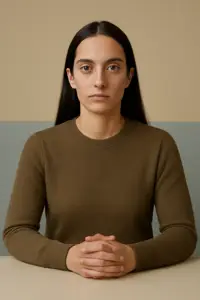
Space and depth: the composition is deep rather than flat. Foreground: the crossed hands and lower sleeves sit at the closest plane to the viewer, occupying the bottom center. Middle ground: the figure’s torso, shoulders and head form the central plane. Background: a broad, receding landscape of low ridges, bodies of water and hazy vegetation stretches back to a low horizon line roughly a little above the upper third of the frame. The background is rendered with decreased contrast and cooler tones, which helps push it back behind the figure. Nothing in the scene appears tightly crowded; the figure dominates the frame with generous space above her head and to either side before the background begins.

Composition and framing: the image is vertically oriented. Split left/right: the subject is nearly centered but slightly shifted toward the right half, so the left half contains more visible landscape behind the shoulder while the right half shows a slightly larger portion of the dark draped garment and the folding of fabric. Split top/bottom: the top third contains the head and the upper portion of hair and sky; the middle third holds the face, neck and upper torso; the bottom third contains the crossed hands and forearms. The horizontal horizon in the background sits low between the top and middle thirds but not at the very bottom—about one third down from the top—so the viewpoint reads as eye level with the seated figure. The viewpoint is close—neither extreme close-up nor wide—presenting a three-quarter portrait distance that shows head, shoulders and hands while maintaining detail in facial features.

Scale: the figure occupies most of the frame vertically and is scaled to dominate spatially; the head and torso are large relative to the overall image, while the background forms a comparatively small-scale landscape that appears distant. Relative proportions among the face, hands and torso are natural and realistic; the hands are proportionate to the arms and body, and the landscape elements are much smaller in perceived scale because of atmospheric recession.

Other visible details: the eyes look forward and are set horizontally across the central planes of the face; the mouth is small and closed with subtle curvature of the lips. The eyebrows are faint and not heavily defined. There is a narrow band or veil of darker material along the top of the head, following the hairline. The sleeves are gathered with soft horizontal folds around the wrists. The overall mood of the image is created by the contrast of warm foreground light and cool, misty background tones, and by the soft, blended handling of form throughout.

Picture 14

Round 14

What the describer wrote about picture 14. These words, and nothing else, painted picture 15.

A three-quarter length portrait of a seated woman fills the frame, her upper body and folded hands occupying the central and lower portions of the image. The first thing the eye is drawn to is her face and décolletage: a softly lit oval face set against darker hair and clothing, centered slightly above the vertical midline and slightly to the right of center. The face stands out because of its relative brightness and the smooth gradation of light across the skin, contrasted with the shadowed, muted tones of her clothing and the misty landscape behind her.

Subject and details: A single female figure is shown from about the waist up, turned slightly toward the viewer’s left but looking nearly forward. Her hair is dark brown, long, and parted down the middle, falling straight and smooth past her shoulders. Her forehead is broad and unobstructed. Eyebrows are very fine and light in tone, barely darker than the skin. Eyes are evenly spaced and set level on the face; they are medium-sized with a calm expression. The nose is straight and narrow. The mouth is small, with closed lips forming a subtle, neutral curve. The skin is warm and even in tone, rendered with soft shading; there are no visible blemishes or markings. Her neck and upper chest are visible; she wears a low, rounded neckline revealing the top of her chest and collarbones.

Clothing and hands: She wears a dark, loosely draped garment with layered, translucent-looking sleeves and a shawl or scarf-like wrap over one shoulder. The fabric appears soft and slightly glossy in places where the light grazes it. Her forearms rest on a horizontal surface at the bottom of the frame; her right hand rests over her left, fingers relaxed and gently curved. The hands are rendered with smooth, rounded contours and warm skin tones matching her face.

Background and setting: Behind the figure is a wide, muted landscape that recedes into the distance. The background consists of rolling, shadowed hills or rocky forms in the mid-ground and a hazy, atmospheric expanse beyond. Low, indistinct clusters of trees or vertical forms rise near the left and center of the horizon, their outlines softened by mist. A body of water or reflective surface is suggested by a horizontal, lighter band that cuts across the middle distance to the viewer’s right. The sky above the horizon is cool and slightly desaturated, becoming faintly lighter toward the top of the image.

Style: The image has the appearance of a realistic oil painting rather than a photograph or drawing. Brushwork is subtle and blended; edges are often soft and smoothed, with visible gradations of tone rather than sharp, sketchy lines. Details like skin transitions and the folds of fabric show meticulous blending typical of oil on a smooth surface. The rendering of the landscape is softer and more atmospheric than the modeling of the figure, with less-defined edges and a misty, sfumato effect.

Color and light: The overall palette is muted and warm-dark. Dominant colors are deep browns, warm golden-beige for skin, and cool grey-blues in the distant landscape and sky. The figure’s skin and the neck area provide the warmest, brightest tones, while her hair and clothing supply the deepest darks. Contrast is moderate: the face and hands are lit from a light source that seems to come from slightly left of the picture plane and above, creating soft highlights along the left side of the face and gentle shadowing on the right. The background is generally cooler and lower contrast, creating a separation between figure and landscape.

Lines and contours: Contours are predominantly smooth and rounded. The edge where the figure meets the background is softly defined rather than sharply outlined. Facial features are modeled with delicate, curved transitions rather than hard lines. Fabric folds are indicated with flowing, curved strokes and gentle tonal shifts. The horizon line sits low to mid-frame, subtly implied by the transition between land and sky.

Texture: Skin appears velvety and smooth; hair appears fine and softly glossy; the clothing shows a soft, slightly translucent textile texture with faint linear striations in sleeve folds. The landscape textures are matte and diffuse, with misty tree silhouettes and smoothed rock shapes.

Space and composition: The composition is centrally focused and symmetrical in weight though the figure turns slightly to her left. Foreground is occupied by the figure and the horizontal support under her hands. Middle ground contains low hills and possibly water; background recedes into hazy atmospheric space with distant ridgelines. Nothing else intrudes into the frame; the sides of the image crop the figure’s elbows and the extremities of the draped fabric. The viewpoint is at approximately eye level with the subject, at a moderate distance that shows torso and hands without compression or wide-angle distortion.

Balance and scale: The figure occupies roughly two thirds of the frame’s height and over half its width, dominating the composition. The background elements are smaller in scale and provide depth without competing for attention. Left and right halves are balanced by the central placement of the head and the near-symmetry of shoulders and hands, though a shawl across the right shoulder introduces a diagonal that slightly shifts visual weight to the right.

Overall, the image presents a softly lit, realistically rendered female portrait set against a muted, misty landscape, with smooth edges, warm skin tones contrasted with darker garments, and a calm, centrally focused composition.

Picture 15

Round 15

What the describer wrote about picture 15. These words, and nothing else, painted picture 16.

A single seated figure fills most of the vertical center of the frame; this figure is the dominant element and draws the eye first because of its central position, the contrast of its illuminated face and hands against darker clothing, and the relatively large scale compared with the background landscape. The figure is shown from about the chest up, facing forward with the torso rotated slightly to the viewer’s left. A smooth, oval face with a calm, neutral expression occupies the upper central area; the forehead and cheeks are softly lit, creating gentle highlights on the brow, nose bridge, and cheekbones. Dark, straight hair falls past the shoulders on both sides, framing the face and blending into the dark garment. The figure’s eyes are near the center horizontally and just above the midpoint vertically; they are softly defined and look slightly toward the viewer’s left. A small, closed mouth sits below the nose and is subtly shaded. The neck and throat are visible, connecting to rounded shoulders and a low, scooped neckline.

Both forearms and hands are visible in the lower central area of the image, crossed and resting on a horizontal ledge or surface that spans the lower frame; the hands are illuminated and show smooth skin tones with soft transitions between light and shadow. The left hand (viewer’s right) rests over the right hand, fingers relaxed; the fingertips are near the lower center. The clothing consists of a dark, draped outer garment covering most of the torso and arms, with visible folds and soft gradations of shadow; beneath that, the sleeves near the wrists are a warmer, golden-brown fabric with subtle horizontal texture and slightly brighter highlights, particularly around the lower forearms. The left and right edges of the garment are cut by the image borders but the overall shape suggests a loose, flowing robe.

Behind the figure is a broad, receding landscape that occupies the background plane and extends from left to right across the upper two-thirds of the image behind the head and shoulders. The landscape contains layered, low mountains or rocky hills that form a hazy silhouette across the middle distance. A winding water body or river snakes from the middle area into the distant right, creating a lighter, horizontal band that divides the landforms. The far background toward the horizon is softly blurred and misty, with atmospheric perspective producing paler, cooler tones and diminished detail. In the left background there are darker, shadowed rock masses closer to the midground; on the far right, rockier terrain and a lighter strip of land meet the horizon. The sky above the landscape is muted, a cool, desaturated tone with subtle gradations from slightly darker at the top to lighter near the horizon; there are no distinct clouds or sun visible.

Style appears photographic-realistic rendered in a traditional medium that resembles oil paint: brushwork is smooth and blended rather than sharply textured, with soft transitions and a varnished surface look. Edges around the face, hands, and folds are soft and carefully feathered; where detail is needed—fingernails, the eyelids, the rim of the neckline—edges are slightly crisper but still rounded rather than angular. The overall effect emphasizes fine blended modeling typical of oil technique rather than pencil line or watercolor wash; there are no visible paper grain or pencil strokes, and no high-contrast, saturated digital artifacts.

Color is predominantly muted and warm in the subject, cooler in the background landscape. The face and hands show warm, pale flesh tones with subtle pinkish undertones; the clothing is deep brown to almost black, providing strong value contrast with the skin. The sleeve fabric at the wrists is a warm yellow-gold, slightly brighter than the rest of the costume. Background colors include desaturated blues, greens, and grays; the distant hills are cool bluish-gray and recede visually. Light appears to come from the viewer’s left and slightly above the subject, creating gentle highlights on the left side of the face, the left cheek, and the left side of the hands, while the right side of the face and body falls into softer shadow. The overall palette is low in saturation, with a restrained number of hues and more emphasis on tonal variation.

Lines and contours are predominantly smooth and curved. Facial features are rendered with soft, flowing contours rather than hard, angular lines. The outline of the hair and shoulders are gently curved; folds in the clothing form rounded, undulating lines. There are no sharp geometric edges; the horizon and landscape silhouettes are irregular but softened by atmospheric haze.

Textures are implied rather than heavily detailed. Skin appears smooth and matte, resembling polished, finely blended paint. Hair has a soft sheen but is not shown as individual hairs; instead it reads as a smooth dark mass with slight tonal variation. The dark robe looks soft and velvety, with broad, soft folds and low specular highlights; the golden sleeves show a subtle ribbed texture suggested by gentle directional strokes and slightly brighter highlights that imply a woven fabric. The distant rocks and water are smoothed by haze and lack crisp texture, appearing more powdery and atmospheric.

Spatially, the image has clear depth: foreground is occupied by the hands and the ledge they rest on, the middle ground by the figure’s torso and head, and the background by the receding landscape and sky. The space feels open behind the subject because of the broad expanse of landscape and the sense of atmospheric recession; the figure blocks a central portion of that space but does not fully fill the horizontal frame. The edges of the image crop the shoulders and the sides of the garment, and the top of the head is near but not touching the upper edge.

Compositionally, the frame is vertically oriented and centered on the figure. If divided left and right, the figure’s face and torso occupy the vertical center with roughly symmetrical placement, while more landscape detail appears to the viewer’s left and right of the shoulder line—darker rock masses slightly more pronounced on the left side, and a lighter distant shoreline band more evident on the right. If divided top and bottom, the upper half contains the head and background horizon, the lower half contains the crossed hands and the garment; the brighter hands and face create two focal points connected by the torso. The horizon of the landscape sits below the centerline, roughly in the upper third to middle third of the frame, and the viewpoint is at roughly eye level with the seated figure, producing a frontal, intimate perspective.

In terms of scale, the human figure is large relative to the frame, occupying most of the vertical height and dominating the scene; the background landforms are small in comparison and recede into distance, providing scale cues that make the figure appear close to the viewer. The hands are proportionate to the head and torso and are large enough to be a secondary focus. No other objects or figures are present.

Picture 16

Round 16

What the describer wrote about picture 16. These words, and nothing else, painted picture 17.

A single seated female-presenting figure dominates the image, shown from about mid-torso up. The face is the focal point: centrally placed, roughly one-third down from the top of the frame, softly lit and detailed so the eyes, nose and mouth draw the eye first because of their brightness against darker hair and clothing. The figure’s long dark hair falls around the shoulders; the hairline is centered at the very top of the head. Both forearms rest on a ledge or armrest at the bottom of the frame and are crossed, with the left hand placed over the right. The hands are visible, softly modelled, fingers relaxed and overlapping at the center-bottom of the image.

Style and medium: The image reads as a realistic painted portrait rendered in oil-like medium. Brushwork is highly blended and smoothed, with minimal visible individual strokes; transitions between light and dark are gradual rather than hard-edged. Facial features and hands are rendered with careful modeling and soft gradations; small details such as the eyelashes and the edge of the eyelids are precise but not sharply etched.

Color: Overall palette is muted and warm-dominant with cool accents. Main colors are warm browns, ochres and beige on the skin and clothing, contrasted with cool, desaturated blue-greens and gray in the distant landscape. The figure’s skin tones are warm and slightly peachy, set against very dark brown to almost black hair and clothing. The background landscape contains layered cool gray-blue and green tones that recede in value, creating depth. The strongest contrast is between the illuminated face/neck and the deeper shadows of the hair and garments; secondary contrasts appear where the warm midground ridge and warmer earth tones meet the cool distant haze.

Light: Light appears to come from slightly left-of-center and somewhat above the subject, illuminating the left side of the face and casting gentle shadowing to the right side, under the chin, and along the neckline. The light is soft and diffused, producing gentle highlights on the forehead, bridge of the nose, left cheek, and the tops of the hands, with no hard or directional specular highlights.

Line and edges: Contours are predominantly soft and rounded. The jawline, cheeks and shoulders are delineated with smooth curved edges. Edges between subject and background are subtly blended, especially where hair meets the distant landscape, creating a smoky transition. Garment folds and the contour of the crossed arms show slightly crisper, but still rounded, lines. There are very few straight or angular lines; the composition relies on curved, flowing contours.

Texture: Skin reads smooth and matte, almost porcelain-like. Hair appears fine and slightly glossy but rendered with soft, diffused detail rather than individual hair strands. The clothing looks like layered, lightweight fabric—sheer or translucent in places—with soft, flowing folds and a slightly fibrous texture suggested by gentle linear shading. The background landscape appears atmospheric and misty, with textures of distant rock and water implied by muted tonal changes rather than fine detail.

Space and depth: The scene has pronounced depth. Foreground: the figure’s arms and the ledge occupy the closest plane, with crisp modeling. Middle ground: the torso and shoulders of the figure recede toward the waist. Background: a wide, hazy landscape stretches behind the figure, with undulating hills or rocky outcrops and a body of water or low-lying plain. The background elements progressively desaturate and soften, creating atmospheric perspective and a sense of distance. The horizon sits roughly at the upper third of the image, behind the figure’s shoulders, and several distant vertical forms (towers or thin rock formations) rise faintly from the haze in the upper-right quadrant.

Composition and balance: The composition is vertically oriented and tightly framed around the figure, which sits centered in the frame. Left and right halves mirror each other closely: the shoulders and hair extend to similar widths on each side, while small asymmetries exist in the turn of the head (slightly toward the viewer’s left) and the placement of the crossed hands (slightly right-of-center at the bottom). Top and bottom: the head occupies the upper third, the torso the middle third, and the crossed hands and ledge the lower third. The viewpoint is eye level with the subject’s face, with a moderate close-up distance that includes hands and some background landscape. The framing cuts off below the hands and above the crown of the head by a small margin, keeping the subject tightly composed.

Scale: The figure fills most of the frame; the head and torso dominate, occupying roughly two-thirds of the image area. Background elements are small in scale relative to the figure and appear far away; their reduced size and softer detail emphasize the figure’s prominence.

Small details: The subject wears a dark, layered garment with subtle, slightly lighter bands at the sleeves and a faint, almost transparent shawl draped over one shoulder. The eyes are almond-shaped and gaze slightly toward the viewer’s left; pupils and irises are clearly defined and lighter than the surrounding shadows. The mouth is small with a slight curvature and defined vermilion. The skin around the collarbone and neck shows soft tonal shifts indicating form. The overall surface finish of the image is smooth and polished, with low contrast edges and an even, warm glow concentrated on the figure’s face and hands.

Picture 17

Round 17

What the describer wrote about picture 17. These words, and nothing else, painted picture 18.

A single young adult female figure fills most of the frame, shown from about the chest upward and turned slightly toward her left so her torso is angled but her face looks almost straight at the viewer. The face and eyes are the first things the eye is drawn to because they sit near the vertical and horizontal center of the image, are smoothly lit, and present the highest contrast of soft highlights and gentle shadow. Her hair is dark, long, and parted in the middle, falling in straight, even masses over her shoulders. Her shoulders and upper chest are visible; her arms are crossed at the wrist in the lower center of the image with both hands resting on a low ledge or the frontmost plane.

Style and medium: the image looks like a realistic oil painting rather than a photograph or sketch. Surfaces, tones and transitions are rendered smoothly, with soft blending of pigments and indistinct brushstrokes; nothing appears highly stylized or abstracted. Details are idealized in finish and softly modeled rather than sharply delineated.

Color and lighting: the overall palette is muted and warm. Skin tones are warm beige and soft peach, subtly highlighted on the forehead, nose, cheeks and the tops of the hands. The clothing is in deep, muted brown and olive tones. The background contains cool, desaturated blues and gray-greens—faint lake or river tones and distant, misty landforms—so there is a warm/cool contrast between foreground (warm browns, ochres) and background (cool blues/greens). Overall brightness is moderate to low; the highest light falls on the sitter’s face and the backs of her hands, suggesting a single, soft light source from slightly above and in front of her, a little to the viewer’s right. Shadows are soft-edged and gradual rather than hard.

Line and edges: contours are primarily smooth and curved. The lines of the jaw, neckline and hair are soft and continuous. Facial features are defined by subtle tonal shifts rather than sharp outline—eyelids, lips and nostrils appear from gentle shadowing. The edges between the figure and the background are softly feathered, especially where the dark hair meets the dim landscape.

Texture: skin appears smooth and matte with a gently blended surface; there are no visible pores or roughness. Hair looks fine and sleek, with long unbroken tonal bands rather than individual strand detail. The clothing appears to be a soft, possibly woven fabric with faint linear texture on the sleeves—thin, closely spaced strokes suggest folds and the drape of material. The background landscape is atmospheric and misty, with a velvety texture and indistinct details.

Space and depth: the image has a clear foreground, middle ground and background. Foreground: the sitter’s crossed hands and forearms rest closest to the viewer at the bottom center of the frame. Middle ground: the torso and head of the figure occupy the central and upper center area. Background: a low, horizontal landscape with a body of water and rolling, tree-covered hills recedes into a soft, slightly hazy distance across the top third of the frame. The background is largely out of focus compared with the figure, creating depth; the horizon line sits roughly one-third of the way down from the top of the frame, behind the sitter’s shoulders. Nothing else crowds the space; the composition feels open around the head and shoulders because the background recedes and remains unobtrusive.

Composition and balance: the composition is highly centered and symmetrical. If the frame is divided left and right, the figure’s face sits almost on the central vertical axis, with hair and shoulders balancing similarly on both sides. Left and right halves are nearly mirror-balanced by the hair falling along each side and the similar shadow mass of clothing. Top and bottom balance is weighted downward by the darker mass of clothing and folded hands in the lower half, while the lighter face and the pale background occupy the upper half. The viewpoint is at approximately eye level with the sitter; the scene reads like a close mid-shot or bust portrait taken from a short distance.

Scale: the figure dominates the picture plane, occupying roughly two-thirds to three-quarters of the frame height. Hands and face are proportionate to one another and to the torso; the landscape in the background is small in scale relative to the figure and appears distant.

Smaller details: the sitter’s eyebrows are dark and softly arched; the eyes are almond-shaped with visible irises and small, dark pupils; the left eye (viewer’s right) catches a small highlight, as does the right, giving each a subtle gleam. The nose is straight with soft shadow along one side; lips are closed, softly contoured, and slightly fuller on the lower lip. Ears are mostly covered by hair. The garment’s neckline is a modest, rounded scoop, showing the upper chest and collarbone area. The hands in the foreground are rendered with care: fingers are slender, without jewelry, and the top hand rests across the other wrist with fingertips visible. The color of the hands matches the face in warmth and is similarly smooth and softly modeled. There are no visible background structures beyond low landscape forms and no other figures or objects in the frame. The overall atmosphere is calm and the rendering emphasizes soft transitions and balanced symmetry.

From round 18 on, the descriptions no longer mention the woman.

Picture 18

Round 18

What the describer wrote about picture 18. These words, and nothing else, painted picture 19.

A single human figure fills most of the vertical frame: a young person shown from about mid-torso upward, posed frontally and centered. The face is the visual focal point because it sits near the vertical and horizontal center, is lit evenly, and contrasts slightly against the paler sky behind it. The subject’s hair is long, straight, and dark brown or black, parted precisely down the middle and falling smoothly past the shoulders on both sides. The eyes are medium brown, open and forward-looking, set symmetrically beneath gently arched, dark eyebrows. The nose is straight and narrow; the mouth is closed with neutral, relaxed lips. The jawline is smooth and the skin tone is fair with subtle, even modeling—soft gradations of light and shadow define the cheeks, temples and neck without hard edges.

The person wears a simple, long-sleeved top in a muted brown or olive-brown tone with a shallow, round neckline. The sleeves reach the wrists. Both forearms rest on a flat surface at the bottom of the frame, with the right forearm crossed over the left and the right hand lying atop the left hand. The fingers are slender and relaxed; the fingernails are short and unadorned. The hands are fully visible and occupy the lower central area of the image, immediately below the torso. The shoulders are level and square to the picture plane.

The background is a shallow landscape rendered in soft, horizontal bands: a low, calm body of water closest to the figure, then distant low hills or ridges that recede into an even paler sky. The background colors are cool and muted—pale blue-gray for the sky, bluish-gray and desaturated blue-green for the hills, and a subdued grayish-blue for the water—creating a gentle tonal contrast with the warmer browns of the subject’s clothing and the warm, flesh tones of the face and hands. The horizon line sits roughly at the level of the subject’s shoulders or the base of the neck, so the distant landscape is immediately behind and around the head.

Overall style reads as realistic and carefully finished rather than photographic sharpness or loose sketching; the surface appears painted with exceptionally smooth, blended transitions rather than visible, painterly brushstrokes. Edges throughout are soft and refined—contours of the face, hair and clothing are clean but subtly feathered into the background. Light is soft, diffuse and frontal, illuminating the face and upper torso evenly and casting only faint, soft shadows under the chin, along the neck, and beneath the hands. There are no strong highlights or specular reflections; the skin and fabric look matte.

Lines are predominantly gentle and curved: the oval of the face, the rounded shoulders, the curved arrangement of the hands. Straight or angular lines are minimal; the hair creates near-vertical lines at the sides of the face, and the neckline forms a shallow curve. Textures are smooth and refined: the skin appears velvety, the hair sleek and even, and the fabric of the top looks soft and slightly felted or knit, without pronounced weave or pattern. The distant landscape is smoothly atmospheric, lacking detailed foliage or hard textural elements.

Spatially, the image feels shallow rather than deep: the subject occupies the foreground and middle ground simultaneously because the background is narrow and set close behind the figure. Foreground is the flat surface under the hands and the hands themselves; middle ground is the torso and head; background is the distant water and hills. The composition is tightly framed—no extra body parts or peripheral objects are visible; the edges of the image come close to the outer edges of the shoulders and the top of the head leaves a small margin to the top edge. The viewpoint is eye level and close, a near portrait distance that centers the face and hands.

If the frame is divided left and right, the subject is centered so both halves mirror one another in mass and detail, producing a symmetrical balance: hair, shoulders, and the eyes align on a central vertical axis. Top and bottom division places the head and upper chest in the upper half and the hands and table surface in the lower half. Scale is human and life-sized relative to the frame: the head occupies roughly the middle third of the vertical span, the shoulders and torso fill the central area, and the hands take the lower third. The overall color palette is limited and muted—primarily warm flesh tones and brown for the clothing contrasted with cool, desaturated blues and grays of the background—producing a restrained, even tonal harmony across the image.

From round 19 on, the descriptions no longer mention the landscape behind her.

Picture 19

Round 19

What the describer wrote about picture 19. These words, and nothing else, painted picture 20.

Subject list first, largest and most important things:
– A single young person, shown from about the mid-torso up, facing the viewer directly. The face is centered and occupies the upper-middle of the frame; the folded hands rest near the bottom center. The person’s straight, dark brown hair falls down past the shoulders and is parted exactly in the middle. The person wears a plain, long-sleeved, brownish-olive top. Behind the figure is a calm, minimal background with a horizontal band suggesting distant low hills or a shoreline near the mid-height of the image and a flat, pale sky above it.

What draws the eye first and why:
– The eye is drawn first to the centered face because it is the brightest and most detailed area, symmetrically placed, with soft but clear modeling of skin and facial features and direct frontal gaze. The contrast between the face’s pale skin tones and the darker hair and clothing also attracts attention.

Now a detailed description, saying where in the frame each thing is:

Style and medium:
– The image appears highly realistic and controlled, resembling a finely finished portrait done in a smooth, painterly medium such as oil paint or a high-detail digital rendering that intentionally emulates oil painting. Surface transitions are blended and even; there are no visible brushstrokes or photographic grain. Facial features and hands are rendered with precise, smooth shading; edges are softly graduated rather than hard photographic edges. The background is simplified and flattened, with minimal detail, while the figure is rendered with careful attention to soft modeling and proportion.

Color:
– The overall palette is muted and limited. Main colors are warm, pale skin tones for the face and hands, deep dark brown for the hair, and a medium brown-olive for the clothing. The background uses cool, desaturated blues and gray-greens: a pale bluish-gray sky in the top half and a slightly darker, desaturated blue-gray band near the middle that suggests distant land or water. The contrasts are subtle: the highest contrast is between the face (light) and the hair/clothing (dark). Lighting is even and frontal, coming from slightly above and in front of the subject; there are gentle highlights on the forehead, nose ridge, cheekbones, and the tops of the hands, with soft, short shadows under the chin and along the collar area.

Line and edges:
– Contours are smooth and softly defined. The edges of the face, hairline, and clothing are clean but not sharp; transitions are gently blended. Facial feature outlines—eyelids, lips, nostrils—are delineated with delicate, thin lines and subtle tonal shifts rather than thick outlines. The hair’s outline is a straight, unbroken curve along each side; interior strands are not individually drawn, giving the hair an even, sheet-like appearance.

Texture:
– Skin looks smooth, matte, and softly modeled with no visible pores or blemishes. The clothing appears like a fine knit or smooth fabric with very little surface texture, matte and uniform. The hair has a soft, silky appearance but is painted as a flat, even mass rather than showing individual strands or glossy highlights. The background is flat and softly gradated, with a powdery, calm texture.

Space and depth:
– The composition reads as shallow and restrained. Foreground: the folded hands rest on a flat surface that occupies the very bottom of the frame; these hands are close to the imaging plane and rendered with the same fine detail as the face. Middle ground: the torso and head of the figure sit squarely in the middle of the frame. Background: a simplified horizontal band suggesting distant land or water sits behind the shoulders, about one-third from the top, and above it is an even, pale sky that fills the upper third. The space feels open, with clear separation between figure and background and little clutter.

Composition and framing:
– The subject is centrally composed and symmetrical. If the frame is split left and right, the vertical centerline runs down the middle of the face and through the gap between the hands. Left and right halves mirror each other closely: hair falls equally on both sides, shoulders are level, and the hands are stacked symmetrically. Top and bottom: the top third contains the empty pale sky and hair crown; the middle third contains the face and shoulders; the bottom third contains the folded hands and the surface they rest on. The horizon-like band in the background sits near the horizontal centerline of the image, slightly below the eyes, producing a calm, balanced feel. The viewpoint is at eye level, set close enough for a near portrait that captures facial detail and hand placement but not more than the upper torso.

Scale:
– The person fills a large portion of the frame: the head occupies roughly the middle vertical third and about one quarter of the width; the shoulders extend almost to the frame edges horizontally but leave narrow margins. The hands are proportionate to the head and are large relative to the bottom area of the image because they are close to the foreground plane. Relative to the frame, the background elements are small and distant, reduced to a thin horizontal band and a flat sky.

Smaller details:
– The face is neutral in expression, with straight eyebrows, evenly spaced eyes, a straight nose, and closed lips. The eyes are centrally oriented and make direct contact with the viewer. The ears are visible and unobstructed. The hair is unadorned and tucked behind the ears so the jawline is visible. The neckline of the top is a simple rounded crew neck. The hands are gently folded, the right hand resting over the left wrist, fingers relaxed and slightly curved; the fingernails are short and natural, with no visible polish. The skin coloration is even with subtle warm blush on cheeks and a soft shadow beneath the chin. Lighting produces soft highlights along the central planes of the face and along the top surfaces of the hands, with minimal cast shadows.

Crop and what’s cut off:
– The image is cropped just below the elbows; lower arms and the rest of the body are not shown. The top of the head is fully within the frame. The sides of the image leave small margins of empty background beyond the shoulders. No extraneous objects or visual distractions appear in the scene.

Overall impression of elements purely as visible features:
– A centered, symmetrical, closely cropped bust portrait rendered in a smooth, realistic painterly manner, using a muted palette dominated by warm skin tones, dark brown hair, and brownish clothing, set against a calm, desaturated cool background with a low horizontal band indicating distant land or water.

Round 20: here the picture tipped. The words move furthest from the first description.

Picture 20

Round 20

What the describer wrote about picture 20. These words, and nothing else, painted picture 21.

A single seated figure fills the center of the frame and draws the eye first because of the figure’s large size, frontal placement, and the clear, evenly lit face. The person is shown from about mid-torso upward, directly facing the viewer. The head is centered both horizontally and vertically in the upper half of the image. The face is symmetrical in the frame, with a neutral, relaxed expression and eyes looking straight ahead. Long, straight dark brown hair falls evenly on both sides of the head to about shoulder level. The hair has a precise center part that emphasizes the symmetry.

The figure wears a plain, long-sleeved sweater in a muted olive-brown color. The sweater covers the shoulders and arms and ends at the wrists; the neckline is a simple round crew neck. Both forearms rest on a flat surface at the bottom of the frame; the hands are clasped one over the other with fingers interlaced and lie in the very foreground, centered. The fingertips and knuckles are visible and pale compared with the sweater; nails are short and unadorned.

The background is simple and horizontally layered. A soft light-gray plane fills most of the upper background, while lower behind the shoulders there is a low horizontal band of desaturated blue that suggests a change in plane or a distant paneled surface. The horizon between the gray and blue bands lies behind the shoulders and head, slightly below the eye line, and runs roughly straight across the image.

Style appears deliberately realistic and photographic in detail but with a slight painterly smoothness to surfaces; the overall rendering suggests a highly finished, realistic medium rather than a loose sketch. Edges are mostly soft and blended, especially in skin and background transitions; some contours are clearer and slightly sharper at the jawline, hairline, and the seam of the sweater neckline. Lines describing facial features — the brows, eyelids, nostrils, and lips — are fine and precise, not heavily stylized.

Color is muted and restrained. Skin tones are pale, warm-leaning beige with gentle gradations of pink around the cheeks and lips. Hair is a deep, cool brown. The sweater and the skin provide the main warm-cool contrast: the olive-brown garment is warmer and darker, while the background is cool and light. Overall the palette is low-contrast and soft; there are no bright or saturated hues. Light appears to be even and diffuse, coming from slightly in front of the subject, producing minimal shadows; subtle shading under the chin, on the neck, and along the sides of the nose gives form without dramatic contrast.

Surface texture details are subtle: skin appears smooth and softly matte, with delicate shifts in tone rather than visible pores or gloss. Hair has a fine, silky texture indicated by gentle, continuous strokes or tones without individual stray hairs. The sweater shows a soft, slightly napped knit texture, matte and even, with faint suggestions of fabric grain and a visible seam or ribbing at the neckline; the forearms and sleeves are uniformly textured, with only slight creasing where the elbows bend. The tabletop in the foreground is smooth with little visible grain, matching the subdued textures elsewhere.

Space feels shallow and calm rather than deep. Foreground is occupied by the hands and the table edge at the very bottom; middle ground is the torso and folded arms; background is the simple horizontally banded planes. The composition is tightly framed — the top of the head is close to the upper edge and the elbows are near the lower corners but not cut off; the sides of the frame include the outer tops of the shoulders and the lengths of the arms, leaving a small amount of negative space on either side.

In left-right balance the image is symmetrical: the figure’s midline aligns with the center of the frame; hair, shoulders, and hands are mirrored in placement, producing a centered, balanced composition. Top-bottom balance places the face and eyes in the upper-middle zone; the hands rest near the lower center, grounding the composition. The viewpoint is eye level and relatively close, comparable to a head-and-torso portrait taken from about an arm’s length away.

Scale: the figure occupies most of the frame, head and upper torso are the dominant elements; hands are smaller but prominent because they rest in the immediate foreground. No other objects, text, or accessories are present. There are no visible logos, jewelry, or patterns on clothing; color and form remain plain and uncluttered throughout.

Picture 21

Round 21

What the describer wrote about picture 21. These words, and nothing else, painted picture 22.

The largest, most immediate element is a single, centrally placed human figure shown from about mid-torso upward; this face and upper body draw the eye first because they are centered, occupy the majority of the frame, and are rendered with the greatest detail and contrast. The head is upright and square to the camera; long, straight, dark brown hair falls down behind the shoulders on both sides with a precise middle part. The face is evenly lit and expressionless, features arranged symmetrically within the frame; the eyes are level with the horizontal center and look straight ahead. The torso shows a plain, long-sleeved crew-neck sweater in an olive-brown color. In the lower third of the frame the subject’s forearms rest on a flat, light-colored surface and the hands are clasped together, fingers interlaced and visible from the knuckles to the tips, centered on the table.

Style: the image reads as a photographic, realistic portrait rather than painterly or highly stylized; surfaces and small details are rendered smoothly with subtle tonal gradations. Nothing is exaggerated; contours and proportions are natural and true to life. The rendering is clean and soft-focus, with crisp enough detail to show skin texture and fingernail edges without hard photographic grain.

Color: the palette is muted and predominantly warm-neutral. Background tones are light beige with a faint cool bluish horizontal band across the mid-background behind the shoulders. The subject’s sweater is a desaturated olive-brown, a warmer mid-tone that contrasts gently with the paler, cooler backdrop. Skin tones are warm and slightly rosy but subdued; hair is a deep brown. Overall the image favors low-contrast, mellow colors rather than bright or saturated hues. Lighting is soft and even, coming from in front of and slightly above the subject, producing gentle, short shadows under the chin and beneath the hands; there are no harsh highlights or deep shadows.

Line and edges: contours are smooth and softly defined rather than angular or hard. Facial features, hairlines and the sweater’s neckline are delineated with gentle, continuous lines; the edges between figure and background are clean but softened by the even lighting. The folds of the sweater and the fingers’ outlines are subtle, with rounded, organic shapes dominating.

Texture: skin appears smooth and matte, with a soft, even surface. Hair looks straight and fine with a soft sheen but without individual flyaway strands standing out. The sweater has a soft, fine-knit fabric texture suggested rather than heavily detailed—matte and uniform. The tabletop is a smooth, non-reflective surface. The background wall appears flat and slightly textured in a very subtle way, but is essentially smooth and plain.

Space and depth: the composition is compact and shallow in depth; the subject fills most of the frame so the scene feels close and intimate rather than expansive. Foreground: the tabletop and the subject’s hands; middle ground: the torso, sweater and arms; background: the flat wall with a faint horizontal color band that crosses behind the shoulders. Space is not crowded with objects; negative space around the head and shoulders is even and unobtrusive. The edges of the frame cut off the body at roughly mid-forearm and leave some space above the head; nothing is cropped at extreme angles.

Composition: the image is tightly symmetrical and balanced. Split vertically, left and right halves mirror one another in subject placement, hair, shoulders and arm positions; the clasped hands lie exactly on the vertical centerline. Split horizontally, the top half contains the head and empty wall above it, the middle contains the face and shoulders, and the lower contains the folded hands and tabletop. There is no visible horizon line; the viewpoint is at eye level with the subject, producing a straightforward, frontal perspective. The camera framing is a medium close-up.

Scale: the figure dominates the frame—head and torso occupy most of the available area—so the person appears life-size relative to the frame. Background elements are minimal and small by comparison, providing simple context without competing for attention.

Smaller details: the sweater’s neckline is a simple round crew cut with a slightly visible seam; ear lobes are visible and unadorned; fingernails are short and natural without polish; the lighting produces a very slight shadow band under the jaw and gentle modeling on the cheeks and nose. The overall effect is of a centered, evenly lit, plainly dressed subject set against a neutral, mostly uncluttered backdrop.

Picture 22

Round 22

What the describer wrote about picture 22. These words, and nothing else, painted picture 23.

The largest and most immediate element is a single person seated centrally, filling most of the frame from the upper chest to the top of the head; this subject draws the eye first because of frontal placement, symmetry, and the contrast between the face’s lighter skin tones and the muted background. The subject faces directly toward the camera with shoulders squared and hands clasped and resting on a flat surface at the bottom edge of the frame. Long, straight dark hair falls down behind the shoulders to just below the shoulders. The hair is parted neatly in the center, creating a vertical line that aligns with the center of the face.

Face and head occupy the upper-middle portion of the image. The face is shown full-on, centered horizontally and positioned slightly above the vertical midline. Eyes look directly toward the viewer; they are evenly spaced and set beneath softly arched eyebrows. The nose is centered and straight; the mouth is closed with neutral expression. Ears are visible at the sides of the head. The skin appears smooth and evenly lit, with subtle shading defining the contours of the cheeks, jawline, and neck. The neck and the top of the torso are visible, leading down to a round neckline of a sweater.

The subject wears a plain, long-sleeved sweater in an olive-brown color that covers the arms and torso visible in the frame. The sweater’s knit texture is fine and uniform, with a ribbed collar and ribbed cuffs noticeable at the wrists. The hands are in the lower center of the frame, fingers interlaced and resting on a light-colored tabletop that spans the width of the image’s bottom edge; the hands are shown palms together with fingertips and nails visible. The arms extend from the outer lower corners of the torso into the frame and are cropped where they meet the edges.

Background occupies the entire area behind the subject and is composed of two broad, flat color planes arranged horizontally: the upper background is a warm, pale beige and the lower background behind the shoulders is a muted, cool light blue-gray stripe about one quarter of the image’s height, creating a low horizontal band behind the subject’s upper chest and shoulders. The lighting is soft and diffuse, coming from in front and slightly above the subject, producing even illumination across the face and minimal shadows; small, soft shadows appear under the chin and slightly at the sides of the nose and beneath the hands on the tabletop.

Style is photographic and realistic, with high-resolution detail and natural textures; edges are generally soft where light gradation occurs (skin transitions) and sharper where material changes (edge of sweater against tabletop, hairline against background). Lines in the composition are predominantly vertical and horizontal: the central vertical line of the hair part and the face, the horizontal band of the background color, the horizontal tabletop edge. Contours of the face and hands are smooth and rounded rather than angular.

Textures visible include smooth, matte skin with subtle pore and tonal variation; fine, straight hair with a soft sheen; knitted fabric of the sweater showing small, regular stitches and slightly raised ribbing at collar and cuffs; a flat, matte tabletop surface that reflects little light. No reflective metals or glossy surfaces are present.

Space reads as shallow and contained: the subject occupies the middle ground, the tabletop forms the foreground plane at the bottom edge, and the flat background planes create little depth beyond the subject, resulting in a compact, uncluttered composition. The image is symmetric and balanced: the subject’s centered placement divides the frame evenly left and right; the band of different background color sits roughly behind the shoulders and helps anchor the subject in the composition. Top and bottom halves are balanced by the head and shoulders in the top half and the hands and tabletop in the bottom half.

No elements are cropped abruptly except the lower arms and the tabletop edges, which are cut by the frame. The viewpoint is eye level and relatively close, a mid-close portrait framing that shows the subject from about mid-chest upward. Scale is life-sized within the frame: the head, shoulders, and hands appear proportionate to one another and occupy the majority of the image area, leaving moderate margins of background on all sides.

Color palette is muted and limited: skin tones are warm and natural, the sweater is an olive-brown, the background upper plane is a warm pale beige, and the lower background stripe is a cool muted blue-gray. Contrast is low to moderate overall, with the strongest contrast between the subject’s dark hair and the lighter background, and between the lighter skin of the face and the darker sweater. Light is even, without dramatic highlights or deep shadows, producing soft tonal gradations across surfaces.

Overall composition emphasizes frontal symmetry, subdued colors, fine realistic detail, and simple, uncluttered spatial arrangement: a centered seated person with long dark hair, neutral expression, olive-brown sweater, clasped hands on a light tabletop, and a two-tone muted background with a horizontal band behind the shoulders.

Picture 23

Round 23

What the describer wrote about picture 23. These words, and nothing else, painted picture 24.

A single person occupies the center of the image, shown from just above the head down to the forearms and hands resting on a table. The subject’s face and upper torso immediately draw the eye because they are centered, take up the majority of the frame and are illuminated evenly compared with the neutral background. The person has long, straight dark hair parted down the middle and falling behind the shoulders. The face is forward-facing and symmetrical in the frame, with large, almond-shaped brown eyes looking straight ahead, straight dark eyebrows, a straight nose, closed lips with a neutral expression, and ears visible at the sides. The skin is smooth and evenly lit, with subtle, natural tonal variations but no prominent blemishes or facial hair.

Clothing is a plain, long-sleeved knit sweater in a muted olive-brown color. The crew neck sits at the base of the throat. The subject’s forearms rest on a flat surface near the bottom edge of the frame; both hands are placed together, fingers interlaced, knuckles relaxed and pointing toward the camera. Fingernails are short and natural. The table or surface under the hands is a pale beige that matches the subdued palette.

The background is divided horizontally into two broad bands: the upper two-thirds a warm beige and the lower third a desaturated blue-gray. The horizontal division runs behind the subject roughly at shoulder height. Lighting is soft and diffuse, coming from in front of the subject; there are gentle, short shadows under the chin and at the base of the neck and very slight modeling at the sides of the nose and under the lower lip. There are no strong highlights or specular reflections; the overall light is even and low-contrast.

Lines and edges are predominantly smooth and soft: the contour of the face and hair are clean and gently curved, the sweater’s neckline and shoulder seams are subtly defined, and the hands show soft rounded joints and fingernails. The background’s band creates a straight horizontal line that contrasts with the curved organic shapes of the head and shoulders. Textures are restrained and minimal: skin appears matte and smooth, hair looks sleek and straight with a soft sheen, the sweater shows a fine knitted texture but is visually flat, and the table and background appear matte and untextured.

Space is shallow and uncluttered: foreground is the tabletop and hands; middle ground is the subject’s torso and head; background is the flat, two-tone wall. The scene reads as mostly flat depth with the subject slightly separated from the background by subtle shadow. Nothing else occupies the frame; shoulders and outer arms are visible but the rest of the body and any surrounding environment are cut off by the image edges.

Composition is centered and symmetrical. If the frame is split left-right, the subject’s face and body sit on the vertical centerline, with similar negative space on both sides. Split top-bottom, the head occupies the top third, shoulders and chest the middle third, and the hands and tabletop the bottom third. The viewpoint is eye level and at a close-to-medium distance: head-and-shoulders portrait scale. Relative scale: the head is the dominant object, occupying roughly one quarter to one third of the frame height; hands are smaller elements near the bottom; the background bands are broad and occupy large areas but remain visually secondary due to muted color and lack of detail.

Picture 24

Round 24

What the describer wrote about picture 24. These words, and nothing else, painted picture 25.

A young adult figure centered in the frame fills most of the image. The person sits at a table facing the camera, shoulders squared and hands folded on the tabletop. The head and torso occupy the upper two-thirds of the frame; the hands rest near the bottom center. The face is front-facing, symmetrically placed on the vertical midline, with long straight dark hair falling behind the shoulders. The gaze is directed toward the viewer. The eyes are large and evenly spaced; the nose is straight and centered; the mouth is closed with relaxed lips. The person wears a plain, long-sleeved crewneck sweater of a medium brown tone. The hands, with fingers interlaced and resting palms-down, show short natural fingernails. A horizontal two-tone background fills the space behind the figure: the upper portion is a warm beige and the lower portion is a muted blue-gray, the dividing line running straight across roughly at the mid-chest level. The tabletop in the immediate foreground is a pale off-white or cream and occupies the bottom edge of the frame.

The element that draws the eye first is the face, due to its central placement, larger relative size within the frame, and contrast between the skin tone and the surrounding muted background and clothing. Secondary draws are the hands because they are in the foreground and lighter than the sweater, and the horizontal color block where the beige and blue-gray meet because it creates a clear visual divider behind the figure.

Style: The image appears photographic and highly realistic, with smooth gradations of tone and lifelike detail in skin, hair, and fabric. There is no visible brushwork or stylization; edges and transitions are rendered with photographic clarity. The composition is straightforward and neutral with minimal embellishment.

Color: The overall palette is muted and restrained, dominated by neutrals. Main colors are warm beige (background upper), muted blue-gray (background lower), medium brown (sweater), natural skin tones (warm light browns and pinks), dark brown to almost black (hair), and pale cream (tabletop). Lighting is soft and even, producing gentle highlights on the forehead, bridge of the nose, tops of the cheekbones, and the backs of the hands, with subtle shadows under the chin and around the eye sockets. Contrast between light and dark is moderate: there are visible but soft shadows rather than harsh chiaroscuro. The light source seems to come from slightly above and in front of the subject, centered, creating symmetrical, even illumination across the face and upper body.

Line: Contours and edges are smooth and clean. Facial features are defined by soft, natural lines rather than sharp angular strokes. The hair edge where it meets the background is a fine, mostly straight line with minimal stray strands. The seam of the sweater and the collar are delineated by subtle lines and seams that are thin and unobtrusive. The horizontal division of the background is a crisp straight line.

Texture: Skin appears smooth with fine matte texture and slight natural sheen on higher planes. Hair looks straight and fine with a soft, slightly glossy surface. The sweater appears knitted or woven, showing a soft, slightly fuzzy fabric texture with visible knit structure at close inspection, but overall matte. The tabletop surface is smooth and flat with a matte finish. The background is flat and even, appearing like painted or papered wall surfaces with no visible texture.

Space: The image is compact and uncluttered. Foreground: the tabletop and the hands resting upon it. Middle ground: the torso in the sweater and the folded arms. Background: the two-tone wall with its horizontal division. The space feels shallow and contained; there is little perceived depth beyond the immediate distance between the tabletop and the wall. Nothing else occupies the periphery; the portrait is tightly framed so that the figure is cropped at the elbows and the top of the head has a small margin of space to the upper edge. The sides of the frame cut close to the outer edges of the shoulders, leaving little lateral negative space.

Composition: Split visually, the left and right halves of the frame are balanced by the subject’s symmetrical placement on the center line. The top half contains the face and upper torso against the beige and blue-gray background; the lower half contains the folded hands and the tabletop. Horizontally, the background’s color division runs straight across near the horizontal center of the image, aligning with the subject’s chest area. The viewpoint is eye level and close, a medium close-up that includes head, shoulders, and hands. There is no visible horizon; the dividing line in the background acts as a horizontal anchor rather than a natural horizon.

Scale: The person is life-sized relative to the frame, occupying the majority of vertical space. The head and shoulders are proportionally larger than the hands in the frame due to perspective and cropping; the hands appear slightly smaller because they rest lower and are closer to the camera plane but still proportionate. No other objects provide a reference for absolute scale, but the table edge and hand size indicate the figure is adult-sized.

Picture 25

Round 25

What the describer wrote about picture 25. These words, and nothing else, painted picture 26.

A single seated figure fills the central vertical axis of the image, framed from just above the top of the head to the tabletop where both forearms and both hands rest. The eye is drawn first to the figure’s face because it is centered, occupies the upper-middle third of the frame, and is the highest-contrast area against the plain background. The face is oval, forward-facing, and evenly lit, with long straight dark hair falling behind the shoulders and out of sight near the lower edge of the head. The hair is parted in the middle and appears smooth and glossy. The figure’s expression is neutral; the mouth is closed; eyebrows are straight and dark; eyes look directly toward the camera. No accessories, jewelry, or visible tattoos appear.

The figure wears a plain, long-sleeved crewneck sweater in a warm medium brown. The sweater covers the torso and both arms to the wrists; ribbed detailing is visible at the collar and cuffs. Both forearms extend down to a light-colored tabletop at the bottom of the frame. Hands are centered on the tabletop, fingers interlaced with the right thumb resting over the left; fingernails are short and unadorned. Sleeves reach to the wrists without bunching. The posture shows the elbows slightly outward with forearms forming a soft horizontal line where they meet the table.

Background occupies the entire area behind the figure and is divided horizontally into two broad, flat color bands. The upper band is a muted warm beige, taking roughly the top two-thirds of the background; the lower band is a cool desaturated blue forming a horizontal stripe across the middle third of the frame behind the shoulders. The horizontal meeting point of these two colors sits approximately at shoulder height, creating a straight, crisp horizontal line behind the figure’s neck.

Lighting is soft and diffuse, coming from in front of the subject, slightly above eye level. Shadows are minimal and subtle: a soft shadow under the chin and faint shading along the sides of the nose and under the lower lip. There are no hard specular highlights. The overall tonal range is moderate—muted midtones dominate, with limited deep shadows and no extreme bright highlights.

Edges throughout the image are generally smooth and well-defined. Facial contours and hairlines are sharp enough to show individual planes of the face without high contrast. The sweater’s contours are soft at the edges where fabric meets skin and table. The tabletop edge is straight and horizontal, with a clean delineation against the sweater and hands.

Texture is visible and restrained: skin appears smooth and matte; hair looks sleek and fine; sweater fabric reads as soft, knitted material with fine, even texture and subtle surface nap; the tabletop surface is smooth and appears matte. The background color bands are flat and textureless.

Spatially, the composition is shallow and frontal. Foreground consists of the tabletop and the hands resting on it. The middle ground is the torso and the face; the background is the flat two-tone wall. There is little perceived depth beyond the figure and the wall because of even lighting and minimal atmospheric perspective. The image is cropped symmetrically, cutting off the figure just above the head and at the lower forearms, and slightly outside the shoulders so both arms are visible but the sides of the frame crop close to the outer sleeves.

Compositionally the image is tightly centered and balanced. If the frame is divided left and right, the figure’s vertical midline aligns with the center; symmetrical elements such as eyes, shoulders, and clasped hands sit on or near that midline. If divided top and bottom, the face occupies the top half’s central portion and the hands rest in the lower third. There is a clear horizontal dividing line in the background near the shoulder level. The viewpoint is at eye level with the subject. Scale is naturalistic: the figure appears life-sized within the frame, with the head and torso proportionate to the hands and table; no other objects provide alternative scale cues.

Overall the image reads as a straightforward, evenly lit, realistic photographic portrait of a single person seated at a table against a two-tone background, with emphasis on the centered face and the clasped hands.

Picture 26

Round 26

What the describer wrote about picture 26. These words, and nothing else, painted picture 27.

A single person sits centered and facing the camera, occupying the vertical middle of the frame. The face is the first thing the eye is drawn to because it is centrally placed, roughly at eye level, plainly lit, and contrasts with the flat background. The subject has a neutral, still expression, with straight dark brown to black hair parted precisely in the middle and falling down past the shoulders. The head and shoulders are visible; the torso and both forearms extend down to rest on a horizontal surface at the bottom of the frame. Both hands are placed together on the table in the lower central area, fingers lightly interlaced and relaxed, with short, natural nails and no visible jewelry.

Style and medium: the image appears photographic and realistic, with naturalistic detail rather than painterly brushwork or stylized exaggeration. Details such as pores, subtle skin shading, the knit of the sweater, and individual strands of hair are rendered cleanly. Edges are mostly smooth and well defined, with soft gradients where light falls across skin and fabric.

Color: the palette is muted and restrained. The background is divided horizontally into two broad bands: the upper two-thirds a warm, desaturated beige and the lower third a cool, muted slate-blue. The subject wears a medium brown sweater with a slightly warm tone that sits between the beige and blue in temperature. Skin tones are light and neutral-leaning, with subtle warm shading on cheeks and around the eyes. Hair is dark brown to black, providing the strongest value contrast in the image. Overall the colors are low-saturation and even; contrasts come more from value (light vs. dark) than from vivid hues. Lighting is soft and diffuse, coming from slightly in front of and above the subject, producing gentle, even illumination with faint, soft shadows under the chin and along the sides of the neck.

Lines and contours: facial and bodily outlines are smooth and rounded. The hair creates a straight, clean vertical line down the center due to the precise middle part; the jawline and shoulders present gentle curves. The neckline of the sweater is a rounded crew neck with a ribbed edge. The cuffs of the sleeves are ribbed and form subtle horizontal texture lines near the wrists. The transition between the two background colors forms a straight horizontal line behind the subject’s upper torso, roughly aligned with the lower part of the subject’s shoulders.

Texture: skin appears smooth and matte with fine natural detail. The sweater displays a fine-knit, soft fabric texture; ribbing at the collar and cuffs is visible and slightly raised. The background surfaces are flat and matte, with no visible material texture—smooth color fields. The tabletop in the immediate foreground is a pale, neutral surface with a matte finish and little visible grain.

Space and depth: the overall space is shallow and uncluttered. Foreground: the tabletop occupies the very bottom strip of the frame and supports the subject’s hands. Middle ground: the subject occupies the central band of the image from shoulders upward, with arms and hands extending into the immediate foreground area. Background: the two-tone flat backdrop, uninterrupted and evenly lit, sits behind the subject and gives little sense of depth beyond the subject’s figure. Nothing else occupies the frame; no props or additional people are visible. The edges of the image crop the subject at the mid-torso level; the top of the head is fully within the frame.

Composition and balance: the composition is strongly symmetrical and centered. If the frame is split into left and right halves, the subject’s vertical midline (marked by the precise hair part) aligns with the image center; facial features, shoulders and hands are balanced on both sides. Top vs bottom: the upper half of the frame contains the face and background beige band; the lower half contains the torso, the blue background band behind the chest, and the tabletop with hands. The horizontal division between background colors falls slightly above mid-height, roughly across the subject’s upper torso, creating a subtle banded backdrop that is visually aligned with the subject’s chest area. The viewpoint is eye-level and fairly close — a medium close-up that shows the head, shoulders and hands with little space around them.

Scale: the subject fills much of the frame vertically; the head and shoulders are large relative to the image, occupying roughly the upper two-thirds of the vertical dimension, while the hands and table take the lower third. Facial features are shown at a scale large enough to read small details (eyebrows, eyelashes, slight skin shading). The background bands are broad and uninterrupted, spanning the frame horizontally and providing a stable, large-scale contrast to the figure.

Additional visible details: eyebrows are dark and straightish, eyes are brown and evenly open looking straight ahead, eyelids and the area around the eyes show subtle natural creasing, the nose is centered and unobstructed, lips are closed and relaxed, ears are visible and unobstructed. The sweater’s sleeves reach the wrists and the fabric shows faint, natural creasing where the arms bend. No accessories, logos, text, or other objects appear anywhere in the frame. The overall impression is of a carefully composed, evenly lit portrait against a simple two-tone backdrop.

Picture 27

Round 27

What the describer wrote about picture 27. These words, and nothing else, painted picture 28.

A frontal photographic portrait of a single seated person, centered in the frame. The largest and most immediate element is the subject’s head and upper torso, filling the vertical middle of the image and drawing the eye first because of its central position and the contrast between the subject’s pale skin and dark hair. The face is viewed straight on, neutral in expression, eyes level with the camera, with a narrow vertical hair part at the top of the forehead. Long, straight, dark hair falls behind the shoulders and out of the frame sides. The subject wears a plain long-sleeved crewneck sweater in a warm medium brown; the sweater’s knit ribbing is visible at the neckline and cuffs. Both forearms rest on a pale flat tabletop at the bottom edge of the image; the hands are clasped lightly, fingers interlaced, centered on the table.

The background is a flat, two-tone wall bisected by a horizontal division roughly one third from the top: the upper portion is a muted beige, the lower portion a desaturated blue-gray. The horizontal line of the color change runs behind the subject at about shoulder height and is parallel to the top and bottom edges of the frame. Lighting is soft and even, with gentle, diffuse illumination from the front (slightly above eye level) that produces minimal shadows and even skin tones; highlights are subtle on the forehead, nose, and the flat plane of the tabletop. Contrast is low to moderate: the darkest areas are the hair and the shadow under the chin; the brightest areas are the tabletop and the lighter parts of the face.

The image style is photographic and realistic, with fine detail and smooth gradations of tone. Edges and contours are mostly soft to moderately sharp: facial features and the sweater’s ribbing are defined without hard, graphic lines. Textures are visible but subdued — skin appears smooth and matte, hair looks straight and slightly glossy, and the sweater reads as soft wool or knit with slight surface texture. The tabletop has a smooth, matte surface. There is minimal visual clutter; the composition is open and uncluttered, with ample negative space around the subject’s head and shoulders.
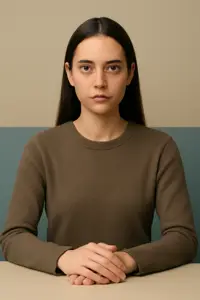
Spatially, the foreground is the tabletop and the subject’s hands; the middle ground is the torso, sweater, and face; the background is the flat, two-tone wall. The viewpoint is eye level and at a close to medium distance, showing the subject from just above the head to the hands on the table (roughly a three-quarter length vertically). The frame is vertically oriented and symmetrical: the subject is centered so left and right halves mirror each other in mass and placement, and the horizontal color division in the background provides a subtle counterbalance between top and bottom. Scale is human-sized relative to the frame: the head and torso occupy most of the vertical space, the hands anchor the lower center, and no other objects or people are visible.

Picture 28

Round 28

What the describer wrote about picture 28. These words, and nothing else, painted picture 29.

A single seated person fills most of the frame, centered vertically and horizontally. The first thing the eye is drawn to is the face, positioned in the upper middle of the image: it is viewed straight on, neutral in expression, with eyes looking toward the camera. Dark, straight hair falls down either side of the head and is parted precisely in the middle; the hair reaches below the shoulders and forms a dark vertical frame against the lighter background. The person wears a plain, long-sleeved, ribbed knit sweater in a warm medium brown; the sweater covers the torso and arms and ends at the wrists. Both hands are visible in the lower center of the frame, resting on a light-colored tabletop with fingers interlaced, palms down.

Style and medium: the image is photographic and realistic; fine detail in skin, hair, fabric and surface textures is visible. Nothing is exaggerated or stylized; edges and contours are clean and natural.

Color and light: the palette is muted and limited. The background is split horizontally into two flat bands: the upper band is a warm, pale beige and the lower band is a desaturated blue-gray. The sweater’s warm brown contrasts with the cooler blue-gray of the lower background and the pale beige above the head. Skin tones are natural, moderately warm and evenly lit. Lighting is soft and diffuse, coming from the front or slightly above the camera — there are no harsh shadows; contours are gently modeled with subtle shading around the nose, under the chin and at the eye sockets. The tabletop is a pale off-white or cream, slightly warmer than the upper background.

Line and edge quality: edges are mostly soft to medium-sharp. Facial features have smooth, softly graded contours; the hairline and the part in the hair create a sharper linear division down the center of the head. The fold lines of the sweater at the cuffs and the ribbing of the knit provide fine linear texture. The horizontal meeting line between the two background colors is a straight, sharp line running behind the subject at roughly chest height.

Texture: skin appears smooth and matte with fine detail visible; hair looks straight and fine with a slight natural sheen. The sweater’s fabric shows ribbed knit texture, visibly soft but structured. The background surfaces are flat and featureless, giving a matte, even look. The tabletop appears smooth and flat.

Space and depth: the composition is compact and frontal, with shallow depth — the person occupies the middle ground and foreground, and the flat background sits directly behind them with little visible spatial recession. Foreground: the tabletop and hands. Middle ground: torso, sweater, and head. Background: the two-tone flat wall that spans the entire width of the frame. Nothing else is visible beyond these elements. The sides of the frame cut off near the outer edges of the upper arms; the image includes the subject from roughly mid-upper torso upward.

Composition and balance: the subject is centrally composed and symmetrical. If the frame is split left/right, the left and right halves mirror each other closely: hair, shoulders, and the position of the hands create near-symmetry. Top/bottom split: the top portion contains the beige background and the head; the mid portion contains shoulders and upper torso against the horizontal color divide; the bottom portion contains the hands and tabletop. The horizontal color split in the background aligns approximately with the subject’s chest, providing a visual band across the middle of the frame. The viewpoint is eye level and close — a medium close-up that captures head, shoulders and hands.

Scale: the person is large relative to the frame, occupying the majority of the visual space; the head and upper torso are the dominant elements. There are no other objects, text, or accessories visible.

Picture 29

Round 29

What the describer wrote about picture 29. These words, and nothing else, painted picture 30.

A single, frontal human figure fills the center of the frame, shown from the top of the head to just below the folded hands resting on a tabletop. The eyes of the figure draw the eye first because they sit near the vertical and horizontal center of the image and are sharply focused against a softly lit face. The hairline and the high contrast between the dark hair and the lighter background also attract attention.

The subject faces the camera directly, shoulders squared and centered. Hair is straight, very dark brown to black, parted precisely down the middle and falling evenly on both sides to about the mid-torso. The forehead is visible; ears are partially covered by hair. Eyebrows are dark and follow a natural arch. Eyes are open and aimed straight forward; eyelids and the area under the eyes show subtle soft shadows. The nose runs from the forehead to the upper lip with soft, even highlights. Lips are closed and relaxed. The jawline and chin are smooth and softly rounded. The neck is visible and centered.

The figure wears a long-sleeved, ribbed knit sweater in a medium brown color. The sweater covers the shoulders and arms to the wrists and has a round neckline that sits close to the base of the neck. The ribbed texture of the fabric creates vertical lines across the torso and sleeves. Both forearms rest on a flat, light-colored tabletop; the hands are in the lower center of the frame, fingers interlaced with the right hand over the left, palms down. Fingernails are natural and short. The tabletop edge aligns horizontally near the lower edge of the frame.

Background is divided horizontally into two broad, flat color planes. The upper background behind the head and shoulders is a muted beige. A band of desaturated, muted blue-green runs behind the torso and across the mid-height of the frame, creating a straight horizontal division about one third from the bottom. No objects or patterns appear in the background; surfaces are smooth and matte.

The overall image is photographic and realistic in appearance, with natural proportions and fine detail. Lighting is soft and even, with no harsh highlights or deep shadows; the light source appears diffuse and frontal, producing gentle modeling on the face and hands. Highlights are subtle on the forehead, nose, and the top planes of the hands; shadows under the chin and beneath the hands are light and soft-edged.

Edges throughout the image are mostly soft to moderately sharp: facial features and the outline of the hair are rendered with clear, smooth contours; transitions between light and shadow are gradual. The ribbing on the sweater produces thin vertical linear texture. Skin texture is smooth and matte with faint visible pores and fine details, not glossy. Hair appears smooth and slightly reflective along the center part where a faint highlight runs. The tabletop surface is flat and appears smooth with a matte finish.

Space is shallow and focused on the figure; the composition is tight and uncluttered. Foreground consists of the tabletop and hands; middle ground is the torso, shoulders, and head of the figure; background is the two-tone flat wall. Nothing else intrudes into the frame; the sides crop just past the outer edges of the shoulders. The viewpoint is eye level and fairly close, producing a medium close-up framing that emphasizes the head, upper torso, and hands.

Compositional balance is symmetrical: the figure is centered horizontally, the vertical center line runs down the middle of the hair part, nose, and hands. Left and right halves mirror each other in pose and negative space. Top and bottom balance: the head occupies the upper third of the frame, the torso the middle third, and the hands and table the lower third. There is no visible horizon line other than the horizontal color change in the background and the tabletop edge near the bottom.

Color palette is muted and limited: medium brown (sweater), very dark brown to black (hair), warm beige (upper background), muted blue-green (mid background), light neutral (tabletop), and natural skin tones that are slightly warm and even. Contrast is low to moderate; the highest contrast is between the dark hair and the beige background and between the sweater and the lighter tabletop. Overall appearance is calm and restrained, with textures and tones rendered in realistic detail and subdued saturation.

Picture 30

Round 30

What the describer wrote about picture 30. These words, and nothing else, painted picture 31.

A single person sits centered in the frame, occupying the majority of the image from the top of the head to the forearms and hands near the bottom edge. The face is the primary focal point: it is centered both horizontally and vertically and draws the eye first because of its relative size, symmetrical placement, and contrast against the plain background. The face is viewed straight-on, with a neutral expression and eyes looking toward the camera. A straight, narrow center hair part continues down into long, straight dark hair that falls evenly on both sides of the head to about chest level. The hair is smooth and untextured, with a slight sheen where light reflects from its surface.

The person wears a long-sleeved, close-fitting sweater made of a ribbed knit fabric. The sweater is a warm brown color and fills much of the middle ground, its vertical ribbing lines visible across the torso and sleeves. The neckline is a modest crew-neck, and the sleeves extend to the wrists. Both forearms rest on a flat horizontal surface, and the hands are clasped together with fingers interlaced and relaxed, positioned in the lower center of the frame and centered on that surface. The visible fingernails are short and natural.

Background and setting are minimal and divided horizontally: the upper half of the backdrop is a warm, neutral beige, while the lower half is a muted teal-green, the dividing line running roughly behind the person’s shoulders at mid-frame. The foreground consists only of the light-colored flat table surface that the hands rest on; this surface is matte and lightly warm in tone. No additional objects, patterns, or decorations are visible.

Style and medium read as photographic and realistic, with soft, even lighting that produces minimal shadows. Light appears to come from slightly in front of and above the subject, producing gentle, diffuse highlights on the forehead, bridge of the nose, and the top planes of the cheeks, and subtle, soft shadows beneath the chin and under the hands. Contrast is low to moderate overall: the darkest elements are the hair and the deep eyes, while the lightest are the table surface and the upper background. The color palette is muted and restrained, dominated by warm brown of the sweater, warm beige of the upper background, muted teal of the lower background, and natural skin tones.

Lines and edges are mostly soft and smooth. Facial contours and transitions between planes of the skin are gradual rather than sharply delineated. The hair edges where they meet the background are relatively crisp against the beige and teal but still retain a slightly soft boundary. The ribbed sweater creates regular vertical lines across the torso; the table edge is a straight horizontal line at the very bottom of the frame.

Textures are clearly distinguishable: skin appears smooth and matte, hair appears sleek and glossy in narrow highlights, and the sweater appears soft and tactile with visible knit ribbing. The tabletop looks flat and smooth.

Spatially, the composition is open and uncluttered, with ample negative space around the subject’s head and shoulders. Foreground: the table surface and hands. Middle ground: torso, sweater, and arms. Background: the two-tone flat wall. The image is framed tightly in a portrait orientation with the viewpoint at eye level and a moderate close-up distance that captures the head, shoulders, and hands without extreme tightness. The left and right halves of the frame are balanced by the subject’s symmetric placement; the top half contains mostly the face and hair against the beige background, while the bottom half contains the sweater, arms, and hands against the teal and table. The scale of the person relative to the frame is large — the head and upper body fill most of the image area — and nothing else in the scene provides a competing scale reference.

Picture 31

Round 31

What the describer wrote about picture 31. These words, and nothing else, painted picture 32.

A single person fills most of the image, shown from about the mid-torso upward, seated squarely in the center of the frame. The figure’s face is the primary focal point: it is directly forward-facing, centered both vertically and horizontally, with even lighting that produces soft, low-contrast shadows. The eyes draw the eye first because they sit near the vertical and horizontal center of the image and are framed by the symmetrical placement of straight, dark hair falling on either side of the face. The hair is long, black, parted precisely in the middle, and reaches a little past the shoulders, its edges forming two straight vertical lines against the background. The face has smooth skin, an oval outline, a straight nose, closed lips in a neutral expression, and well-defined but soft jawline and cheek contours. The eyebrows are dark and gently arched; the eyes are brown and evenly lit with visible irises and pupils. Ears are mostly covered by hair. No accessories, makeup accents, or facial markings are visible beyond the natural skin tones.

Below the face, the person wears a fitted, long-sleeved sweater made of a ribbed knit fabric. The sweater is a warm, medium brown and covers the shoulders, chest, and arms visible in the frame. The ribbing produces vertical textured lines that run continuously down the torso and sleeves. Both forearms rest on a flat tabletop at the bottom edge of the frame; the hands are clasped together with fingers interlaced and positioned in the lower center of the image, just above the table surface. The nails are short and natural. The table surface visible in the foreground is a pale beige color and provides a horizontal plane that occupies the very bottom strip of the frame.

The background is composed of two broad, flat color planes: the upper two-thirds is a muted warm beige, while a band of muted teal runs horizontally across the mid-to-lower background behind the subject’s shoulders. The color band aligns roughly with the subject’s upper torso, producing a simple geometric division behind the figure. There are no patterns, objects, or details in the background; it is uniformly smooth and untextured.

Style and medium appear photographic and highly realistic: fine skin detail, realistic shading, and natural fabric texture indicate a photograph rather than a painting or sketch. Nothing is exaggerated; shapes and proportions follow natural human anatomy. Edges and contours are generally soft but well defined: facial features and hairlines are crisp without hard, high-contrast outlines, while the transition of light across the face is gradual. Lines in the image are predominantly vertical and horizontal: the hair, torso, and ribbed sweater create vertical emphasis, the tabletop and the horizontal color band in the background create horizontal divisions. Curved lines appear in the roundness of the face, the curve of the shoulders, and the interlaced fingers.

Surface textures are distinct: the skin looks smooth and matte, the hair appears glossy and straight with a subtle sheen, and the sweater displays a tactile knitted rib texture with visible linear ridges. The tabletop and background look flat and non-reflective.

Spatially the composition is open and uncluttered. Foreground: the tabletop and the subject’s clasped hands. Middle ground: the torso, sweater, and arms. Background: the two-tone flat color field. The image has little perceived depth beyond the subject’s projection from the flat background; the subject occupies most of the picture plane. The top and sides of the frame cut close to the head and shoulders but do not crop the crown; the lower edge crops the forearms and leaves the hands fully visible.

Compositional balance is centered and symmetrical. If the frame is split vertically, nearly identical visual weight appears on both left and right sides: hair lengths, shoulders, and arm positions mirror each other. If split horizontally, the top half contains the head and upper background, the middle contains shoulders and torso aligned with the horizontal color band, and the bottom contains the hands and tabletop. The viewpoint is eye level and relatively close, producing an intimate, head-and-shoulders portrait scale. Relative sizes: the head occupies roughly one-quarter to one-third of the vertical frame; the torso and arms fill the remainder; background areas are broad but empty, emphasizing the figure’s scale against the simple field.

Picture 32

Round 32

What the describer wrote about picture 32. These words, and nothing else, painted picture 33.

Centered in the frame is a single human figure shown from about mid-chest upward, seated behind a flat surface. The face and upper torso occupy the largest visual area and draw the eye first because they are centrally placed, evenly lit, and framed symmetrically. The eyes, set near the vertical center and looking straight toward the viewer, pull attention next because they are the darkest small elements against otherwise muted tones.

The person has long, straight, dark hair that falls down past the shoulders and is parted precisely in the middle; hair edges are smooth and uninterrupted against the background. The face is directly front-facing, with evenly balanced features: rounded forehead, straight brows of medium thickness, almond-shaped eyes with visible irises and pupils, a straight nose, and closed lips forming a neutral line. The skin surface appears smooth and matte, with subtle, even shading that models the planes of the face without harsh shadows. Ears are visible at the sides of the head. No jewelry, patterns, or accessories are present on the head or neck.

The person wears a long-sleeved, ribbed knit sweater in a warm medium brown. The sweater’s ribbed vertical texture is visible across the chest, arms, and neckband. Sleeves extend to the wrists. Hands are placed in the foreground on the flat surface: both hands are clasped together with fingers interlaced and knuckles showing; fingernails are short and natural. The surface the hands rest on is a smooth, pale beige plane that occupies the immediate foreground and is horizontally aligned across the bottom of the frame.

Background behind the figure is divided horizontally into two broad, flat color bands. The upper two-thirds of the backdrop is a warm light beige; a muted cool green-blue band runs across the lower third, aligning roughly with the person’s mid-torso and providing a horizontal color break behind the arms. The transition between these two background colors is a straight horizontal edge.

Overall style reads as photographic and realistic: details such as skin tone gradations, knit fabric ribs, and hair strands are rendered with clarity and natural proportions. Lighting is soft and diffuse, coming from the front or slightly above, producing even illumination across the face and torso with minimal contrast and only gentle shadowing beneath the chin and along the inner arms. Edges and contours are mostly soft but defined where different planes meet (for example, the jawline against the neck, the sweater edge against the background); there are no hard specular highlights or glossy reflections.

Color palette is limited and muted: warm mid-browns of the sweater, warm beige of the background and tabletop, cool muted teal/green-blue in the lower background, and natural skin tones. Contrast is low to moderate—greatest between the dark hair and the light upper background, and between the brown sweater and the cooler lower background.

Lines in the image are predominantly straight or gently curved: the vertical ribs of the sweater create repeated straight vertical lines; the hair creates a smooth vertical frame on either side of the face; facial contours are soft curves. Texture contrasts include the fine ribbing of knit fabric, the smooth matte appearance of skin, and the flat, even painted-like background.

Space reads shallow and compact: foreground (hands and tabletop) occupies the bottom portion, middle ground is the torso and sweater, and the background is a flat color field behind the subject. Nothing else is visible in the environment; the edges of the frame cut off below the elbows and above the top of the head leaves only slight headroom. The viewpoint is eye level and relatively close, producing a portrait-scale framing that centers and balances the subject.

In a left/right division, the figure is precisely centered so left and right halves mirror one another with the hands near the vertical center line. In a top/bottom division, the head and upper chest occupy the top half while the hands and tabletop occupy the bottom half; the horizontal junction of background colors sits near the lower third of the frame. Relative scale: the head and shoulders fill roughly half the vertical frame, hands fill a small foreground strip, and the background dominates remaining space as flat color.

Picture 33

Round 33

What the describer wrote about picture 33. These words, and nothing else, painted picture 34.

Centered in the image is a single human figure shown from roughly the chest upward, occupying most of the vertical middle of the frame. The viewer’s eye is first drawn to the face because it is centrally placed, near the top half of the picture, and set against a uniformly pale background that creates clear tonal contrast with the dark, straight hair. The face is oriented directly toward the viewer, with a symmetrical, vertical centerline emphasized by a precise middle part in the hair.

Hair: long, straight, very dark (near black), parted exactly down the middle, falling evenly down both sides of the head and extending past the shoulders out of the frame. Hair edges are smooth and glossy with a crisp, clean part.

Face and head: the forehead is broad and smoothly illuminated; eyebrows are well defined, slightly darker than the surrounding skin, with a natural arch. Eyes are evenly spaced, neutral in expression, with eyelids visible but no heavy makeup. The nose is centered and straight. Lips are closed, relaxed, neither smiling nor frowning. Ears are visible, small to medium size, and sit close to the head. Skin tone is even and smooth, with soft, diffuse frontal lighting that produces minimal shadows; the light appears to come from slightly above and directly in front of the subject, creating gentle shading along the sides of the nose and under the chin but no harsh highlights or deep shadows.

Torso and clothing: the figure wears a long-sleeved, ribbed knit sweater in a warm medium brown. The sweater’s vertical ribbing texture is visible across the chest and sleeves, with clear, evenly spaced ribs. The sweater has a round neckline that sits close to the base of the neck.

Hands and foreground: in the lower center of the frame, both hands are placed on a flat horizontal surface and clasped together—fingers interlaced, knuckles uppermost. The hands are photographed in sharp focus; skin texture and fingernails are visible, and the wrists are covered partly by the sweater sleeves. The flat surface on which the hands rest is a pale, neutral color.

Background and color planes: the background is composed of two horizontal color bands. The upper two-thirds behind the head is a smooth, warm beige. A lower horizontal band behind the torso is a muted tealy blue-green. The seam between the two background colors runs roughly at chest level, slightly above the hands.

Style and medium: the image is photographic and highly realistic, with fine detail and soft, even focus across the face and hands. Edges are mostly smooth and well defined; contours around the hair and shoulders are crisp against the plain background. There is no visible grain or painterly brushwork.

Lighting and contrast: overall lighting is soft and even, warm in tone; contrasts are moderate rather than stark. The most prominent contrast is between the dark hair and the pale beige background, and between the warm brown sweater and the cooler teal band behind it.

Lines and texture: vertical lines dominate in the sweater’s ribbing and the hair’s fall; facial contours are composed of soft, curved lines. Textures include the fine, smooth texture of skin, the subtle sheen and straightness of hair, and the tactile, ribbed knit texture of the sweater. Surfaces are matte to softly satin; there is no visible gloss except a small natural sheen on hair.

Space and composition: the composition is tight and frontal, with little empty space around the figure’s head and shoulders but some negative space in the background above and to each side. Foreground contains the hands and table edge; middle ground is the torso; background is the two-toned wall. The image is balanced symmetrically along the vertical centerline. The viewpoint is at eye level and relatively close, a medium close-up framing that shows hands and upper torso while excluding lower body and most of the arms beyond the elbows. No other objects, text, or patterns appear in the frame.

Picture 34

Round 34

What the describer wrote about picture 34. These words, and nothing else, painted picture 35.

A single human figure fills the vertical center of the frame, seated and facing directly forward. The face and upper torso draw the eye first because they occupy the central and largest area of the image and are lit evenly, presenting clear features against a plain background. The head is centrally placed, hair falling straight and dark down both sides; the jawline, neck, shoulders and ribbed sweater occupy the middle of the picture; both forearms rest on a flat, light-colored surface at the bottom edge, with the hands clasped together and centered on the table.

Style and medium: the image reads as photographic and realistic with smooth, natural rendering of skin, fabric and hair. Nothing appears heavily stylized; proportions and textures are true to life. Areas of simplification occur in the uncluttered background and the evenly diffused lighting that minimizes deep shadows.

Color: the palette is warm and muted overall. Background above the shoulders is a soft beige; a narrow horizontal band of muted teal or greenish-blue sits behind the lower half of the torso at mid-height. The subject wears a medium-brown, ribbed knit sweater. Skin tones are warm and natural, slightly lighter than the sweater. Hair is a deep black with subtle highlights. The tabletop at the bottom is a very pale, neutral beige or off-white. Contrast is modest: the darkest elements are the hair and the ribbing shadows in the sweater; the lightest elements are the tabletop and the even illumination on the face. Light appears soft and frontal, producing gentle gradations rather than harsh highlights or deep shadows.

Line and edge quality: contours are smooth and clearly defined. Facial features—brows, eyes, nose, lips—have crisp yet soft edges, not harshly outlined. The hair edges along the sides of the face are smooth and continuous. The ribbed pattern of the sweater creates vertical linear texture across the torso. The folded fingers create small curved lines and soft separations. Overall lines are predominantly vertical and horizontal, with curved lines concentrated in the face, neck and hands.

Texture: surfaces are rendered with perceptible texture differences. The sweater shows a fine, regular ribbed knit texture, appearing soft and matte. The skin appears smooth with a subtle matte sheen, minimal pore detail visible at this scale. Hair looks straight, glossy and smooth, with slight reflective highlights. The tabletop and background are flat and featureless, appearing smooth and untextured.

Space and depth: the scene is uncluttered and shallow. Foreground: the tabletop edge at the bottom and the clasped hands rest on it; the hands and lower arms are the closest visible elements. Middle ground: chest, shoulders and torso in the sweater. Background: the upper background plane is a flat beige field interrupted by the horizontal teal band at mid-height. Depth cues are minimal; the figure is clearly separated from the background but overall the space feels compressed and intimate rather than deep. The left and right edges of the frame crop close to the outer edges of the shoulders and upper arms; the top of the head is within the frame; no elements are cut awkwardly except the table’s lower edge which runs across the bottom border.

Composition: the subject is centered symmetrically on the vertical axis. If the frame is split left and right, both halves mirror each other closely: one shoulder on each side, hair falling evenly, eyes aligned on a horizontal axis. Top and bottom division: the top half contains the head against the beige background; the midline contains the shoulders and upper torso with the teal horizontal band behind; the bottom half contains the forearms and clasped hands on the light tabletop. There is a strong vertical emphasis from the ribbing of the sweater and the straight hair. The viewpoint is eye level and relatively close, capturing the head and torso with some negative space above the shoulders; the horizon or implied eye line sits near the center of the frame at the level of the subject’s eyes.

Scale: the human figure occupies most of the frame vertically and horizontally; head and shoulders are dominant while hands are smaller but clearly visible in the lower center. Background elements occupy relatively little area and serve as simple planes behind the figure.

Additional small details: the sweater has a crew neckline that sits close to the base of the neck. The hands are interlaced with fingers resting gently together; nails are short and natural. Ears are visible at the sides of the head. Eyebrows are natural and follow the eye shape. The overall mood from the visual data is composed and neutral, created by the centered framing, muted warm palette and even frontal lighting.

Picture 35

Round 35

What the describer wrote about picture 35. These words, and nothing else, painted picture 36.

The main subject is a single seated person shown from about the waist up, centered in the frame. The person's face and upper torso dominate the image; the face is the primary attention point because it is placed at the vertical and horizontal center, is the brightest area against a muted background, and occupies a large portion of the upper half of the frame. Secondary elements are the person's long, straight dark hair that falls down behind the shoulders, the ribbed knit sweater in a warm brown tone that covers the torso and arms, and the hands resting on a flat table surface at the bottom center. The backdrop is a two-tone wall, with a lighter beige upper section and a darker muted teal lower band that runs horizontally across the mid-background.

The image reads as a photographic, realistic depiction with smooth tonal transitions and naturalistic detail; it looks like a high-resolution photograph rather than a painting, drawing, or digital cartoon. There is no stylization such as exaggerated brushstrokes or linework; details such as skin pores, fine hair, and knit ribbing are rendered with photographic clarity. The only simplification is the minimal, almost studio-like setting with a plain two-color wall and no distracting objects.

Color is muted and warm overall. The dominant hues are warm beige and brown on the upper background and sweater, cool muted teal in the lower background band, and natural skin tones on the face and hands. The hair is a deep, near-black brown. The contrast is moderate: the face and sweater sit against the lighter beige above and darker teal below, creating a horizontal contrast line behind the shoulders. Lighting is soft and diffuse, coming from slightly above and in front of the subject; highlights and gentle shadows model the face and hands without sharp specular highlights. Shadows are subtle under the chin, in the eye sockets, and along the sides of the nose, indicating soft frontal lighting rather than hard directional light.

Lines and contours are smooth and rounded. Facial features are defined by soft edges rather than hard angular lines: the jawline and cheeks are curved, the hairline and shoulders form smooth descending arcs. The ribbing on the sweater creates numerous thin vertical lines that run from the shoulders down to the visible waist area, providing a regular repeating linear texture. The horizontal seam of the background where the beige meets teal is a straight, clean line cutting across the mid-frame.

Texture is apparent and realistic: the sweater shows fine ribbed knit texture that looks soft and slightly fuzzy; the skin of the face and hands appears matte and smooth with minimal sheen; the hair looks straight, fine, and glossy but not shiny; the tabletop is a flat, smooth surface with no visible grain. The background wall appears smooth and matte.

The spatial arrangement is open and uncluttered. Foreground: a flat tabletop edge occupies the very bottom of the frame, with both hands resting on it and extending slightly forward, bridging foreground into middle ground. Middle ground: the subject’s torso, sweater, and hands; the torso fills the central vertical band of the image. Background: the two-tone wall sits behind the subject, with the dividing line of color at roughly the mid-height of the image, intersecting near the subject’s chest and shoulders. Nothing else is visible behind or around the subject; the edges of the frame cut off the outer parts of the shoulders and the lower forearms. The composition feels shallow in depth — the subject sits close to the camera and the background plane is near behind them, giving a compressed, studio portrait depth rather than a deep landscape.

If the frame is mentally split into left and right halves, the subject is centered, so both halves mirror each other closely: left and right shoulders and arms are symmetrical in position and amount of visible space; the face is oriented squarely toward the camera with minimal tilt. Top and bottom divisions: the top half contains the head and muted beige background; the bottom half contains the torso, the teal lower background band, and the table with hands. The horizontal dividing line between beige and teal crosses roughly at the lower third but visually aligns near the chest area of the subject. There is no visible horizon; the viewpoint is eye level with the subject and slightly close, a mid-shot that frames the person from waist to just above the head.

Scale: the person is life-size relative to the frame, occupying most of the vertical dimension; the head occupies about one-quarter to one-third of the image height, the torso another large portion, and the hands and table occupy the lower strip. Relative to each other, the hands are proportionate to the head and torso; the ribbing on the sweater is fine-scale compared with the larger smooth areas of skin and background.

Additional small visible details: the person’s hair is parted in the middle and tucked behind the ears so both ears are partly visible; eyebrows are natural and follow the brow line; the eyes look straight toward the camera and are symmetrically placed; lips are closed in a neutral position; the sweater neckline is a crew neck that sits close to the base of the neck; the hands are clasped loosely with fingers interlaced, knuckles down, and fingernails short and unadorned. The lighting produces gentle shadows beneath the hands on the tabletop and beneath the chin, and the edges where the subject meets the background are clean, with a slight shadow contour around the shoulders. The overall mood of the visual information is calm and restrained due to the centered composition, neutral posture, and muted palette.

Picture 36

Round 36

What the describer wrote about picture 36. These words, and nothing else, painted picture 37.

A single person fills the central vertical axis of the image and draws the eye first because of their large, front-facing position, symmetrical placement, and the contrast between their skin and the neutral background. The person sits squarely facing the camera with shoulders level and head centered; their torso occupies the middle third of the frame, their folded hands rest on a flat tabletop in the bottom third, and their head and shoulders reach into the top third. Their hair is long, straight, dark brown to black, parted in the center and falling behind the shoulders. The face is neutral, looking straight ahead; eyes are level with the horizontal center of the image. Eyebrows are dark and gently arched. The nose is straight; the mouth is closed. Ears are visible at the sides of the head. The neck is visible between the jawline and the collar of the garment.

The person wears a long-sleeved, close-fitting, ribbed knit sweater in a medium brown color. The sweater’s ribbed vertical texture is visible across the chest, sleeves and cuffs; seams and a circular neckline are visible. Both forearms rest on the tabletop, with hands folded: right hand over left, fingertips and knuckles visible, fingernails short and unpolished. The tabletop is light wood or wood-toned and occupies the extreme bottom of the frame, forming a horizontal plane along the lower edge.

Background is minimal and two-toned: the upper portion behind the head and shoulders is a muted beige, the lower background behind the torso is a muted teal-green band that runs horizontally across the mid-lower background. The transition between beige and teal is a straight horizontal line behind the subject’s shoulders, roughly at chest height.

Style: photographic, realistic, high-resolution photo. Edges and contours are soft but well defined; there are no painterly brushstrokes or stylization. The image exaggerates neither features nor colors; details such as skin pores, fine hair strands and fabric ribs are visible.

Color: palette is muted and warm overall. Dominant colors are medium brown (sweater), warm beige (upper background), muted teal-green (lower background), and natural skin tones (warm, slightly cool shadows). Contrast is subtle: the sweater’s brown contrasts moderately with the teal band behind it and less with the beige above. The face contrasts against the beige background due to slightly darker hair framing and the uniform skin tone. Lighting is soft and even, producing gentle highlights on the forehead, bridge of the nose, cheeks and the tops of the hands; small, faint shadows appear under the chin, beneath the lower lip, and at the inner edges of the hands, indicating a diffuse frontal light source slightly above eye level.

Line: contours are smooth and rounded—curved lines define the jaw, shoulders and arms; the neckline and ribbed vertical lines of the sweater introduce straight, parallel vertical lines. Edges between the figure and background are clean but softened by subtle shadow, not hard or graphic. The horizontal line separating the two background colors is straight and crisply defined.

Texture: skin appears smooth and matte; fine skin texture is visible without sheen. Hair looks smooth and straight with a soft, slightly glossy finish. The sweater shows a tactile ribbed knit texture—parallel ridges and troughs visible across surfaces. The tabletop appears flat and smooth with a faint wood grain or even finish. The background surfaces look flat and uniform, with a matte, painted-wall quality.

Space: composition is uncluttered and open around the subject. Foreground: the tabletop and hands are in the immediate foreground. Middle ground: the person’s torso, arms and head occupy the middle ground. Background: the two-tone flat wall behind provides a shallow depth of field effect; there are no other objects behind the person. The image feels shallow rather than deep—background is close behind the subject and there is little visual recession.

Composition and framing: the subject is centered horizontally. If the frame is split into left and right halves, each side mirrors the other closely: hair falls evenly on both sides, shoulders are level, and hands are centered along the vertical axis. Split top and bottom: the top half contains the head and upper background (beige), the lower half contains torso, sweater and tabletop, with the teal band crossing the mid-lower area. There is balance due to symmetry. The viewpoint is at eye level and relatively close—head and upper torso are shown, making this a waist-to-top-of-head portrait. Nothing is tilted; the horizon implied by the tabletop and the horizontal band in the background is level.

Scale: the person dominates the frame, filling about two-thirds of the vertical space and nearly the full width of the central area; the hands and tabletop appear proportionate and occupy the lower portion of the frame. No additional objects compete for scale or attention.

Crop and edges: the top of the head is included with a small margin; elbows are near the lower side edges but not fully cropped out. The image is vertically oriented and tightly framed around the subject with little surrounding negative space beyond the flat background.

Picture 37

Round 37

What the describer wrote about picture 37. These words, and nothing else, painted picture 38.

A single seated figure dominates the image: a person shown from about the mid-abdomen upward, facing the camera directly. The head occupies the upper-central portion of the frame and draws the eye first because of its central position and the contrast between the subject’s skin tone and the plain background. The person has long, straight dark hair that falls down behind the shoulders and out of view at the lower edge of the head, a neutral facial expression with closed lips, and a symmetrical, forward-facing posture. The torso is clothed in a long-sleeved, close-fitting ribbed knit top with a crew neckline; the top is a medium brown color and extends to the wrists. Both forearms rest on a light-colored horizontal surface at the bottom of the frame, with the hands placed one on top of the other, fingers interlaced gently and centered on the table. The background is composed of two horizontal color fields: a wider upper field in a muted beige and a narrower lower field in a muted green that begins roughly behind the subject’s chest and extends to the edges of the image. The tabletop in the foreground is a pale wood tone.

The image appears photographic and realistic in style, with smooth gradations of tone and clear, naturalistic detail; nothing is visibly stylized or painterly. The lighting is soft and even, coming from a frontal direction slightly above eye level, producing gentle, diffused highlights on the forehead, nose, and the tops of the hands, and mild, unobtrusive shadows beneath the chin and around the collarbones. Overall color is warm and muted: the dominant colors are brown (the sweater), beige (the upper background), muted green (the lower background), and natural skin tones; contrasts are subtle, created more by value differences than by saturated hues. The face and hands are slightly lighter than the sweater and the green background, creating moderate contrast that emphasizes the central figure.

Edges and contours in the image are generally smooth and well-defined: facial features and the outline of the hair show precise, soft-edged transitions rather than harsh lines. The ribs of the knit top create thin, vertical linear textures across the torso and sleeves, producing repeated narrow lines. The hair edges are straight and continuous where they meet the background, and the jawline and shoulders form soft, rounded curves. The tabletop provides a straight, horizontal edge at the bottom of the frame.

Surface textures are visible and distinct: the sweater’s ribbed knit looks soft and slightly textured; the skin appears smooth with even tone and a matte quality; the hair looks straight and smooth with a slight sheen; the tabletop shows a smooth, matte wood grain or finish but without prominent wood patterning. The background fields are flat and uniformly colored, with no noticeable texture.
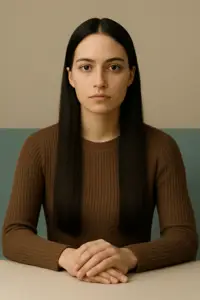
The spatial arrangement is simple and uncluttered. The foreground is the tabletop and the hands resting on it. The middle ground contains the person’s torso, shoulders, and arms. The upper middle ground contains the head and hair. The background is a continuous, two-tone flat plane behind the subject. The composition reads as shallow in depth: subject and table occupy most of the perceived depth, while the background appears flat and close behind the subject, creating little sense of deep recession.

If the frame is mentally split left and right, the figure is centered, occupying roughly the central third with near symmetry between left and right halves; the left and right sleeves and forearms extend toward the lower corners, balancing the image horizontally. Split top and bottom, the head and upper chest take the upper half and the hands and tabletop fill the lower half; the horizon or demarcation between the two background color fields sits behind the subject’s mid-chest, forming a horizontal band across the frame. The viewpoint is eye level and moderately close, producing a portrait-scale image that shows fine facial detail without being an extreme close-up. Scale is human-scale: the head and torso take up most of the vertical dimension of the frame, with the hands and a small section of the forearms visible, and the background fields occupying the remaining space. No additional objects, text, or visual distractions appear within the frame; edges of the image crop the lower arms just above the elbow and the top of the head has a small margin of space above it.

Picture 38

Round 38

What the describer wrote about picture 38. These words, and nothing else, painted picture 39.

A young person occupies the center of a vertical photographic frame, seated at a light-colored wooden table that fills the bottom strip of the image. The first thing the eye is drawn to is the subject’s face because it is centrally placed, well lit, and contrasts subtly against the two-toned background. The face is directly facing the camera with a neutral expression; it is evenly illuminated, with smooth, even skin tone and no strong shadows. Long straight dark hair falls behind the shoulders and down the back, forming a vertical mass that frames the head and extends toward the lower background.

The subject wears a fitted, long-sleeved, ribbed sweater in a medium brown hue. The sweater covers the torso and arms completely; the texture of the knit is visible as narrow vertical ribs across the garment. The hands are placed on the tabletop in front of the subject, with fingers interlaced or relaxed together; the forearms rest on the table so the elbows are out of frame. The table’s pale, warm wood grain is visible as a flat horizontal plane at the very bottom of the image and provides a horizontal base against which the subject’s hands and sleeves rest.

Background and framing: The background is divided roughly horizontally into two bands. The upper two-thirds of the background is a warm, light beige. Directly behind the subject’s torso and across the midline of the frame, a darker, muted olive-green band runs horizontally, creating a clear but soft color division. The boundary between the two background bands is straight and level, located slightly below the subject’s shoulders. The frame is vertically oriented; the subject is centered both left-to-right and top-to-bottom, so there is symmetrical space on either side of the head and shoulders.

Style and medium: The image is photographic and realistic in presentation. Surfaces and small details are rendered with fine clarity; edges are smooth and softly defined where skin meets hair, and sharper where the sweater meets the table edge. There is no visible brushwork or stylization. Proportions are natural, and small skin texture and fabric ribbing are clearly visible.

Color: The overall palette is warm and muted. Dominant colors are medium brown (sweater), warm beige (upper background), muted olive-green (mid-lower background band), and warm light wood (table). Skin tones are warm, slightly tan, and natural. Hair is a very dark brown or black. There is low color contrast overall; the strongest contrasts are between the dark hair and the lighter beige background above, and between the brown sweater and the olive-green background band. Lighting is soft and diffused, likely from a frontal source slightly above eye level, producing even illumination with minimal shadowing. The light highlights the forehead, bridge of the nose, cheeks, and the tops of the hands, and leaves only gentle, soft shadows under the chin and along the sides of the nose.

Line and edges: Contours are mostly smooth and gently curved. The outline of the head, shoulders and arms are continuous curved lines. The ribbed texture of the sweater introduces many thin vertical lines across the torso and sleeves. The horizontal edge of the table and the horizontal seam between the two background colors introduce straight, crisp horizontal lines that counterbalance the verticals of the body and hair. Facial features—eyebrows, eyelids, nose, lips—are defined by soft, precise lines rather than sharp graphic edges.

Texture: Skin appears smooth and matte with subtle natural texture. The hair looks straight and fine with a soft, uniform surface. The sweater has a tactile knit texture; the ribbing is visible and suggests a slightly raised, soft fabric. The tabletop surface appears smooth and slightly matte with visible pale wood grain. The background surfaces are flat and untextured, appearing as smooth painted or paper planes.
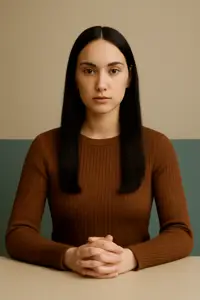
Space and depth: The space is shallow and compact. The subject fills most of the vertical middle of the frame, leaving narrow margins of background to the left, right, and above the head. There is a clear foreground (the tabletop and hands), a middle ground (the subject’s torso and face), and a background (the two horizontal color planes). Depth is subtle: the subject is clearly separated from the background by tonal contrast and slight shadowing around the shoulders, but there are no deep receding elements or distant planes. Nothing in the scene is crowded; the composition feels open and orderly with generous negative space around the subject’s head and shoulders.

Composition and balance: The composition is centered and symmetrical. If the frame is split vertically, the subject’s nose and the vertical centerline of the face align near the central axis; the shoulders and arms mirror each other left and right. Horizontally, the left and right halves contain similar amounts of background and sleeve, producing visual balance. If the frame is split horizontally, the top third is mostly the beige background above the head, the middle third contains the subject’s head and upper torso with the olive-green background band crossing behind, and the bottom third contains the lower torso, hands, and the tabletop. The subject’s eye level is roughly at the upper third line of the frame, and the viewpoint is straight-on at eye level, producing a frontal portrait perspective. The horizon line is not visible; the dividing line between background colors is the only strong horizontal reference and sits behind the middle of the torso.

Scale and proportion: The subject occupies the majority of the frame vertically, from near the top of the head to the table at the bottom. The head and shoulders are life-sized relative to the frame, and the hands on the table are slightly smaller in visual emphasis due to their placement and the lighter tone of the table. Objects beyond the subject are absent; nothing is cropped awkwardly except the forearms, which are truncated at the lower edge of the frame where they meet the tabletop, and the sides of the torso where the frame edges pass just beyond the elbows.

Other visible details: The subject’s eyebrows are straight and natural, the eyes are open and directed straight toward the camera, and the lips are closed with a neutral line. Ears are partially visible, peeking from behind the hair at the sides of the head. There are no visible accessories, jewelry, patterns, or logos on the clothing or tabletop. Lighting produces soft catchlights in the eyes—small, bright reflections that indicate a frontal light source. The overall atmosphere of the image is calm and uncluttered due to the minimal background and the centrally composed figure.

Picture 39

Round 39

What the describer wrote about picture 39. These words, and nothing else, painted picture 40.

A single seated figure fills the vertical center of the frame and draws the eye first because of her size and central placement: a young adult, shown from about the elbows upward, facing straight toward the viewer with a neutral, relaxed expression. Her head is upright and centrally aligned; her long, straight dark hair falls evenly on both sides, parted precisely down the middle and reaching past her shoulders. She wears a fitted, long-sleeved, ribbed-knit sweater in a warm, medium brown that covers her neck to a shallow crew collar; the vertical ribbing of the fabric is visible across the torso and sleeves. Both forearms rest on a pale, light-wood tabletop at the bottom edge of the frame, with her hands lightly folded—right hand over left—centered on the table. The skin tones are even and smooth; facial features face directly forward and the subject looks straight ahead. No jewelry, patterns, or other accessories appear.

The image is photographic and realistic in style, with natural proportions and photographic clarity rather than painterly or sketch-like marks. Lighting is soft and diffused, producing gentle, even illumination across the face and upper body with minimal shadowing; highlights are subtle, mainly on the forehead, the bridge of the nose and the tops of the hands, suggesting a frontal or slightly overhead light source. Color is dominated by muted, warm earth tones: the subject’s brown sweater and warm skin tones contrast against a two-toned, horizontally divided backdrop. The upper portion of the backdrop is a pale beige, roughly the top third of the frame, and the lower portion is a desaturated olive green, the horizontal division occurring behind the subject’s shoulders at approximately mid-height. The tabletop is a pale, natural wood color that is lighter than the sweater and backdrop, providing a low-contrast foreground plane.

Edges and contours in the image are smooth and softly defined rather than sharp or painterly; transitions between planes (face to hair, sweater to background) are clear but not harsh. Lines are predominantly straight and vertical—hair fall, the ribbing on the sweater, and the spine alignment—balanced by soft curved lines of the face, shoulders, and hands. Texture is visible and specific: skin appears matte and even, hair looks smooth and straight with a fine texture, the sweater shows tactile ribbed fabric with small, regular ridges, and the wooden tabletop shows a subtle grain and a smooth finished surface.

Spatially the scene is simple and uncluttered, with a shallow depth of field that keeps the entire subject and the immediate background in clear focus; there is no visible depth beyond the two-tone wall. The foreground is the tabletop occupying the bottom strip of the image; the middle ground is the subject’s torso, arms and hands; the background is the flat, horizontally divided wall behind her. The frame is tightly composed: the subject’s head is near the upper third of the image but with ample space above, shoulders nearly reach the left and right thirds so the composition reads as symmetrical and centered. If the frame is mentally split left/right, the figure is centered so both halves mirror each other; split top/bottom, the top third contains the subject’s head against the beige band, the middle third contains shoulders and upper torso against the olive band, and the bottom third contains forearms and tabletop. The viewpoint is eye level and close enough to show facial detail and fabric texture while keeping the overall figure contained within the frame; the image is cropped roughly at the elbows and at a small margin above the head. Relative scale: the person occupies the majority of the vertical frame and dominates the foreground-to-background relationship, while the simple background and table remain subordinate flat planes.

Picture 40

Round 40

What the describer wrote about picture 40. These words, and nothing else, painted picture 41.

Centered in the frame is a single upright figure shown from the mid-torso up, facing directly toward the viewer. The most eye-catching element is the face because it is centered, well lit, and occupies the upper-middle portion of the image; the even, frontal gaze and symmetrical placement draw attention first. The figure has long, straight dark hair parted precisely down the middle and hanging straight on both sides to just past the shoulders. The hair’s edges are smooth and create a dark vertical frame for the face.

The face sits near the vertical center of the image and is evenly lit from the front, producing soft, diffuse highlights on the forehead, nose, and cheeks and gentle, shallow shadows under the chin and around the sides of the neck. The skin appears smooth and evenly toned with subtle, warm undertones. The eyes are level with each other and positioned roughly at the horizontal midpoint of the face; they are open, almond-shaped, and framed by thin, well-defined eyebrows that follow a gently curved line. The nose is straight and centered; the mouth is closed with relaxed, neutral lips. The chin is rounded. Ears are partially visible at the sides of the head where the hair tapers away.

The figure wears a long-sleeved, ribbed-knit top in a medium brown color. The ribbing produces closely spaced vertical lines across the torso and sleeves, creating a textured pattern of shadow and highlight that follows the body’s contours. The neckline is a round crew neck that sits just below the base of the neck. The sleeves extend to the wrists; the fabric conforms fairly closely to the arms, showing subtle creasing and the natural folds where the elbows bend. The hands are placed in the lower center of the frame, resting on a flat, light wood surface. One hand lies over the other with fingers lightly interlaced; nails are short and natural. The wood tabletop shows straight, parallel grain lines and a pale, warm beige tone.

The background is divided into two broad horizontal bands that run uninterrupted across the width of the frame. The top band, occupying the upper third of the background, is a muted, light beige color. The lower band, occupying roughly the middle third behind the shoulders and upper torso, is an olive-green or muted sage tone. The horizontal division between the two colors is nearly straight and aligns behind the upper chest of the figure, creating a clear midpoint contrast behind the subject. There is no clutter, objects, or patterns in the background beyond these two flat color fields.

Lighting is soft and even, without harsh directional shadows; highlights are subdued and distributed symmetrically on the face and torso, suggesting diffuse frontal illumination. The overall color palette is warm and muted — brown of the shirt, beige upper background, and olive-green lower background — with moderate contrast between the darker hair and clothing and the lighter background band above the shoulders.

Lines in the image are predominantly smooth and vertical: the hair’s straight fall, the ribbed pattern of the sweater, and the vertical posture of the torso. Contours of the face, shoulders, and hands are softly defined with gentle curves rather than sharp angles. Edges between background color bands and the silhouette of the figure are crisp and clean, producing a clear separation between subject and background.

Textures shown include the soft, even texture of skin, the fine, linear ribbing of the knit fabric on the top, the sleek smoothness of the hair, and the hard, slightly grained surface of the wooden tabletop. None of these textures appear glossy; reflections are minimal and subdued.

Spatially the scene is shallow and compact. The foreground is occupied by the tabletop and the hands; the middle ground holds the torso and head of the figure; the background consists solely of the two flat color bands. There is little sense of deep spatial recession — the background is flat and closely related to the figure, producing an intimate, contained composition. The figure is fully contained within the frame from roughly the mid-chest upward; lower body and any surroundings beyond the tabletop are cropped out. The top of the head is close to but not touching the top edge of the image; shoulders and outer arms are visible nearly to the frame edges, leaving small margins.

Compositionally the image is symmetrical and centered. If the frame were split into left and right halves, the figure’s vertical centerline aligns with the image center. The left and right sides mirror each other in pose, hair position, and sleeve appearance, producing a balanced, formal arrangement. If split top and bottom, the top portion contains the upper background band and the top of the head, the middle band contains the face and shoulders against the darker background, and the bottom band contains the hands on the tabletop. The viewpoint is eye level and relatively close — a medium close-up — with the camera positioned straight on, neither above nor below the subject. Scale is such that the head and upper torso occupy the majority of the frame; the hands and tabletop provide a reference that anchors the lower third.

Overall color contrasts are modest: the darkest values are the hair and the deeper shadows in the ribbed sweater; the lightest values are the pale upper background and the highlights on the forehead and hands. The olive-green middle background band provides a mid-tone contrast behind the brown sweater, and the straight horizontal seam between the beige and green bands creates a visual line that intersects behind the subject’s chest. There are no additional objects, text, accessories, or visible markings in the scene; the presentation is minimal and restrained, focused solely on the single centered figure and the two-tone background.

Picture 41

Round 41

What the describer wrote about picture 41. These words, and nothing else, painted picture 42.

A single seated person occupies the center of the image, filling most of the vertical frame from just above the top of the head to the tabletop at the bottom. The figure draws the eye first because of precise centering, symmetrical pose, and the contrast between the smooth, light skin tone of the face and the muted background and clothing. The person faces the camera directly with a neutral expression, shoulders square to the viewer. Straight dark hair is parted precisely down the middle and falls behind the shoulders. The head is near the top third of the frame, the collarbone and shoulders occupy the middle third, and the folded hands rest on a pale wooden tabletop in the lower third.

Style: The image reads as photographic and realistic rather than painterly or heavily stylised; surfaces, skin, and fabric appear rendered with photographic clarity. No brushstrokes or sketch lines are visible; edges are clean and soft where required. The face and hands are depicted with natural proportions and fine detail. There is slight softening of shadows and highlights consistent with controlled studio lighting rather than natural, harsh sun.

Color: The palette is muted and warm overall. The background is divided horizontally into two flat color bands: the upper band is a very pale beige, the lower band a muted olive-gray-green; the division line runs roughly through the torso at shoulder height behind the subject. The subject wears a medium brown ribbed sweater that sits between the tones of the background, creating low-contrast harmony. The skin tones are light and warm, with subtle variations around the cheeks, lips, and eyelids. Hair is dark brown to nearly black. The tabletop in the foreground is a pale, light wood color, slightly warmer than the background beige. Lighting is even and diffuse, coming from in front of the subject and slightly above eye level; highlights appear along the forehead, bridge of the nose, and tops of the hands, while gentle shadows fall beneath the chin and between the fingers.

Line: Contours are smooth and gently rounded. Facial features are defined with soft but distinct edges: the eyebrows are fine, the eyelids and lashes are delineated without harsh lines. The jawline and neck form smooth, continuous curves. The ribbed knit of the sweater introduces many thin vertical lines across the torso and sleeves. The horizontal seam at the wrist and the tabletop edge provide straight linear elements that counterbalance the vertical ribbing. Overall, lines are predominantly soft and straight or gently curved rather than angular.

Texture: Skin looks smooth and matte with subtle pore and tone variation visible at close range. Hair appears glossy and straight with a fine, even texture. The sweater shows pronounced ribbed knit texture—repetitive raised ridges that create a tactile sense of soft, dense fabric. The tabletop shows a smooth wood grain that is barely visible, appearing polished and flat. The background surfaces are flat and matte with no visible texture.


Space: The composition is open and uncluttered. Foreground: the pale wooden tabletop occupies the bottom edge and supports the subject’s folded hands. Middle ground: the seated torso, arms, neck, and head are centered and occupy most of the frame; the folded hands sit slightly forward on the table, closer to the viewer. Background: the two-tone flat wall occupies the entire area behind the subject, divided horizontally about mid-height. The image reads relatively shallow in depth—subject separated from background by minimal shadow but no props or additional objects create deep recession.

Composition: The figure is symmetrically centered, creating visual balance between left and right halves. Left and right halves mirror each other closely: shoulders, arms, and the visible portions of the sweater are nearly identical on each side; hands are centered but slightly offset with one resting over the other. Top and bottom balance: the head and face are in the upper half while the hands and table anchor the lower half. The horizontal division in the background crosses near shoulder level, producing a subtle horizon-like line slightly above the subject’s torso. The viewpoint is eye level, straight-on, and at a moderate distance—close enough to capture facial detail and hands but far enough to include torso and background bands.

Scale: The subject is life-sized relative to the frame, occupying most of the image height. The hands appear proportionate to the head and torso. No other objects provide alternate scale cues beyond the tabletop and the wall bands, which emphasize human scale by alignment with the seated figure. The overall impression is of a tightly framed, centered portrait with controlled, neutral presentation of color, light, and texture.

Picture 42

Round 42

What the describer wrote about picture 42. These words, and nothing else, painted picture 43.

A single person sits centered in the frame, shown from about the waist up. The face is the primary focal point: it is centered both horizontally and vertically, evenly lit, and contrasts with the darker hair that frames it, which draws the eye first. The person has straight, dark brown to nearly black hair that is long, smooth, and parted precisely down the middle, falling behind the shoulders. The expression is neutral and the head is held upright, facing forward.

Clothing covers the torso: a long-sleeved, close-fitting sweater with vertical ribbing in a warm medium brown. The ribbed texture is regular and fine, visible across the chest, sleeves and shoulders. Both forearms rest on a flat, pale wood tabletop that occupies the bottom strip of the image; the hands are folded lightly one over the other, fingers relaxed and visible at the very front and center of the lower edge of the frame.

The background is minimal and composed of two horizontal bands. The upper roughly two-thirds of the background is a warm, light beige; a straight horizontal line across the middle of the frame separates it from the lower band, which is a cool, muted gray-green. This two-tone backdrop meets the subject at about shoulder height and runs uninterrupted to the left and right edges. There are no distracting objects in the background.

Lighting is soft and diffuse, appearing frontal and slightly above eye level: there are gentle, even highlights on the forehead, nose, and cheeks and subtle, soft shadows under the chin and at the neck. Contrast is low to moderate overall; the face has slightly brighter tonal values than the sweater and the lower background band, while the hair is the darkest element, forming a strong, smooth outline against the lighter upper background.

Edges and contours are generally smooth and clearly defined. Facial features—eyebrows, eyes, nose, mouth—have crisp, natural boundaries but no harsh lines; transitions between light and shadow on the skin are gradual. The hair edges are sleek and create a straight vertical contour down both sides of the head. The horizontal line of the background creates a sharp, straight edge that contrasts with the vertical lines of the sweater’s ribbing and the vertical fall of the hair.

Surface textures are distinct: the skin appears even and matte with a soft, fine quality; the sweater’s knit shows narrow, repeated ridges that suggest a slightly tactile, soft fabric; the tabletop looks smooth, matte-finished pale wood with a uniform grain that is not pronounced. The background appears flat and smooth, with no visible texture.

The space is uncluttered and shallowly layered: foreground is the tabletop and hands at the bottom edge, middle ground is the torso and hands, and the face occupies the central middle plane, while the background is a flat plane behind the subject. The scene reads as largely two-dimensional in depth because of the plain backdrop, but the subject projects subtly forward due to lighting and scale.

Composition is symmetrical and centered. If the frame is split left and right, the person’s face and body sit on the central axis with near-mirror balance; the two sleeves and both hands are symmetrically arranged around the center. If split top and bottom, the upper third contains the person’s head against the lighter upper background, the middle third contains shoulders and chest against the darker lower background band, and the bottom third contains the hands and tabletop. The horizon-like dividing line in the background sits roughly at the mid-shoulder level of the subject. The viewpoint is at eye level, with the camera aligned straight-on and at a short distance that yields a medium close-up framing.

Scale: the person dominates the frame, occupying most of the vertical and horizontal center; the head is proportionally large within the composition, and the tabletop and hands form a smaller horizontal element at the bottom. No other objects or people are visible; none of the subject’s limbs are cut off above the elbows, and the top of the head is fully within the frame. The overall impression is of a carefully centered, minimal, evenly lit portrait with muted, warm colors and clear, simple geometric divisions in the background.

Picture 43

Round 43

What the describer wrote about picture 43. These words, and nothing else, painted picture 44.

Subject, listed by size and prominence: a young adult human figure shown from the waist up, facing forward; a plain horizontal tabletop beneath their hands; two hands clasped lightly on the tabletop; long, straight dark hair falling down behind the shoulders; a ribbed, long-sleeved sweater; a two-tone flat background wall with a horizontal division; and the small visible portions of forearms and fingertips.

What draws the eye first is the face, centered in the frame and occupying the upper middle third, because of its size, frontal orientation, neutral expression and the contrast between the skin tones and the muted background. The second focal areas are the torso and hands: the vertical ribbing of the sweater and the crossing of the fingers produce fine linear detail and repetition that draws attention.

Overall image appearance and medium: photographic and realistically rendered, resembling a studio portrait photograph with high detail and smooth gradations. There is no painterly brushwork, sketch lines or visible grain; edges and surfaces are rendered with photographic clarity. Exaggeration or simplification is minimal; the image presents natural proportions and realistic surface detail without stylization.

Color: the palette is muted and warm. The sweater is a medium brown with warm reddish undertones. The skin is a light, neutral-beige tone with subtle warm shading. The background is divided horizontally: the upper portion is a pale beige, the lower portion is a muted gray-green. The tabletop is a light, slightly warm wood tone. Overall contrast is moderate — not high-key, with gentle transitions between light and shadow. Light appears soft and diffuse, coming from in front of and slightly above the subject, producing even illumination on the face and minimal cast shadows beneath the chin and hands.

Line and edges: contours are smooth and softly defined. The outline of the head and shoulders is rounded and continuous. Facial features — eyelids, nose bridge, lips — are delineated with soft, fine lines rather than stark, angular strokes. The ribbing on the sweater creates parallel vertical lines across the torso that are thin and regular. The horizontal seam of the background introduces a straight, clean, sharp line across the mid-height of the frame.

Texture: skin appears smooth and matte, with subtle pores and soft highlights on the forehead and cheeks. The sweater shows visible knit texture through evenly spaced vertical ribs, suggesting a fine, soft fabric. Hair looks straight, fine and glossy to a low sheen, with individual strands not isolated but forming smooth, continuous blocks of dark tone. The tabletop has a smooth, lightly grained wood texture. The background wall is flat and even, with no surface texture visible.

Space and depth: the composition is open and uncluttered; negative space surrounds the figure on both sides and above. The foreground is the tabletop and hands placed at the bottom edge of the frame. The middle ground is the torso and arms. The background is the two-tone wall, flat and close behind the subject, creating a shallow depth of field that keeps the entire figure in focus while minimizing perceived distance. Nothing else occupies the space; the left and right edges cut off portions of the upper arms and the tabletop, and the very top of the head is fully visible within the frame.

Composition and framing: the subject is centered horizontally and vertically positioned so the face occupies the upper third of the image. If the frame is split into left and right halves, the two halves mirror each other closely: the head sits on the central vertical axis, shoulders extend nearly equally to both sides, and hands rest symmetrically on the tabletop. Top and bottom halves: the top half contains the head and upper background, the bottom half contains the torso, hands and tabletop. There is a horizontal dividing line in the background slightly above the midpoint, creating a visual band across the center. The viewpoint is eye level, front-facing, with a medium close distance that includes the head, shoulders and upper torso.

Scale: the person appears life-size relative to the frame; the head is proportionally correct to the shoulders and hands. The hands are smaller features within the frame but occupy a clear foreground position at the bottom center. No other objects provide alternate scale cues; proportions are natural and human-scaled.

Picture 44

Round 44

What the describer wrote about picture 44. These words, and nothing else, painted picture 45.

A single person occupies the image, shown from about the mid-torso upward. The viewer’s eye is drawn first to the person’s face because it sits near the vertical and horizontal center of the frame, is well lit, and framed by long, dark hair that contrasts with the lighter background. The face is neutral in expression, looking straight toward the camera. Directly below the face, both hands rest on a flat tabletop with fingers interlaced; the hands form a secondary focal point because of their central placement and the visible texture of skin and nails.

The photograph is realistic and photographic in style. It presents even, soft lighting with gentle shadows beneath the chin and along the sides of the nose and hands, indicating light coming from in front of and slightly above the subject. There are no harsh highlights or dramatic contrasts; the overall illumination is diffuse.

Color is muted and warm. The dominant hues are a medium brown of the subject’s ribbed sweater, the warm beige of the upper background, and a desaturated olive-green horizontal band across the lower background. The tabletop is a pale, light wood tone. Skin tones are warm and slightly peach-tan. The hair is a deep brown, nearly black, which provides the strongest dark contrast against the pale background. Overall the palette is limited to a few warm, earthy colors with soft transitions and low saturation.

Lines and edges are mostly smooth and soft. Facial contours and the outline of the hair are defined but without hard, graphic edges; the ribbing in the sweater introduces a series of evenly spaced vertical lines across the torso. The table edge forms a crisp horizontal line at the bottom of the frame. The seam where the two background colors meet creates a precise horizontal band behind the subject, dividing the backdrop into two flat planes.

Texture is visible and varied: the sweater has a fine, regular ribbed knit texture that reads as soft fabric; the tabletop shows smooth, fine-grained wood; skin appears matte and smooth with subtle natural detail; hair looks straight and glossy but without strong specular shine; the background surfaces are flat and smooth, lacking texture.
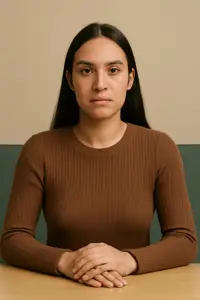
Space is shallow and uncluttered. Foreground: the tabletop surface along the bottom edge, and the hands resting on it. Middle ground: the subject’s torso, sweater, and face, occupying the central and largest portion of the frame. Background: a plain, two-tone wall divided horizontally roughly one third from the bottom. The image is tightly framed so that the subject nearly fills the vertical space; little empty space remains around the head and shoulders. The sides of the frame cut close to the subject’s upper arms; the top of the head has a small margin to the frame edge.
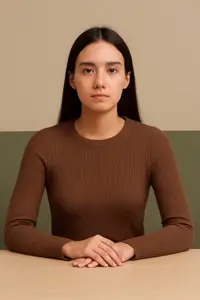
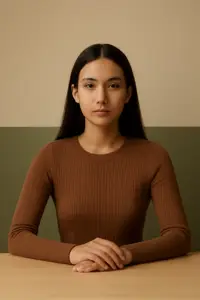
Composition is highly symmetrical and balanced. If the frame is split left and right, the person sits exactly centered, with shoulders and arms mirrored in placement and posture. If split top and bottom, the upper background occupies roughly the top half and the subject’s torso and the table occupy the lower half; the horizontal seam in the background lies slightly above the subject’s shoulders, creating a clear horizontal division. The viewpoint is eye level and relatively close, a medium close-up that shows face, shoulders, and hands without any forced perspective or foreshortening. There is no visible horizon line beyond the background seam.

Scale: the person is the dominant element and fills most of the frame vertically; the hands and tabletop appear proportionate to the head and torso, with the table occupying a narrow band at the very bottom. No other objects or people enter the scene; ears, jawline, collarbones, and the top of the sweater’s neckline are fully visible. The photograph frames the subject tightly, emphasizing facial features, hair, sweater texture, and the neatly folded hands.

Picture 45

Round 45

What the describer wrote about picture 45. These words, and nothing else, painted picture 46.

Primary subject: a single seated person occupying the central vertical axis of the image. The subject fills most of the frame from just above the top of the head to the lower forearms and hands resting on a flat surface. The face is centered and looks directly toward the viewer; the head is symmetrically placed. The upper torso and arms are visible; both hands are placed one over the other, fingers interlaced loosely, near the bottom center of the frame. Behind the subject is a flat, two-tone background with a horizontal division roughly at mid-height behind the shoulders.

What draws the eye first is the subject’s face: it is centrally positioned, evenly lit, and occupies a large portion of the upper-middle area of the frame, creating strong visual focus. The secondary focal elements are the hands in the foreground and the ribbed-texture sweater that covers the torso and arms.

Style and medium: photographic, realistic. The image looks like a high-resolution studio portrait photograph with naturalistic detail. There are no visible painterly marks or stylized distortions; edges and surfaces are rendered with photographic clarity. Proportions are realistic; nothing appears exaggerated.

Color: an overall muted, warm palette. The subject wears a medium brown, ribbed knit sweater that dominates the lower two-thirds of the frame. The background consists of two closely related neutral tones: a lighter beige in the upper half and a slightly darker, muted greenish-beige in the lower half, creating a subtle horizontal contrast behind the shoulders. Skin tones are warm and even, slightly paler than the sweater and background, with soft gradations. Hair is a deep, near-black brown. Lighting is soft and diffuse, coming from in front of and slightly above the subject, producing gentle, even highlights on the forehead, nose, and cheekbones and minimal harsh shadows.

Line: contours are smooth and softly defined. Facial features are delineated with gentle transitions rather than sharp outlines. The hair creates long, straight vertical lines down either side of the head. The ribbed texture of the sweater introduces repetitive vertical thin lines across the torso and sleeves. The horizontal division in the background provides a straight, crisp line that contrasts with the soft curves of the head and shoulders. Edges around the face and hands are slightly softened by the lighting and shallow depth of field.

Texture: skin appears smooth and matte. Hair looks straight, fine, and sleek with a low sheen. The sweater shows a visible knit texture — medium-thick ribs that create tactile visual rhythm; it looks soft and slightly dense. The tabletop in the foreground is smooth and flat with a matte surface. The background is visually flat and untextured.

Space and depth: the composition is compact and shallow in depth. Foreground: the smooth tabletop and the subject’s hands rest on it. Middle ground: the subject’s torso and face occupy the central area. Background: the flat two-tone wall sits behind, close enough to create a compressed perspective. The scene is not crowded; negative space surrounds the subject’s head and shoulders, especially above and to the sides, creating a calm, centered arrangement. The image is cropped just above the subject’s head and at the lower forearms, so elbows and lower body are out of frame.

Composition: symmetrical and balanced. Splitting the frame vertically places the face on the central axis; left and right halves mirror each other in posture and visual weight. Horizontally, the top half contains the head and neutral upper background, the middle contains shoulders and sweater, and the bottom contains hands and tabletop. The horizontal background division runs across the middle third of the frame, roughly aligned with the subject’s upper chest. The viewpoint is eye level and relatively close, producing a near-medium portrait crop. There is no visible horizon.

Scale: the subject is shown at a near life-size scale within the image; the head and torso occupy most of the frame. Hands appear proportionate to the head and torso. Background elements are minimal and small relative to the subject, emphasizing the person as the dominant element.

Picture 46

Round 46

What the describer wrote about picture 46. These words, and nothing else, painted picture 47.

A young adult figure occupies the center of the image and fills most of the vertical frame: a head and upper torso seen straight-on, with both hands visible in the lower center, folded together and resting on a flat surface. The face sits squarely in the middle and immediately draws the eye because it is centrally positioned, lit evenly, and framed by the dark, straight hair that creates a clear contrast with the pale, neutral background. The hair falls in two straight, dark panels down each side of the head, meeting at a neat center part directly above the forehead.

From the top of the frame downward: the background is a smooth, two-tone plane divided horizontally roughly at the level of the subject’s shoulders — the upper portion a warm, pale beige and the lower portion a muted, slightly cooler greenish-beige. The division between these two background colors is a straight horizontal line that runs behind the subject at shoulder height. The lighting is soft and diffuse, coming from the front so there are no harsh shadows; highlights are subtle and the overall illumination is even across face, hair and clothing.

The face is oval and symmetrical in its placement. Eyes are level with each other, looking straight ahead; they are medium-dark brown and are set at about the vertical midpoint of the head. Eyebrows are dark, narrow and smoothly curved. The nose is centered; the lips are closed and relaxed, neither smiling nor frowning. Skin appears smooth and evenly toned, with gentle transitions between planes of the face rather than stark contrasts. Ears are partially visible at the sides, aligned roughly with the eyes. The jawline and neck form smooth, soft contours.

The subject wears a long-sleeved, ribbed knit sweater in a warm medium brown. The sweater’s vertical ribbing texture is visible across the torso and sleeves, creating evenly spaced parallel lines that run from neckline to hem. The neckline is a simple round crew neck that sits just below the throat. Sleeves extend to the wrists; the forearms form the outer edges of the lower portion of the frame. The sweater’s color contrasts with the paler background but remains within a muted, warm palette.

Hands sit at the bottom center on a flat horizontal surface that matches the warm, muted tones of the scene. Fingers from both hands interlock lightly; fingernails are short and unadorned. The surface they rest on is matte and featureless, forming a horizontal band across the extreme lower edge of the frame. The hands create a small focal area of detail because they intersect the sweater’s sleeve cuffs and the table edge.

Edges throughout the image are soft but well defined: the contour between hair and background is clear due to color contrast, while facial features blend smoothly because of the gentle frontal light. Lines are predominantly vertical and horizontal — the hair’s fall, the sweater’s ribbing, the background division, and the table edge — producing a structured, orderly feel. Curved lines are present in facial contours, the round neckline, and the rounded shapes of the hands and fingers.

Textures are restrained and tactile: the sweater’s ribbed fabric reads as soft and slightly raised; the skin appears matte and smooth; the hair shows a silky, flat texture with minimal stray hairs. The background and table are smooth and untextured, reinforcing the material contrasts of clothing and skin.

Spatially the image is shallow and compact. Foreground: the tabletop and hands occupy the very front. Middle ground: the torso and folded arms sit just behind the hands. Background: the two-tone flat wall lies behind the shoulders and head. The viewpoint is eye level and at close range, a tight medium portrait framing that crops just below the elbows and just above the top of the head, leaving little empty space on either side. The composition is strongly centered and balanced left-to-right; the horizontal background split sits across the lower third of the upper half of the frame, and the subject’s eyes align near the vertical centerline, creating a symmetrical, front-facing arrangement. Relative scale: the head and shoulders dominate the frame, occupying roughly two-thirds of the image height, while the hands and tabletop occupy the remaining lower third. The overall color scheme is muted and warm, with a small range of neutral tones and gentle contrast between the brown sweater, dark hair, and pale background.

Picture 47

Round 47

What the describer wrote about picture 47. These words, and nothing else, painted picture 48.

A young person seated at a table fills the center of the frame. The face, neck and upper torso dominate the image and draw the eye first because they are centrally placed, occupy the largest area, and are set against a plain background that provides clear contrast. The person’s straight, dark hair falls evenly on both sides behind the shoulders. The hair is parted precisely down the middle at the top of the head. The person’s expression is neutral, with eyes looking forward, closed lips, and a relaxed jaw. Both hands rest on the tabletop in the lower center of the frame, fingers interlaced loosely with palms down. The shoulders are squared and the arms are visible down to the wrists. The subject wears a long-sleeved, ribbed knit sweater with a crew neckline.

Style and medium: The image is photographic and realistic in appearance, with fine detail in skin, hair and fabric. There is no painterly brushwork or drawn line; edges and surfaces are rendered with photographic clarity. No obvious exaggeration of features or stylization is present; proportions and textures appear natural and true to life.

Color: The overall palette is warm and muted. The sweater is a medium brown with subtle variations from the ribbed texture. The background is composed of two horizontally banded, desaturated beige tones: a lighter beige in the upper portion and a slightly darker, muted beige-green or gray-beige band across the middle. The table surface in the foreground is a pale, warm beige that contrasts slightly with the sweater. The subject’s skin tone is warm and even. Hair is dark, nearly black, creating the strongest dark value in the image. Lighting is soft and even, producing gentle, low-contrast shadows; highlights are subdued, especially on the face and fabric. The light appears to come from the front and slightly above, illuminating the face evenly and casting minimal shadow under the chin and hands.

Line and edges: Contours are smooth and softly defined. Facial features—eyebrows, eyelids, lips, nose—are delineated with subtle, soft edges rather than harsh lines. The vertical ribbing on the sweater introduces a series of fine, parallel lines across the torso. The hair outlines at the sides of the face are clean and straight, creating a crisp silhouette against the lighter background.

Texture: Skin appears smooth and matte with slight natural variation. The sweater’s knit texture is visibly ribbed and tactile, suggesting soft fabric. Hair looks smooth and straight with a slight sheen. The tabletop and background surfaces appear flat and uniformly painted, lacking visible grain or pattern.

Space and depth: The scene is shallow in depth; foreground, middle ground and background are closely spaced. Foreground: the tabletop occupies the bottom edge and supports the hands. Middle ground: the subject’s hands, torso and face occupy the central area. Background: the two-tone flat wall fills the rear of the frame with no additional objects. The space feels open and uncluttered; nothing else appears in the frame. The edges of the frame cut off the subject just below the hands at the bottom, and leave a small margin of space above the head at the top. The sides of the frame include the subject’s outer shoulders but do not show the full arms beyond the wrists.

Composition and balance: The composition is symmetrical and centered. If the frame is split vertically, the left and right halves mirror each other closely: hair, shoulders, and arms are similarly placed on each side. If split horizontally, the top third contains the upper background above the head, the middle third contains the face and shoulders, and the bottom third contains the hands and tabletop. The horizon is not visible; the viewpoint is at eye level with the subject. The camera is positioned straight-on and close enough to be a medium close-up, capturing head, neck and upper torso. Scale: the person occupies most of the frame vertically and horizontally; the head and torso are large relative to the frame, while the hands appear smaller but proportionate. No other objects provide reference for absolute size.

Picture 48

Round 48

What the describer wrote about picture 48. These words, and nothing else, painted picture 49.

A single human figure occupies the center of a vertically oriented photographic image. The subject is shown from about mid-torso upward, seated at a pale, flat surface that runs along the bottom edge of the frame. The viewer’s eye is drawn first to the subject’s face because it is centered, evenly lit, and occupies the upper-middle portion of the frame; the face’s symmetrical placement and the calm, forward gaze toward the camera make it the focal point. The subject’s hands are visible and folded together on the tabletop in the lower center, forming a secondary focal area because of their foreground position and the contrast between skin and the fabric sleeves.

Style: The image is photographic and realistic with smooth, finely detailed rendering. Edges are clean and soft where skin meets background; fine details such as individual hair strands, fabric ribbing, and subtle skin texture are visible. There is no painterly brushwork or stylized exaggeration; proportions and textures read as naturalistic.

Color: The palette is muted and dominated by warm, neutral tones. The subject wears a medium brown, ribbed knit sweater that fills much of the lower two-thirds of the visible body; the sweater’s brown is warm but subdued. The background consists of two horizontal bands of very pale, desaturated beige — a slightly darker beige band across the middle of the frame and a lighter beige above — creating a soft, low-contrast backdrop. The subject’s skin tones are warm and slightly yellow-beige; hair is a very dark brown, almost black. Lighting is soft and diffuse, producing gentle, even illumination across face and torso with minimal harsh shadows; highlights are subtle and there is no single strong specular source. Contrast between light and dark is low to moderate: the hair provides the darkest element against the pale background, while the face and sweater occupy midtones.

Line: Contours are generally smooth and rounded. The outline of the shoulders and neck are soft, with curved transitions. Facial features—eyebrows, eyelids, nose, lips—are defined by delicate, fine lines and softly modeled planes rather than sharp, angular strokes. The ribbed texture of the sweater introduces a series of thin vertical lines that run consistently across the torso and sleeves. The folded hands create interlocking curved lines from fingers and knuckles.

Texture: The image shows multiple textures. Skin appears matte and smooth with subtle pores and natural variation but no heavy sheen. Hair is straight, smooth, and dense, with a slight natural sheen that catches light along the central part. The sweater’s knit is visibly ribbed and soft; the ribs appear slightly raised and tactile. The tabletop is flat and smooth with a matte surface. The background is flat and even, with no visible texture.
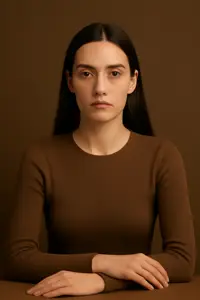
Space: The composition is uncluttered and open around the subject. Foreground: the tabletop and the subject’s folded hands rest nearest to the viewer. Middle ground: the subject’s torso, shoulders, and head occupy the central band of the image. Background: a plain, two-tone beige wall fills the space behind the subject, providing depth by tonal separation but remaining visually neutral. There is a shallow sense of depth: the subject clearly separates from the background because of tonal contrast and focus, but no deep environmental cues or distant elements are present. The image frames the subject tightly; parts of the forearms and the lower torso are cut off by the bottom edge, while the top of the head is completely within the frame but close to the upper edge.

Composition: The subject is centered horizontally. If the frame is split into left and right halves, the left and right sides mirror each other closely: shoulders and sleeves sit almost symmetrically, and the hair falls evenly on both sides. Vertically, the frame divides into top and bottom with the face occupying the top-middle region and the clasped hands in the bottom-middle, creating a balanced vertical stacking. The horizon line is not visible; no external reference for ground or horizon exists aside from the tabletop edge implied near the bottom. The viewpoint is eye level and frontal; the camera faces the subject head-on with a moderately close crop, producing a direct, face-on perspective.

Scale: The subject fills a substantial portion of the frame; head and shoulders are life-size relative to the frame, with the folded hands appearing proportionate in the foreground. The background bands are wide and occupy a large area but serve mainly as negative space. Relative scale between elements is natural and realistic: the hands are smaller than the torso, the head is proportionally sized above the neck and shoulders, and the sweater dominates the lower visual field.

Additional visible details: The subject’s hair is long, straight, and parted precisely down the center; it falls behind the shoulders and out of the frame close to the lower edges. Ears are partially visible and lie close to the head. Eyebrows are thin to medium in density; eyes are open and directed straight ahead. The nose is centered and proportionate; lips are closed and relaxed. There are faint natural shadows beneath the chin and along the sides of the nose caused by the soft, diffuse lighting. The knit sweater’s cuffs extend to the wrists, ending where the hands fold; the sleeves are neither loose nor tightly fitted, showing a comfortable, slim profile. The tabletop’s visible edge is flush with the bottom of the frame; no objects are present on the table aside from the subject’s hands. The background’s two horizontal tones meet in a straight, nearly horizontal line that crosses behind the subject’s shoulders at roughly mid-head height. Overall, the scene is composed of simple, neutral elements arranged symmetrically with soft, even lighting and precise, realistic detail.

Picture 49

Round 49

What the describer wrote about picture 49. These words, and nothing else, painted picture 50.

The image shows a single seated figure occupying the central vertical axis of the frame, immediately drawing the eye by size and position. The largest visible element is the figure’s upper body — head, shoulders, torso and clasped hands — which fill most of the frame from just above the top of the head to the table edge near the bottom. The face is centered and frontal, with the eyes roughly at the horizontal midpoint of the image. Long straight hair falls behind the shoulders on both sides. The figure wears a ribbed, long-sleeved sweater with a round neckline. The hands are clasped together and rest on a flat, pale surface at the bottom of the frame. Behind the figure is a plain wall divided horizontally by a subtle change in tone, forming two bands: a lighter band above and a slightly darker band below, which align roughly with the top of the shoulders. There are no other objects, patterns or text present.

The image reads as photographic and realistic; it appears to be a color photograph with smooth gradations of light rather than a painting or drawing. Colors are muted and warm overall: the sweater is a medium brown with visible vertical ribbing; skin tones are warm, neutral beige with gentle shading; hair is dark brown to black; the background bands are soft beige and light tan. The contrast is low to moderate, with the most contrast between the dark hair and the lighter background and between the mid-tone sweater and the pale table surface. Light appears soft and diffuse, coming broadly from the front and slightly above, creating gentle, even illumination on the face and minimal harsh shadows. Specular highlights are minimal; the photograph emphasizes even, matte surfaces.

Edges throughout are soft and smooth: facial contours and the boundary between hair and background are defined but not harsh, producing gentle transitions. The ribs of the sweater provide a set of thin, vertical linear details across the torso and sleeves. The outline of the hands and fingers shows subtle curves and small creases where fingers interlock. Lines of symmetry are strong: the central vertical axis through the face, nose and mouth aligns closely with the clasped hands. The neckline forms a soft curved line around the collarbone area.

Textures are varied but subdued: skin appears smooth and matte with slight visible pores and natural tonal shifts; hair looks smooth and straight with a faint sheen; the sweater has a tactile ribbed knit texture that reads as soft fabric; the table surface is smooth and flat, appearing slightly reflective only in the sense of uniform brightness. The background wall is smooth and untextured in appearance.

The composition is open rather than crowded, with the figure occupying the middle ground and foreground simultaneously; the table and hands are in the immediate foreground, the torso and head sit in the central plane, and the plain wall forms the background. The image is cropped so the shoulders and upper arms extend nearly to the left and right edges, while the lower arms are fully visible until the hands meet the table edge near the bottom. The top of the head is close to the upper edge but not cut off. No horizon line is visible; the viewpoint is at eye level and close-up, framed roughly from mid-chest to just above the head, producing an intimate, head-and-torso portrait scale. Left and right halves are visually balanced by near-perfect symmetry: the face, shoulders and hands sit centrally, while small asymmetries in hair and the slight tilt of the head provide minor variation.

Relative scale is straightforward: the human figure dominates the frame, with the background wall serving as negative space. The table edge provides a horizontal baseline near the bottom third of the frame. Overall, the photograph emphasizes the centered figure, muted warm tones, soft diffuse lighting, smooth contours and the vertical rhythm of the sweater’s ribbing.

Picture 50

Round 50

What the describer wrote about picture 50. These words, and nothing else, painted picture 51.

Centered in the image is a single human figure occupying most of the frame from just above the head to the forearms and hands on a table. The person faces the camera directly, shoulders squared, with a neutral, unsmiling expression. The eyes sit almost exactly on the vertical centerline of the picture and draw the eye first because they are centrally positioned, symmetrically framed by the face, and set in a relatively uniform, softly lit field of skin tone that creates gentle contrast. Long, straight dark hair falls behind the shoulders on both sides, forming a roughly triangular dark area that contrasts with the lighter background.

Clothing consists of a long-sleeved, fitted, ribbed sweater in a medium brown. The vertical ribbing of the garment creates a repeated linear texture across the torso and sleeves. The cuffs reach the wrists, and the lower arms rest on a flat, pale tabletop that crosses the image horizontally just below mid-height. Both hands are clasped together at the center bottom of the frame, fingers interlaced and positioned on the tabletop; the hands are in the foreground relative to the torso but do not obscure it.

The background is a smooth, even wall in muted beige tones with a subtle horizontal shift in shade roughly at the height of the subject’s shoulders, creating a faint two-band effect across the background but remaining very neutral and unobtrusive. Lighting is soft and diffuse, coming from the front and slightly above the subject; it produces even illumination across the face and upper body with minimal shadows, yielding gentle shading rather than strong highlights or deep dark areas.

Edges throughout are soft and smooth: the contours of the face, neck, and hair are clean and gently defined rather than sharply delineated. The sweater’s ribbing introduces fine, straight vertical lines against the otherwise soft curves of the body. Skin appears smooth and matte, without visible shine, while the sweater’s fabric appears textured and slightly coarse due to the ribbed knit. The tabletop surface looks flat and smooth, with a pale, desaturated tone that differentiates it from both the sweater and the background.

The spatial organization is shallow and uncluttered: foreground is the tabletop and clasped hands; middle ground is the torso and head of the figure; background is the even wall behind. Nothing else is visible; the frame is spare. The composition is symmetrical and balanced around the central vertical axis: the head is centered horizontally, shoulders occupy roughly the middle third of the frame, and the hands sit on the lower center. If the frame is divided top and bottom, the top half contains the upper head and background, while the lower half contains the torso, arms, and table. The viewpoint is at eye level and fairly close, giving a medium-close portrait scale in which the figure fills most of the frame without extreme cropping of the head but with the lower arms and most of the torso included. Contrast is low overall, using a limited, muted palette of warm browns, beige, and skin tones, with the greatest tonal contrast between the dark hair and the lighter wall behind it.

Picture 51

Round 51

What the describer wrote about picture 51. These words, and nothing else, painted picture 52.

A single person sits centered in the frame, occupying most of the vertical space from just above the top of the head to the flat surface at the bottom edge. The viewer’s eye is drawn first to the face because it is centrally placed, roughly at the upper third of the image, and because the face is evenly lit against a plain, slightly darker background. The face is oval with straight, dark hair parted precisely in the middle and falling down behind the shoulders. The expression is neutral; the mouth is closed and the eyelids are open, with the gaze directed straight toward the camera. Both shoulders and the upper torso are visible; the hands are clasped lightly and rest on a smooth tabletop at the bottom center of the frame.

The image is photographic and realistic in appearance, with soft, even lighting and fine detail in skin and fabric. There is no visible brushwork, line work, or artificial texture that would suggest painting or drawing. The image is not overtly stylized; proportions and tones appear natural and unexaggerated. Lighting is diffuse and appears to come from a frontal source slightly above eye level, producing soft, minimal shadows under the chin and beneath the hands, and creating even highlights on the forehead, nose bridge, and the rounded parts of the hands.

Color is muted and limited in range. The background is a monochrome beige or warm taupe that provides low contrast with the subject’s skin tone. The subject’s hair is dark, near black, creating the strongest tonal contrast in the image. The clothing is a warm, medium brown ribbed knit sweater that covers the arms and torso visible in the frame. Skin tones are light and warm, subtly different from the background. The overall palette is warm and subdued, composed mainly of beige, brown and dark neutral tones; contrasts are gentle rather than stark, with the darkest areas being the hair and the folds at the outer edges of the sweater sleeves.

Edges and contours are soft and clean. Facial features—eyebrows, eyes, nose, lips—are defined with smooth, gradual transitions rather than hard, graphic lines. The hair edge where it meets the background is distinct but not harsh. The ribbing of the sweater creates repeating vertical lines across the torso that are straight and regular. The fingers and knuckles show subtle creases and rounded contours; the tabletop edge is straight and horizontal.

Textures are clearly rendered. Skin appears smooth with subtle pores and fine shading, not glossy. Hair looks straight and fine, with a matte surface and little visible individual strand separation. The sweater shows a knitted, ribbed texture that suggests soft fabric with a slight stretch; the ribs cast very soft shadows that emphasize the three-dimensionality of the garment. The tabletop is smooth and matte, untextured in the visible area.

Space is compact and shallow. The background is a plain single-color plane with no visible depth cues, creating a relatively flat negative space behind the sitter. The foreground is the tabletop and the clasped hands; the middle ground is the torso and shoulders; the background is the uninterrupted wall or backdrop behind the head and hair. Nothing else occupies the space; the frame is uncluttered and composed tightly around the subject. The image crops the lower arms where they meet the bottom edge, and the sides cut close to the outer edges of the sleeves, so portions of the arms are truncated.

Composition is symmetrical and centered. Vertically, the subject divides the frame almost exactly down the middle, with the face aligned on the central axis. Left and right halves mirror each other in posture and clothing folds, producing a balanced appearance. Horizontally, the top half of the frame contains the head and upper shoulders; the lower half contains the torso and hands on the tabletop. There is no visible horizon line; the viewpoint is eye level and straight-on, creating a frontal portrait perspective.

Scale is human-scale and fills the frame: the head and shoulders occupy approximately the upper two-thirds of the composition, while the folded hands take up a small but prominent area at the bottom center. Relative sizes appear natural—hands are proportionate to the torso and head—and the negative space around the subject is narrow enough to keep attention on the centered figure.

In summary, the image presents a centered, frontal photographic portrait of a single person with dark, straight hair, neutral expression, warm muted colors (beige background, brown ribbed sweater, light warm skin tones), soft frontal lighting, smooth contours, clear fabric texture, a plain uncluttered background, and a symmetrical, eye-level composition with hands clasped on a tabletop in the foreground.

Picture 52

Round 52

What the describer wrote about picture 52. These words, and nothing else, painted picture 53.

A single person sits centered and facing the camera, occupying most of the frame from mid-torso upward. The face draws the eye first because it is centrally placed, well lit, and contrasts subtly with the neutral background: a symmetrical, oval face with straight, dark hair parted in the middle and falling behind the shoulders. The person’s expression is neutral; lips are closed and relaxed. The eyes look straight ahead; eyebrows are dark and gently arched. The nose is straight and centered on the face. Ears are visible at roughly the same horizontal level as the eyes. The neck is straight and visible down to the collarbone. Both forearms rest on a flat surface at the bottom of the frame, hands clasped together with fingers interlaced and knuckles lightly touching the table.

From top to bottom, the image shows a narrow vertical composition. The very top contains the upper portion of the background: a smooth, evenly lit, warm beige surface with no visible texture or pattern. The middle of the frame is dominated by the head and shoulders: hair is a uniform dark brown or near-black, straight and smooth, creating a vertical dark band against the lighter background. The face is illuminated evenly from the front, with soft, gradual transitions between highlights and shadows on the cheeks and forehead; there are no harsh shadows. The skin tone is a warm, light-to-medium hue with subtle, natural variation on the cheeks and around the eyes. Eyebrows and eyelashes are defined but not heavily contrasted. The eyes’ irises are mid-toned and sit within white sclera that are slightly shadowed at the lids.

The person wears a long-sleeved, ribbed knit sweater that is a warm medium brown. The sweater’s neckline is a simple crew neck sitting just below the base of the neck. The ribbed texture of the fabric runs vertically along the torso and sleeves, visible as fine, regular narrow lines that create gentle tonal shifts on the garment’s surface where the light grazes. The sleeves extend to the wrists and meet the hands at the lower edge of the frame. The hands are pale relative to the sweater and display natural skin details: visible knuckles, nail beds, and the soft folds where fingers bend. The table surface beneath the hands is smooth, flat, and slightly darker than the background but within the same warm beige-brown range, creating a subtle horizontal plane at the bottom edge.

Style: photographic, realistic, high-resolution portrait. The medium appears to be a photograph rather than a painting or digital illustration: fine skin detail, realistic rendering of hair strands, subtle fabric texture and natural light falloff indicate a photographic medium. Nothing is exaggerated; forms and proportions are natural and consistent with a frontal portrait. Simplification appears only in the background, which is an untextured, even field.

Color: the palette is warm and muted, dominated by beige, light brown, and deep brown. The background is a pale warm beige; the sweater is a medium warm brown; hair is a dark cool-to-warm brown; skin is a warm, light-to-medium tone. Contrasts are modest: the greatest contrast is between dark hair and the pale background and between the brown sweater and the skin tones. Overall brightness is moderate; no areas are blown out or extremely dark. The primary light source is frontal and slightly above eye level, producing even illumination across the face and a faint shadow under the chin and along the underside of the hands. Highlights are soft and diffuse.

Line: edges are mostly smooth and softly defined. The contour of the face and hair is clean and continuous; hair edges are slightly softer where they meet the background. Lines created by the ribbed sweater are thin and parallel, vertical across the torso and sleeves. Facial feature lines—around the eyes, nose, and mouth—are subtle and natural, not sharp. The line where the arms meet the table is a clean horizontal break.

Texture: skin appears smooth and matte with slight natural pores and fine detail near the eyes and mouth. Hair looks straight and glossy but without strong specular highlights, giving a soft sheen. The sweater’s ribbed knit texture is tactile and slightly coarse compared to the skin: regular, narrow ridges that create gentle shadows. The table and background are smooth and untextured.

Space: the composition feels open and uncluttered. Foreground is the hands and lower sleeves resting on the table at the bottom edge; middle ground is the torso and shoulders; background is an empty, flat wall that recedes little, keeping the subject visually close to the viewer. The space is shallow rather than deep; there is limited perceived depth beyond the subject. The subject fills most of the vertical center of the frame; little else intrudes from the sides. The frame cuts off below the clasped hands and above the top of the head leaves a small margin of negative space.

Composition: the subject is centered both horizontally and vertically, creating a symmetrical composition. If the frame is split left and right, the left half mirrors the right in subject placement and posture: both shoulders visible at similar heights, hands centered across the midline. Top and bottom split: top contains head and hair with background, bottom contains clasped hands and table. There is a strong vertical axis down the center of the face and body. The viewpoint is eye level and close, roughly a mid-shot (head and upper torso), with the camera perpendicular to the subject’s face. No horizon line is visible.

Scale: the person occupies the majority of the frame height—approximately three-quarters—with the head roughly one quarter to one third of the frame height. Hands are smaller elements but are prominent due to placement in the foreground. Relative sizes of face, shoulders, and hands are natural and proportional.

No objects, text, patterns, or other people appear in the image. There are no accessories, jewelry, or visible logos. The overall impression is a spare, balanced, frontal portrait with warm, muted colors, soft-even lighting, smooth contours, and clear, realistic textures of skin, hair, and knit fabric.

Picture 53

Round 53

What the describer wrote about picture 53. These words, and nothing else, painted picture 54.

A single seated figure fills most of the frame, centered and upright, with hands folded and resting on a flat surface at the bottom edge of the image. The head and upper torso occupy the upper two-thirds of the frame; the hands and forearms sit in the lower third. The viewer’s eye is first drawn to the face because it is centrally placed, vertically aligned with the frame, and contrasts slightly with the surrounding uniform background in tone and detail. The hair, straight and dark, forms a narrow vertical mass on either side of the face and draws the eye toward the centerline where the hair parts.

Style and medium: photographic, realistic. Edges and details are rendered with photographic clarity and smoothness; there is no visible brushwork, sketching, or stylization. Facial features, hair strands, fabric ribbing and skin texture are all depicted with fine, natural detail, and proportions are lifelike without exaggeration.

Color: the palette is muted and warm overall. The background is a flat, neutral beige that is uniform in tone and occupies the entire backdrop. The figure wears a medium brown, ribbed knit top whose warm hue is slightly darker than the background, producing a soft contrast. Hair is a deep, nearly black brown. Skin tones are warm and even, mid-tone beige with gentle highlights. The eyes are dark brown, matching the hair family but slightly lighter in reflected areas. Lighting is soft and diffuse from the front and slightly above center, producing even illumination across the face and upper body with subtle, gradual shadows beneath the chin and under the hands. There are no harsh highlights or deep shadows; contrast is low to moderate.

Line and edges: contours are smooth and softly defined. The jawline, cheek contours and nose edges are gently rendered, without sharp angularity. The ribbed pattern on the sweater provides repeated vertical lines that are thin and evenly spaced, adding linear texture to the torso. The hair edges are smooth against the background, with a clear parting line at the scalp.

Texture: skin appears matte and soft, with fine, realistic surface detail but no pronounced pores or blemishes. The sweater texture is visually noticeable: a vertical rib knit pattern that suggests a soft, slightly dense fabric. Hair looks smooth and straight, with a faint sheen indicating healthy surface but not glossy. The flat surface supporting the hands appears smooth and matte, similar in tone to the background.

Space and depth: the image reads as shallow to moderate depth. The background is a single-color plane with no visible features, creating a flat backdrop that isolates the figure. Foreground consists of the folded hands and forearms at the very front, middle ground is the upper torso and clothing, and background is the uniform beige wall. The composition feels tight and uncluttered; no other objects or persons appear. The shoulders are fully visible; the elbows are cropped just inside the frame sides. The top of the head is close to but not touching the top edge of the image.

Composition and balance: the figure is symmetrically centered along the vertical axis. If the frame is split left-right, both halves mirror each other closely: equal shoulder widths, sleeves at similar angles, hair falling evenly. Top-bottom division places the face and upper chest in the top half and the folded hands in the lower half, giving visual weight both above and below the center. There is no visible horizon. The viewpoint is straight on at eye level and moderately close, roughly a bust-to-shoulders portrait distance. The gaze axis of the subject is directed forward toward the viewer, aligned horizontally with the center of the frame.

Scale: the figure occupies the majority of the frame; the head is proportionally large relative to the frame height, making facial features the dominant scale element. Hands are slightly smaller in scale compared to the head but are prominent because they rest in the foreground and are well lit. No other scale references are present.

Specific placements: the hair is parted at the center of the scalp and falls straight down behind each shoulder, the parted line forming a narrow vertical slit at the top center of the image. Ears are partially visible and tucked close to the sides of the head. Eyebrows are fine and follow a natural arch above the eyes. The nose is centered and straight. The mouth is closed with neutral positioning of the lips. The neck is visible between chin and collar of the sweater; a slight shadow under the chin indicates the light direction from above. The sweater’s neckline is a round crew neck sitting close to the base of the neck. The ribbing on the sweater runs vertically from the neckline down to the waist and along the sleeves. The hands are clasped one over the other with fingers interlaced; fingernails are short and natural in color. The wrists meet the sleeves at the lower frame; slight shadowing falls to the left and right of the hands consistent with frontal, slightly elevated lighting.

Overall impression strictly as seen: a centered, frontal photographic portrait of a single seated figure against a plain beige background, warm muted colors, soft frontal lighting, even balanced composition, smooth textures on skin and hair, and a vertically ribbed brown sweater covering the torso.

Picture 54

Round 54

What the describer wrote about picture 54. These words, and nothing else, painted picture 55.

The image shows a single seated person occupying most of the frame, centered both horizontally and vertically. The face is the primary focal point: it sits almost exactly in the vertical and horizontal center and draws the eye first because of its relative brightness against the uniformly toned background and its central placement. The face is seen straight-on with a neutral, unsmiling expression, eyes looking toward the camera. The hair is long, dark, straight, and parted precisely down the middle, falling behind the shoulders on both sides. The ears are visible at the sides of the head. The forehead, eyebrows, eyes, nose, mouth and chin are symmetrical in the composition.

Below the head, the person wears a ribbed knit sweater in a medium brown color. The sweater covers the torso and arms; the ribbed vertical texture of the fabric is visible across chest, shoulders and sleeves. The shoulders are level and appear at about one third down from the top of the frame. The arms extend forward and downward to rest on a flat surface at the bottom of the image. Both hands are in the lower center of the frame, palms together with fingers interlaced and thumbs resting on top, forming a compact shape that sits on the tabletop. The forearms and the cuffs of the sweater are visible; the elbows are cut off by the lower edge of the frame.

The background fills the entire image behind the subject and is a uniform, soft beige color with no discernible texture, objects, or patterns. Lighting is even and soft, coming from in front of the subject; there are gentle, diffuse shadows under the chin and beneath the hands on the tabletop, but no harsh highlights or deep contrasts. The overall color palette is warm and muted: variations of beige and brown dominate—beige background, medium brown sweater, warm natural skin tones—and the dark brown or black hair provides the strongest contrasting element. The eyes appear medium brown; the lips are a natural muted tone close to the surrounding skin. There are no visible accessories, logos, text, or other objects in the frame.

Edges and contours in the image are smooth and softly defined: the outline of the head and shoulders is clear against the plain background, but transitions of light across the face and fabric are gradual rather than sharp. The ribbing on the sweater introduces regular, fine vertical lines across the torso; the hair is rendered in long straight lines. Skin texture appears smooth with subtle shading that indicates form rather than surface detail. The tabletop in the foreground is a flat plane in a similar beige tone to the background, occupying the very bottom edge of the frame and providing a base for the clasped hands.

Spatially, the scene is shallow and compressed: the subject fills the picture from near the top of the head to the hands at the bottom, leaving little empty space vertically. The composition is tightly framed and symmetric: left and right halves mirror each other in subject placement and posture, creating visual balance. The viewpoint is eye-level and fairly close — a mid-shot that shows the head, upper torso and hands. There are no other figures or objects; the image is uncluttered and focused solely on the single seated person.

Picture 55

Round 55

What the describer wrote about picture 55. These words, and nothing else, painted picture 56.

A single, centered human figure fills most of the rectangular frame; the face draws the eye first because it sits at the geometric center, is the brightest area against a uniformly muted background, and is rendered in clear, sharp detail. The head is upright and square to the camera, with long, straight dark hair parted precisely down the middle and falling behind the shoulders. The expression is neutral, with closed lips and eyes looking straight toward the viewer. The upper torso and forearms occupy the lower half of the image. Both hands rest on a flat surface at the bottom edge of the frame, fingers interlaced and positioned centrally.

Style: photographic and realistic, appearing like a studio portrait photograph with high fidelity detail and naturalistic rendering. Nothing is stylized; proportions and textures follow photographic reality.

Color: the overall palette is warm and very muted. Background and table share a similar beige-tan tone, producing a low-contrast, monochromatic field. The clothing is a medium brown ribbed sweater that provides the strongest color contrast in the image. Skin tones are light and warm, slightly pinkish, and sit between the brown clothing and the beige background. The dark hair and darker irises create the strongest local contrasts against the lighter face. Lighting is soft and even, coming from the front and slightly above the subject; there are gentle, short shadows beneath the jawline and under the hands, but no harsh highlights.

Line: contours and edges are mostly smooth and softly defined. Facial features—cheeks, nose bridge, jawline—are outlined with subtle, clear lines rather than hard strokes. The hair edge is well defined where it contrasts with the background, creating a crisp linear separation. The ribbing in the sweater introduces a series of vertical lines across the torso that are regular and evenly spaced.

Texture: skin appears smooth and matte with minimal visible pores or blemishes; the hair looks sleek and fine; the sweater shows a knitted, ribbed fabric texture that reads as soft and slightly raised. The background and tabletop surfaces are even and flat, lacking noticeable texture or pattern.

Space: the composition is uncluttered and open, with the subject isolated against a uniform backdrop. Foreground: the folded hands and the tabletop plane at the bottom edge. Middle ground: the tors o clad in the ribbed sweater. Background: an uninterrupted beige wall or backdrop that occupies the entire rear plane. The image has a shallow sense of depth—subject stands out from the background primarily through tonal contrast and subtle shadowing rather than complex spatial cues. No other objects or elements are visible; the scene is tightly cropped at the upper chest and just above the elbows, with the very top of the head clear and centered.

Composition: symmetrical and balanced. If the frame is divided vertically into left and right halves, the subject’s vertical center line—marked by the hair part, nose, and clasped hands—aligns with the image center, producing mirror-like balance. Horizontally, the face occupies the upper-middle band while the hands and table anchor the lower band. There is no visible horizon line. The viewpoint is at eye level and relatively close, a mid-shot that crops the subject at mid-torso and leaves narrow margins of negative space on either side.

Scale: the human figure is large relative to the frame, occupying most of the vertical and horizontal space; the face and hands are rendered at life-size or slightly larger-than-life relative to the cropped view, emphasizing facial detail and hand placement. The proportions of head to shoulders to hands are natural and consistent, with no elements appearing disproportionately large or small.

Picture 56

Round 56

What the describer wrote about picture 56. These words, and nothing else, painted picture 57.

A single seated person fills the center of the frame, occupying the majority of the vertical space from just above the head to the hands on a tabletop. The eye is drawn first to the face because it is centrally positioned, well lit, and contrasts subtly against the uniform neutral background; the face sits near the vertical midline and is the brightest area in the image. The person looks straight toward the viewer with a neutral, relaxed expression. Their hair is long, straight, dark brown to black, parted exactly down the middle and falling evenly along both sides of the head to the upper back. The hair edge is smooth where it meets the background.

Facial features are evenly spaced and symmetrical in placement: a smooth, light complexion with minimal visible blemish or texture; medium-thickness eyebrows that taper slightly; almond-shaped eyes with visible irises and pupils, set approximately one-third down from the top of the head; a straight nose of moderate width; closed lips of medium fullness; a gently rounded chin and a smooth jawline. Ears are visible at the sides, partially framed by the hair. There is soft shadowing under the cheekbones and around the neck that provides gentle modeling of the face.

The person wears a long-sleeved, ribbed knit sweater in a warm medium brown color. The sweater has a crewneck collar that sits close to the base of the neck and the ribbed vertical texture is visible across the torso and sleeves, creating fine, regular parallel lines. The sleeves extend to the wrists. Both forearms rest on a flat horizontal surface at the bottom edge of the frame. Hands are lightly clasped, fingers interlaced, knuckles relaxed and centered in the lower part of the image; fingernails are short and natural. The tabletop surface and background share a similar beige-tan color family but are slightly differentiated by lighting and subtle texture.
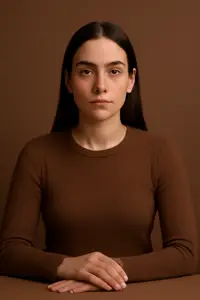
The background is an even, smooth, warm beige with no visible pattern, objects, or depth cues; it is unadorned and extends to the frame edges. Lighting is soft and diffuse, coming from a frontal direction slightly above eye level: there are no harsh shadows or bright specular highlights, but gentle gradations of light create soft shadows beneath the chin, along the sides of the nose, in the eye sockets, and under the hands. Overall contrast is low to moderate, with the face and hands as the brightest elements against a slightly darker sweater and a mid-tone background.

Edges throughout the image are generally soft to moderately crisp: the contours of the face, neck, and hair are smoothly defined without hard lines; the ribbing of the sweater creates finer linear edges where each rib catches light. Textures are visible but understated: skin appears smooth and matte; hair looks fine and straight with a subtle sheen; the sweater appears soft and slightly textured because of the rib knit; the tabletop looks smooth and flat.

Space in the image feels shallow: the subject is positioned in the foreground and middle ground with no additional objects or receding elements to convey deep distance. The background is flat and uninterrupted, creating a planar effect behind the subject. The image is framed tightly around the person’s upper body — head and shoulders through the hands — with the top of the head close to the upper edge and the hands near the lower edge; little empty margin exists on either side, so the composition is compact and centered.

Compositionally, the subject is centered both horizontally and vertically; if the frame is split left and right, both halves contain nearly mirror-image portions of the person’s hair, shoulders and sleeves, producing visual symmetry. If the frame is split top and bottom, the top half contains the head and upper torso while the bottom half contains the folded hands and forearms on the table. There is no visible horizon line; the viewpoint is at eye level with the subject, creating a direct, straight-on perspective. Scale is human-scale: the person occupies most of the frame so that facial features and hand details are clearly legible; relative sizes of head, shoulders and hands appear natural and proportionate.

Color palette is limited and warm: dominant tones are light skin tones, warm medium brown of the sweater, and beige-tan background and tabletop. Contrasts are subtle, mostly between the lightness of the skin and the mid-tone sweater, and between the dark hair and the lighter background. There are no bright colors, patterns, or high-contrast elements. The overall visual effect is restrained and even, with emphasis placed on the central figure through light, position and symmetry.

Picture 57

Round 57

What the describer wrote about picture 57. These words, and nothing else, painted picture 58.

Centered in the frame is a single human figure shown from about mid-torso upward, facing directly toward the viewer with shoulders squared and hands folded on a flat surface that occupies the bottom edge of the image. The face is the element that draws the eye first because it sits almost exactly at the vertical and horizontal center of the frame, has smooth, even skin tones and a neutral expression, and is surrounded by the darker vertical mass of long, straight hair which provides contrast against the lighter, uniform background. Secondary focal elements are the clasped hands in the lower center and the ribbed knit sweater that covers the torso and arms.

The image appears photographic and realistic in style, resembling a studio photograph with controlled, soft lighting and natural detail. The palette is muted and warm: skin tones are light and even, the sweater is a medium brown with warm orange-brown undertones, the hair is a dark brown near black, and the background is a desaturated beige that sits between the skin and sweater in value. Contrasts are modest and subtle rather than graphic; the strongest contrast is between the dark hair and the pale background and face. Light appears diffuse and even, coming from in front of and slightly above the subject: there are gentle highlights on the forehead, the bridge of the nose, and the tops of the hands, and soft, shallow shadows under the chin and along the sides of the neck and beneath the hands, but no hard shadows or bright specular highlights.

Edges and contours are mostly smooth and softly defined. Facial features—brows, eyelids, nose, lips—are rendered with soft transitions; jawline and hairline are clear but not sharply etched. The sweater shows linear contours defined by vertical ribbing, which produces regular, parallel lines that run top-to-bottom across the torso and sleeves. The hands have rounded, organic contours with visible creases where the fingers interlock; the fingernails are short and unobtrusive.

Textures are distinct and realistic: skin appears smooth and matte, hair appears straight and fine with a subtle sheen, and the sweater has a visible knitted texture with a ribbed pattern that suggests softness and slight thickness. The tabletop or surface under the hands is smooth and matte, similar in tone to the background but a touch lighter, emphasizing the hands without strong separation. The background is smooth and uniform, with no visible pattern or detail.

Spatially the image is open and uncluttered. The foreground consists of the folded hands resting on the flat surface at the very bottom of the frame; the middle ground is the torso and sweater occupying the lower two-thirds of the image; the primary subject’s head and shoulders occupy the center and upper middle; the background is an even, shallow plane of color that fills the entire frame behind the figure and creates very little sense of depth beyond the subtle shadowing around the shoulders. No other objects or persons are visible. The edges of the frame cut the body roughly at the mid-torso and leave small margins of space to either side of the shoulders; nothing else is cropped besides the lower body below the mid-torso.

Compositionally the subject is precisely centered both horizontally and vertically, producing bilateral symmetry: the left and right halves of the frame mirror one another in major shapes and tones, with the vertical part in the subject’s hair at the crown aligning with the center. Top and bottom balance is stable: the face occupies the upper middle, the ribbed torso fills the central band, and the hands anchor the image at the bottom center. The viewpoint is at eye level and relatively close, offering a medium close-up perspective that emphasizes facial detail and hand placement while excluding full-body context. There is no visible horizon line.

Scale is intimate: the head and upper torso fill most of the frame so that the figure appears large relative to the image area, with the face taking up roughly one quarter to one third of the frame height and the hands about one sixth. Proportions between elements are natural: the hands look proportionate to the arms and torso; the head size is typical for a close portrait. Overall the visual impression is of a single, centered person photographed against a plain, neutral backdrop with soft, frontal lighting, smooth edges, and a restrained warm color scheme.

Picture 58

Round 58

What the describer wrote about picture 58. These words, and nothing else, painted picture 59.

The subject is a single seated person, shown from approximately mid-torso upward, centered in the frame. The first element that draws the eye is the subject’s face because it occupies the central vertical axis and is rendered with even, soft lighting that produces gentle contrasts; the face is framed by long, straight dark hair that falls down behind the shoulders. Below the face, the subject’s folded hands rest on a flat surface in the lower foreground and form a compact visual anchor.

Starting from the top and moving down: across the entire top third of the image is a neutral, smooth background of an even beige tone with no visible pattern or texture. In front of that background, the subject’s head sits near the center of the image. The hair is dark brown or black, parted in the middle with a precise center line at the crown; the hair is straight, sleek, and falls symmetrically behind the ears and down past the shoulders but is cropped by the bottom of the background mid-portrait area. The face is directly forward-facing and occupies the vertical middle of the frame. Facial features are rendered clearly and evenly: symmetrical eyebrows, almond-shaped eyes set level across the horizontal midline, a straight nose, closed lips with a neutral expression, and small hoop earrings visible on each earlobe. Skin tone is warm and even, with subtle shading around the nose and under the eyes that indicates soft three-dimensional form.

The subject wears a long-sleeved, ribbed-knit sweater of a warm, medium brown color. The sweater’s neckline is a round crew neck that sits close to the base of the neck. The ribbed vertical texture of the fabric is visible across the torso and sleeves, producing narrow, regularly spaced vertical lines. The sleeves extend to the wrists; the forearms rest on the flat surface. The hands are clasped loosely—fingers interlaced—centered just above the bottom edge of the frame. Fingernails are short and natural. The flat surface on which the hands rest is a pale beige similar to the background but marginally lighter, forming a slight tonal plane separation between the body and the backdrop.

The image is photographic and realistic in style, with smooth gradients and fine detail typical of high-resolution portrait photography. Edges of forms—hairline, jawline, sweater seams—are soft to moderately sharp; facial contours are gently modeled by diffuse lighting rather than hard directional highlights. The overall color palette is warm and muted: the dominant colors are beige for the background and surface, warm brown for the sweater, dark brown or black for the hair, and natural skin tones for the face and hands. Contrast is low to moderate; the most noticeable contrast is between the dark hair and the pale background and between the warm sweater and the neutral backdrop.

Line in the composition is primarily vertical and horizontal: the vertical ribs of the sweater and the vertical fall of the hair, the horizontal line implied by the shoulders and the table edge. Contours are smooth and rounded—curved jawline, soft cheek shapes, rounded fingers—rather than angular. Texture is most evident in the sweater’s ribbed knit and the smooth, matte appearance of the skin; the background and flat surface are smooth and uniform with no visible texture. The hair appears smooth and glossy but without high shine; the earrings provide a small metallic accent.
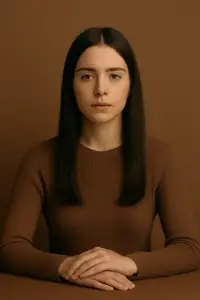
Space in the image is open and uncluttered. Foreground: the hands and the table surface occupy the bottom area. Middle ground: the torso, sweater, and shoulders. Background: the flat beige backdrop with no depth cues. There is little sense of deep spatial recession; the subject is placed close to the camera, creating a shallow, intimate framing with minimal negative space around the head and shoulders. The edges of the frame crop the lower arms and hips; the top of the head is fully within the frame with some headroom above.

Compositionally the subject is centered and symmetrical. If the frame is split left and right, the face, hair, shoulders and hands are balanced almost identically on both sides; if split top and bottom, the face occupies the central band, the sweater torso fills the middle-lower area, and the hands and surface ground the bottom. The viewpoint is eye level and relatively close, a standard portrait distance that renders the head and upper body prominent within the frame. Scale: the head and upper torso occupy the majority of the image height, with the face roughly one third of the image height and the hands about one sixth, making the person the dominant element relative to the background.

Picture 59

Round 59

What the describer wrote about picture 59. These words, and nothing else, painted picture 60.

A single upright human figure fills most of the vertical frame, centered frontally and facing the camera. The figure’s head and upper torso occupy the central and upper two-thirds of the image, drawing the eye first because of its size and placement against a uniformly plain background. The person’s hands are visible in the lower center foreground, folded together and resting on a flat surface that forms the image’s bottom edge.

Style and medium: the image is photographic and realistic, with natural gradations of tone and fine detail in skin, hair, fabric, and small metal objects. Nothing is heavily stylized or abstracted; edges are generally soft but well defined, and surfaces show subtle, photorealistic texture.
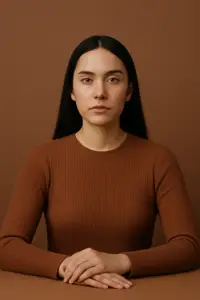
Color: the overall palette is warm and muted. The background is a uniform warm beige/taupe, low in contrast. The subject wears a long-sleeved, ribbed knit top in a medium brown tone; the ribbed texture creates vertical tonal variations within the brown. The skin tones are warm and natural, slightly lighter than the brown garment but darker than the background. Hair is dark brown to black, creating the strongest color contrast against the background. Small metallic earrings on each earlobe introduce a cool, slightly reflective silver tone. Lighting is even and soft, coming from in front of and slightly above the subject; there are no harsh shadows, only gentle modeling on the face and slight highlights on the forehead, nose bridge, upper cheeks, and the tops of the knuckles.

Line and edge quality: contours of the face, hair, shoulders, and hands are smooth, with curved lines dominating the composition. Facial features—brows, eyelids, nose, lips—are defined with subtle, soft-edged transitions rather than sharp graphic lines. The ribbing in the sweater creates thin, straight vertical lines across the torso and sleeves. The fingernails and folds of the hands show fine, delicate lines.

Texture: skin appears smooth with a soft matte finish; pores and microtexture are not prominent but the surface reads as skin rather than uniform tone. Hair is straight, fine, and glossy with a smooth surface and a central part that creates a symmetrical fall of hair on either side of the head. The sweater’s knit texture is visibly ribbed and slightly matte, with faint shadows between ribs signaling fabric depth. The metallic hoop earrings are small, smooth, and slightly reflective, catching small highlights. The flat surface beneath the hands is smooth and untextured, matching the neutral background color.

Space and depth: the composition is shallow and compressed; there is minimal visual space between the figure and the background, which appears uniformly lit and uninterrupted. Foreground: the folded hands and the edge of the flat surface are in the nearest plane, slightly cropped at the bottom edge. Middle ground: the torso and arms occupy this zone. Background: the plain beige backdrop fills the entire area behind the subject, creating a flat, unobtrusive space that isolates the figure. Nothing else occupies the frame; no objects, patterns, or additional figures are present.

Composition and framing: the image is vertically oriented. The subject is centered horizontally and vertically offset slightly upward so the top of the head is near the upper edge but not cropped. Splitting the frame into left and right halves yields near-perfect symmetry: the head is bisected by a precise central hair part, shoulders extend symmetrically on both sides, and the clasped hands fall on the midline. Top half: head and upper torso; bottom half: the lower torso and folded hands resting on the surface. The left and right halves mirror each other closely; visual weight is balanced. The viewpoint is eye level and close enough for a mid-portrait: the frame shows from just above the top of the head down to the hands, making it an intimate, frontal midshot. There is no visible horizon line.

Scale: the person’s head is the largest identifiable object in the frame relative to the whole image, occupying roughly one quarter of the vertical dimension. The hands are smaller but prominent in the lower center. The earrings are small details relative to the face. The background scale is neutral and featureless, serving only to set off the figure. The overall impression is that the subject is life-sized within the frame, photographed from a short distance with a moderate focal length that produces minimal distortion.

Additional details: hair is straight, parted exactly at the center, and extends downward behind the shoulders so the front surfaces of the ears and earring loops are visible. Eyebrows are well defined and slightly arched. Eyes face directly forward and are evenly spaced; lashes are visible but not heavily made up. The nose is centered and proportionate; lips are closed and relaxed. The jawline and neck are visible; the neckline of the sweater is a simple round crew neck that sits at the base of the throat. Sleeves extend to the wrists; the ribbing on the sleeves continues the vertical pattern of the torso. Fingernails are short and natural, without polish. The lighting produces a gentle, even illumination with minimal shadow beneath the chin and slight shadowing between fingers where they interlace. The entire picture is free of clutter, and every visible element is presented plainly and clearly.

Picture 60

Round 60

What the describer wrote about picture 60. These words, and nothing else, painted picture 61.

A single person fills most of the frame, seen from about the chest upward and centered vertically and horizontally. The face is the first thing the eye is drawn to because it is large in the picture, occupies the central upper third of the frame, and is lit evenly against a plain background. The subject’s head is straight and upright, with long, dark hair that falls down past the shoulders on both sides. The hair is parted precisely in the middle and appears straight and smooth. The face shows neutral expression, with closed lips and eyes looking forward toward the viewer. Small, gold-colored hoop earrings are visible on both ears. The subject wears a long-sleeved, ribbed knit sweater in a medium brown color. Both forearms rest on a flat surface at the bottom of the frame; the hands are clasped together with fingers interlaced and sit in the foreground.

Style and medium: the image is photographic and realistic; details of skin, fabric, hair and metal are rendered with photographic fidelity rather than painterly or stylized marks. Nothing appears exaggerated; edges of features are soft but clearly defined as in a high-quality portrait photograph.

Color: the overall palette is warm and muted, dominated by beige and brown tones. The background is a uniform light beige, a few shades lighter than the sweater. The sweater is a medium, slightly reddish brown with visible vertical ribbing. Skin tones are warm and natural, sitting between the beige background and the darker hair. The hair is a deep brown to near‑black. The small hoop earrings introduce a spare metallic gold accent near the face. Contrast between light and dark is gentle: the hair and eyes are the darkest elements, the background and highlights on skin are the lightest, and the brown sweater sits in the midrange.

Light: illumination is soft and diffused, coming primarily from the front with a subtle bias slightly above and to the subject’s left (viewer’s right), producing very mild, even shadows beneath the chin and at the sides of the nose. There are soft highlights on the forehead, the bridge of the nose, and the cheeks; the light renders skin texture smoothly without harsh specular glare.

Line and edges: contours are mostly smooth and rounded — the jawline, cheeks and shoulders form soft, continuous curves. Facial features (eyebrows, eyelids, lips) are defined with clear but soft edges rather than hard, angular lines. The vertical ribs of the sweater create a repeated linear pattern across the torso; these ribs are thin, parallel lines giving a regular striped texture.
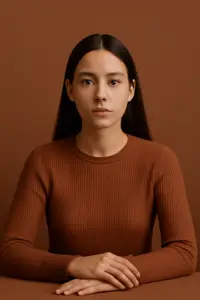
Texture: skin appears smooth with subtle, realistic pore and tonal variation but no strong blemishes. Hair looks fine and glossy, lying flat against the head. The sweater’s fabric texture is clearly knit and ribbed, showing parallel ridges that catch light differently from the flat background. The small hoop earrings read as metallic and slightly reflective. The tabletop in the foreground is smooth and matte, similar in tone to the background but marginally darker.

Space and depth: the composition is shallow in depth of field but not extremely compressed; the subject stands out from the plain backdrop with a soft separation rather than strong blur. Foreground contains the clasped hands and the edge of the table at the bottom of the frame; middle ground contains the torso and sweater; background is an uninterrupted flat beige wall that fills the entire back of the frame and extends to the edges. No additional objects or scenery appear; the sides of the frame crop close to the subject’s upper arms and hair so nothing else is visible beyond that.

Composition and balance: the subject is centered symmetrically along the vertical axis. If the frame is split left and right, each half contains roughly the same visual weight: hair falling evenly, one hoop earring on each side, and shoulders at similar heights. If split top and bottom, the top half contains the upper head and hair, the middle contains the face and neck, and the bottom contains the clasped hands and table. The viewpoint is eye level and close enough to be a bust portrait — neither a wide-angle distant shot nor an extreme closeup, showing the head, neck and upper torso. There is no visible horizon line.

Scale: the face occupies the upper-central portion and is proportionally the largest single element in the frame. The sweater and torso occupy a similar horizontal span but less visual emphasis. The hands in the foreground are smaller than the head but prominent because they sit on the lower center and are in sharp focus. The background is large in area but visually minimal and subordinate to the subject.

Crops and edges: the top edge of the frame leaves a short margin above the head; the sides crop near the subject’s upper arms and hair so those elements are not fully separated from the frame. The lower edge cuts off the table surface and lower forearms just past the wrists. No other objects, text, patterns or people appear in the image.

Picture 61

Round 61

What the describer wrote about picture 61. These words, and nothing else, painted picture 62.

A centered, eye-level photographic portrait of a single person shown from about mid-torso upward. The largest and most immediately attention-drawing element is the subject’s face: it sits almost exactly in the vertical and horizontal center of the frame, occupies a substantial portion of the upper half of the image, and is lit evenly so that its smooth, lightly shadowed planes stand out against the uniformly colored background. Directly below the face and in the lower center of the frame are the subject’s clasped hands resting on a flat surface; these hands form the second major visual anchor because they are placed at the front edge of the composition and are shown in clear focus. The third obvious element is the subject’s long, straight hair that falls down behind the shoulders and toward the back of the frame, forming a dark vertical mass that contrasts with the lighter background.

Everything in the frame is photographic and realistic, with naturalistic detail and soft depth of field typical of studio portrait photography. The rendering is not stylized; skin pores, the knit pattern of clothing, and the subtle highlights on metal jewelry are all visible without painterly brushwork or illustration artifacts. Edges are generally soft rather than hypercrisp — contours of cheeks, hair, and fabric transition gently into shadow — though small details, like the rim of the earrings and the fine ribs of the sweater, remain clearly defined.

Color is muted and warm overall. The background is a flat, pale beige that fills the entire backdrop with no pattern or texture, creating low contrast with the subject’s skin tone. The subject’s sweater is a medium brown with a vertical ribbed texture; this brown is warmer and darker than both the skin and the background, providing most of the chromatic contrast in the image. Hair is a deep, near-black brown that reads as the darkest value in the composition. Skin tones are light to medium with neutral warm undertones; lips are a slightly darker, neutral pink-beige. Small gold hoop earrings introduce a faint metallic yellow accent at the horizontal midline near the ears. Lighting is soft and even from the front and slightly above eye level; there are gentle shadows beneath the chin and along the lower sides of the nose and eye sockets, but no harsh highlights or deep, high-contrast shadows.

Lines and contours are predominantly smooth and curved. Facial contours—cheeks, jawline, and eyelids—are defined with soft, rounded edges. The shoulders and arms show more subtle straight and slightly angled lines but remain generally softened by the knit fabric. The vertical ribs of the sweater introduce repeated thin, straight lines across the torso, adding linear texture that runs parallel to the hair. The boundary between hair and face is a clean, continuous curve. The outline of the hands comprises interlocking curved shapes of fingers and knuckles; fingernails are short and softly delineated.

Textures include: skin that appears smooth and matte with very fine detail visible; hair that looks straight, dense and smooth with a slight sheen; a knitted sweater with clearly visible vertical ribbing that suggests a soft, slightly fuzzy fabric; small metal earrings with a subtle reflective sheen; and a flat, matte tabletop surface under the hands that matches the neutral palette. The background is visually textureless and uniform.

The picture’s spatial organization is open and uncluttered. Foreground: the subject’s hands on the tabletop occupy the bottom center, slightly toward the viewer. Middle ground: the torso and sweater fill the lower half and middle of the frame. Background: the plain beige backdrop occupies the entire rear area with no objects or gradients to suggest depth beyond a gentle falloff of light. Nothing else competes for space; the scene is tightly composed around the single figure. The frame cuts off just below the elbows and just above the top of the head leaves a narrow margin of background above.

Composition is highly symmetrical and balanced. If the frame is divided left and right, each half mirrors the other closely: the face is centered, hair falls evenly on both sides, shoulders and arms are level, and the clasped hands are aligned with the center vertical axis. If divided top and bottom, the top half is dominated by the head and hair, the lower half by the sweater and hands. There is no visible horizon line; the viewpoint is straight on at eye level and at a moderate close-up distance that keeps the subject’s face and hands prominent. Scale is life-size within the frame: the head and upper torso occupy roughly two-thirds of the image height, the hands are proportionate to the body and not magnified or diminished, and no other objects provide contradictory scale cues.

Additional visible details: the subject’s eyebrows are naturally shaped and not heavily stylized; the eyes are open and centered, with a neutral gaze directed toward the camera; lips are closed; ears are partly visible and each bears a small, smooth, circular gold hoop earring; fingernails are natural, short, and lightly colored. The sweater’s neckline is a simple round crew neck. The entire scene uses a restrained, limited palette of beige, brown, warm skin tones, near-black hair, and small gold accents, producing an overall calm, neutral appearance without bright or saturated colors.

Picture 62

Round 62

What the describer wrote about picture 62. These words, and nothing else, painted picture 63.

A single seated person fills the vertical frame, centered frontally and taking up most of the image from mid-torso to just above the top of the head. The first thing the eye is drawn to is the face in the upper center of the picture: it dominates because of its central position, symmetry, and the contrast between smooth skin tones and the plain background. Directly below the face, a pair of hands are clasped together and rest on a flat surface at the very bottom center of the frame; their placement forms a vertical axis linking hands, torso and face.

The subject is photographed realistically; the image looks like a high-resolution color photograph with natural proportions and detailed rendering of skin, hair and fabric. Nothing is stylised or abstracted; surfaces and micro-details such as pores, hair strands and knit ribs are visible and rendered with photographic clarity. Exaggeration or simplification is minimal — features are represented as they appear, with even, soft focus across the face and hands.

Color is muted and warm overall. The background is a uniform, desaturated beige that covers the entire backdrop and creates a low-contrast, warm field behind the subject. The subject’s sweater is a medium brown with warm undertones, slightly darker than the background, and provides the next broad color area. Skin tones are light to medium with warm peach and neutral beige variations across forehead, cheeks and hands. Hair is dark brown to near-black, forming a strong vertical contrast against the lighter background. Small silver hoop earrings add tiny cool-toned highlights at ear level. Lighting is soft and even, coming from in front of the subject, slightly above eye level; there are no hard shadows, only gentle gradations of light across the face and under the chin, and a subtle highlight along the centerline of the forehead and bridge of the nose.

Edges and contours are predominantly smooth and rounded. The facial outlines — jawline, cheeks, eyebrows, lips — are softly defined with fine, clear edges rather than harsh lines. The hair creates long straight vertical lines down the sides of the head, with a defined center part at the top. The sweater shows parallel vertical ribs that produce regular, narrow linear texture across the torso. The hands show short, curved lines of knuckles and fingernails; the fingers are interlocked, producing a repeating curved contour.

Textures are varied but subtly rendered. Skin appears smooth and even, matte with a soft sheen on the forehead and nose. Hair looks straight, fine and glossy with distinct but closely packed strands. The sweater’s fabric texture is visible: a knitted rib pattern that looks soft and somewhat fuzzy, indicating a warm textile. The background is flat and textureless, reinforcing the tactile contrast between cloth, hair and skin.

Space in the image is shallow and uncluttered. Foreground contains the hands and the lower edge of the sweater sleeves resting on a flat, neutral-toned surface that blends chromatically with the background. The middle ground is the subject’s torso and the lower part of the face; the background is a single flat plane with no visible objects, creating minimal depth cues. Nothing else occupies the frame edges except the subject; the vertical edges crop the outer sleeves and lengths of hair, and the horizontal edges crop just below the tabletop and just above the head.

Composition is strictly symmetrical and centralized. If the frame is split into left and right halves, the face, torso and clasped hands align almost exactly on the central vertical axis. Left and right halves mirror one another in pose and negative space: each ear and earring sits at a similar distance from the center; hair falls evenly to both sides; the ribbed sweater shows equal patterning on both halves. Splitting top and bottom, the top third contains most of the head and hair, the middle third contains the face and shoulders, and the bottom third contains the hands and the flat surface. There is no visible horizon line; the viewpoint is eye level, straight-on, at a medium close distance that captures from mid-chest upward. The viewpoint is neither from above nor below.

Scale: the subject occupies the majority of the frame, so the head and upper torso are large relative to the image dimensions; the hands are proportionate to the body and appear in the foreground but are close to the same focal plane as the face, reinforcing a shallow depth of field with overall clarity. Small details — earrings, ribbing on the sweater, fingernails — are visible and measured in scale against the larger masses of head, hair and shoulders. The background remains empty and of consistent scale, emphasizing the subject’s central placement.

Picture 63

Round 63

What the describer wrote about picture 63. These words, and nothing else, painted picture 64.

The image shows a single person, centered and facing the camera directly, occupying most of the frame. The head and torso are the largest elements and draw the eye first because they are centrally placed, symmetrically arranged and well lit against a plain background. The face is oval with straight, dark hair parted in the middle and falling behind the shoulders. The eyebrows are natural and follow the brow line; the eyes are level with one another, looking forward. The nose is straight and centered on the vertical axis of the face. The mouth is closed with relaxed lips. Small hoop earrings are visible on both ears. The person wears a long-sleeved, ribbed-knit sweater in a mid-to-dark brown tone. Both hands rest on a flat surface at the bottom edge of the frame; the fingers are interlaced, palms down, and the wrists are visible. The visible portion of the tabletop is a light neutral color.

The image is photographic and realistic, resembling a studio portrait with a high level of detail rather than a stylised or painterly rendering. The palette is muted and warm: beige and tan in the background, medium to dark brown in the sweater, natural skin tones, and dark brown to black hair. Contrasts are subtle — the face and sweater are slightly darker than the pale, even background, and small specular highlights appear on the metal of the hoop earrings. Light is soft and frontal, illuminating the face and upper body evenly with minimal shadowing; faint shadows under the chin and at the inner sides of the arms indicate a light source slightly above eye level.

Edges and contours are smooth and softly defined. The lines of the shoulders and neckline are gently rounded; facial features are delineated with fine, natural contours rather than sharp or angular strokes. Vertical ribbing on the sweater creates a series of parallel soft lines running from the neckline down across the torso. The hair forms straighter, smoother vertical bands on either side of the head. The outline of the hands shows subtle curves of knuckles and finger joints.

Textures are rendered clearly: skin appears smooth and matte, with uniform tone and minimal surface detail; the sweater has visible knitted rib texture that looks soft and slightly fuzzy; the hair appears smooth and straight with a soft sheen; the earrings show a metallic, slightly reflective surface. The background is flat and even, with a matte appearance and no visible texture.
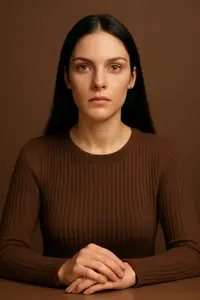
Spatially, the composition is shallow and compressed; there is little visual depth beyond the person and the flat backdrop. Foreground elements are the hands and the tabletop at the bottom of the image. The middle ground is the torso and sweater. The head and face occupy the upper middle ground and approach the top third of the frame. The background is uninterrupted and stretches to the edges of the image; there are no additional objects or props. The frame cuts off at the forearms and leaves some negative space around the head and shoulders.
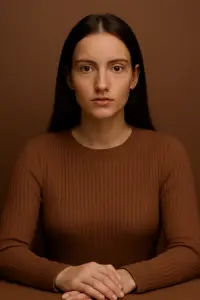
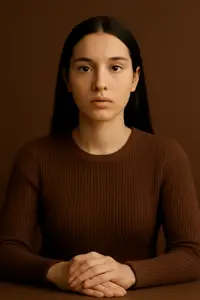
Compositionally the image is strongly symmetrical and balanced. Split vertically, the left and right halves mirror each other: hair falls evenly on both sides, earrings sit at matching heights, shoulders are level, and hands sit on the centerline. Split horizontally, the lower half contains the clasped hands and ribbed sweater, while the upper half contains the head and plain background. The viewpoint is eye level and relatively close — a tight portrait that captures head, neck and upper torso. There is no visible horizon. Scale is life-size relative to the frame: the person nearly fills the vertical space, with the head occupying roughly the top third and the hands the bottom third, emphasizing the central alignment and proportion of the subject within the rectangular frame.

Picture 64

Round 64

What the describer wrote about picture 64. These words, and nothing else, painted picture 65.

A single seated figure dominates the image, centered and facing directly toward the viewer; the face and upper torso draw the eye first because they occupy the central vertical axis and are lit evenly against a plain background. The figure has long, straight dark hair parted precisely down the middle and falling symmetrically along both sides of the head to the shoulders. The head sits near the upper third of the frame. The facial expression is neutral; eyes are open and directed straight ahead, eyebrows are gently arched, the nose is straight, and lips are closed without a smile. Ears are visible at the sides of the head. The skin surface appears smooth and evenly illuminated.

The figure wears a fitted, long-sleeved sweater with a fine vertical ribbing texture; the garment is a medium brown and covers the torso and arms down to the wrists. The round neckline of the sweater sits just below the base of the neck. Both forearms rest on a flat horizontal surface at the bottom of the image; the hands are placed together in the center foreground with fingers interlaced or gently overlaid so the fingertips form a neat, compact shape. The visible portion of the table or surface is a slightly lighter beige tone than the background.

The backdrop is a plain, uniform beige that matches the overall warm tonal palette and creates minimal visual distraction; there are no discernible patterns, objects, or depth cues in the background. Lighting is soft and diffuse from the front, producing even illumination across the face and torso with very subtle, soft-edged shadows beneath the chin and under the hands, indicating a light source slightly above eye level. Highlights are gentle and not specular; there are no strong reflections.

Coloring is predominantly warm and muted: variations of beige, tan and medium brown dominate. Contrast is low to moderate — the darkest tones are the hair and eyes, which stand out against the lighter skin and background; the ribbed sweater provides tonal contrast through its texture rather than through bright color differences. Overall the palette is restrained and cohesive, with little color saturation.

Edges and contours are smooth and softly defined; transitions between planes (cheeks to jaw, neck to collarbone) are gradual rather than harsh. Lines formed by the hair are straight and unbroken; the neckline and shoulder seams form gentle curves. The ribbing on the sweater creates many fine vertical lines across the torso, introducing a subtle linear rhythm.

Textures are evident and distinct: skin appears matte and even; hair looks silky and smooth; the sweater shows a tactile, knitted ribbed texture; the tabletop surface appears flat and matte. No glossy or highly reflective surfaces are present.

Spatially the image feels shallow and compact. Foreground: the tabletop and the hands resting on it occupy the bottom portion of the frame. Middle ground: the torso and upper arms fill the central area. Background: the uniform beige wall occupies the entire rear plane with no visible depth. The composition is tightly cropped, cutting off the lower arms near the wrists and the lower body at or just below mid-torso; the top of the head and shoulders are fully included but there is little extra space above.

The composition is symmetrically balanced along the vertical centerline: facial features, hair parting, shoulders and hands mirror left and right closely. If the frame is divided horizontally, the top half contains the head and upper torso while the lower half contains the lower torso and hands; visually the face occupies the focal center. The viewpoint is at eye level and relatively close, producing a head-and-shoulders portrait scale where the figure fills much of the frame. Relative scale: the head is proportionate to the torso and hands; none of the elements appears disproportionately large or small within the cropped frame.

No additional objects, text, or identifiable marks are present. The overall impression is of a single, centrally placed human subject rendered in photographic realism with even front lighting, warm muted colors, smooth contours, and a plain, unobtrusive background.

Picture 65

Round 65

What the describer wrote about picture 65. These words, and nothing else, painted picture 66.

A single seated figure fills most of the frame, centered and facing forward. The head and shoulders occupy the upper middle of the image; the folded hands rest on a flat surface at the bottom center. The figure’s straight, dark hair falls past the shoulders and frames a symmetrical, oval face. The eyes look directly toward the viewer, set roughly on the horizontal center line of the head. The lips are closed and relaxed. The ears are visible on both sides of the head. The neck is visible above a round neckline. The figure wears a long-sleeved, ribbed knit top with a crew neck; the sleeves reach the wrists and the hands are bare. The hands are folded one atop the other with fingers relaxed and nails short and natural. A flat table surface appears at the lower edge of the frame, directly beneath the hands.

Style: The image is photographic and realist in appearance, with fine detail and smooth gradations of tone. Edges and forms are rendered with photographic clarity rather than painterly or sketchy marks; there is no visible brushwork or illustrative stylization.

Color: The overall palette is warm and muted. Background, clothing and table are in similar tan and light brown tones that create a low-contrast, monochromatic effect. The top is a medium brown with subtle vertical ribbing that creates slightly darker lines. The skin tones are pale with warm undertones, slightly lighter than the clothing and background, providing the main contrast. The hair is a dark brown to near-black, creating the strongest contrast against the paler background and face. Lighting is soft and even, coming from the front and slightly above, producing gentle highlights on the forehead, bridge of the nose and tops of the hands, with soft, short shadows beneath the chin and along the sides of the nose.

Line: Contours are smooth and softly defined. Facial features are delineated by gentle transitions rather than hard outlines. The vertical ribs in the sweater introduce a series of fine, straight lines across the torso. Hair edges are clean and slightly softened where they meet the background. The fold of the hands and fingers shows subtle, curved lines.

Texture: The skin appears smooth and matte, with slight natural variation. The sweater shows a fine knitted texture with vertical ribbing visible across the chest and sleeves. Hair appears straight and smooth with a soft sheen. The table surface is flat and matte, visually similar to the background. The background itself is smooth and even, with no visible pattern.

Space: The composition is open and uncluttered. Foreground: the flat table surface and the folded hands. Middle ground: the torso and arms clothed in the ribbed sweater. Background: a plain, even-colored wall that fills the remainder of the frame. There is minimal depth; the figure is placed close to the background but separated enough to allow soft shadowing that suggests shallow depth.

Composition: The figure is centered horizontally. Vertically, the head sits in the upper-middle third, the torso occupies the central third, and the hands and table occupy the lower third. Split left and right, the image is symmetrical: both shoulders, both ears and both hands are visible and balanced. Top and bottom split: top shows background and the crown of the head; middle shows face and torso; bottom shows hands and table. The viewpoint is eye level and close enough for a three-quarter to medium portrait that includes head, shoulders and hands. There is no visible horizon.

Scale: The figure is close to life-size within the frame; the head and shoulders dominate, taking approximately two-thirds of the vertical space. The hands appear proportional to the torso and face. Nothing else is present to imply a larger environment; the plain background keeps focus on the person and clothing.

Picture 66

Round 66

What the describer wrote about picture 66. These words, and nothing else, painted picture 67.

A single seated person fills most of the frame, shown from just above the top of the head down to the forearms and hands resting on a flat surface. The subject is centered and upright; the face and torso occupy the vertical middle of the image and draw the eye first because of their size, central position, and the slight contrast between the skin and the surrounding warm tones.

The face is near the top-center of the frame. It is oval, with smooth, even-toned skin and a neutral, relaxed expression. The subject’s eyes are level with the horizontal centerline of the head and look straight toward the viewer. Eyebrows are narrow and follow a soft arch above the eyes. The nose is straight and proportionate; the lips are closed and relaxed. The hair is long, straight, dark brown, parted precisely down the middle and falling evenly behind each shoulder, reaching below shoulder level but cut off by the lower edge of the head and upper torso in the frame.

The clothing is a long-sleeved, ribbed knit sweater in a mid-to-dark brown color. The ribbed vertical lines of the fabric are visible across the chest and sleeves. The neckline is a rounded crew neck that sits at the base of the neck and is centered in the frame. Sleeves extend to the wrists, and cuffs meet the forearms where the hands rest.

Both forearms extend forward to the bottom-center of the frame where the hands are placed on a flat, light brown tabletop. The left hand rests on top of the right in a loose, overlapping position; fingers are gently curved and visible from above. Fingernails are short and natural. The wrists and lower arms are visible; the sleeves reach nearly to the wrists with a small gap of skin showing.

The background is a uniform, matte beige or light tan with no visible texture, pattern, or objects; it fills the entire space behind the subject and creates a calm, continuous field of color that isolates the figure. Lighting is soft and diffuse, coming primarily from the front and slightly above, producing even illumination across the face and torso with minimal shadows. Subtle, soft shadows appear beneath the chin and around the sides of the nose, under the lower lip, and where the arms meet the tabletop; these shadows are low-contrast and gradated rather than harsh.

Edges and contours throughout the image are smooth and softly defined. Facial features are delineated with gentle transitions rather than sharp lines. The hair outlines are clean and straight against the background. The vertical ribs of the sweater create faint linear texture contrasted with the smoothness of the skin and the flat tabletop.

Surface textures are distinct: the skin appears matte and smooth; the hair appears sleek and uniform; the sweater shows a soft, slightly fuzzy knit texture with clear ribbing; the tabletop has a smooth, matte wood or laminate appearance with minimal grain detail. There are no reflective highlights or shiny surfaces.

Spatially, the composition is shallow and tightly framed. There is little sense of depth beyond the subject; the background is flat and uninterrupted, placing visual emphasis on the person. Foreground elements are the hands and lower sleeves on the tabletop; the middle ground is the torso and chest; the background is the plain wall behind. Nothing is cropped awkwardly—top of the head is slightly below the top edge of the frame, the outer edges of both shoulders are within the frame, and the bottom edge cuts off the forearms at or just below the wrists.

Compositionally the image is symmetrical and balanced left-to-right: the vertical center line passes through the middle of the face, the part in the hair, and the hands. Horizontally, the image is divided roughly into three zones: head and shoulders occupying the upper third to middle third, chest and sweater the middle third, and hands plus tabletop the lower third. The viewpoint is at eye level and relatively close, a medium close-up framing that emphasizes facial features and hands without including the whole body.

Scale: the person fills most of the frame; the head is a dominant element but not oversized. The hands are proportionate to the torso and are relatively small within the overall image but clearly visible because they rest forward on the tabletop. There are no other objects or people visible, and no text, logos, or identifying marks.

Picture 67

Round 67

What the describer wrote about picture 67. These words, and nothing else, painted picture 68.

The largest, most immediately visible element is a single human figure occupying the center of the frame from the chest upward; this figure fills most of the vertical space and draws the eye first because of its size, frontal position, and the contrast between skin and clothing against a uniform background. Secondary elements are the figure’s long, straight dark hair that falls behind the shoulders, the ribbed long-sleeve sweater the figure wears, the figure’s folded hands resting on a flat horizontal surface at the bottom of the frame, and the plain, even-toned background that surrounds and isolates the figure.

The image is photographic and realistic in appearance, with smooth, even lighting and fine detail. The overall color palette is warm and muted: the background is a uniform beige-tan, the sweater is a medium to dark brown with a warm undertone, the hair is a deep, near-black brown, and the skin tones are light to medium with warm, slightly golden hues. Color contrasts are minimal and subtle: the brown sweater contrasts gently with the beige background, and the darker hair and eyes provide modest focal contrast against the lighter skin and backdrop. The lighting appears soft and diffused, coming from in front of and slightly above the subject, creating even illumination across the face and body with minimal shadows; subtle shading defines the cheeks, under the chin, and along the side of the nose without harsh highlights or deep shadowed areas.

Edges and contours in the image are smooth and well-defined but soft rather than harsh: the outlines of the face, hair, shoulders and hands are clear and continuous, with slender, slightly curved lines for the eyebrows, nose bridge, and jaw. The ribbed pattern of the sweater introduces vertical linear elements—narrow, evenly spaced raised ribs that run from the neckline down to the visible cuffs and hem—adding regular, fine linear texture against otherwise broad smooth planes. The hair appears as a smooth, untextured curtain with gentle, straight edges where it meets the background; individual hair strands are not prominent.

Textures visible include smooth skin with a matte finish, soft knit fabric with a subtle ribbed texture, and a flat, matte paper-like or painted background. The sweater’s ribs create slight shadowing along each ridge, signaling a tactile, slightly raised fabric surface. The hands and face show soft, even skin texture without pronounced pores or irregularities. The tabletop or surface on which the hands rest shares the same warm beige-brown tone as the background but is slightly darker and appears smooth and flat.

The scene is open and uncluttered, with large negative space around the figure created by the uniform background. Spatial depth is shallow: the figure sits in the middle ground, the folded hands rest in the foreground at the bottom edge, and the background is flat and featureless, producing a compressed sense of depth. No other objects or environmental details appear; the frame is tightly composed around the upper body and hands. Portions of the figure are cropped by the frame: the very top of the head is near but not touching the top edge, the elbows and lower arms are partially out of frame as they extend downward, and the lower torso below the tabletop is not shown.

Compositionally, the figure is centered symmetrically in the frame. If the frame is split left and right, the figure occupies the vertical center line; the face is positioned on that center line, with each shoulder and arm mirrored in placement and angle. Top and bottom division places the face in the upper-middle portion, the chest and sweater in the center, and the hands and flat surface in the lower portion. The composition is balanced horizontally and vertically, with the visual weight of the head counterbalanced by the hands at the bottom. There is no visible horizon line; the viewpoint is at eye level with the figure, producing a direct, frontal perspective and a moderate close-up scale that shows head, neck, shoulders and hands.

Scale relationships are straightforward: the head is proportionally natural relative to the shoulders and torso visible; the hands are medium-sized in relation to the face and rest naturally on the tabletop, occupying the lower third of the image. The sweater’s ribbing provides a repeated scale cue that runs vertically and appears consistent across the visible chest and arms.

Facial features are presented frontally: a neutral, closed mouth, evenly spaced eyes looking straight ahead, straight eyebrows, a straight nose centered on the face, and smooth skin across forehead, cheeks and jaw. Hair is centered with a middle part that aligns with the vertical axis of the face. The hands are placed one atop the other with fingers relaxed and together; fingernails are short and unadorned. The visible wrist and forearm portions show the sweater sleeve ending at the wrist area; the sweater collar is a simple, round neckline that sits close to the base of the neck.

Overall, the image is an evenly lit, centered, close-to-medium portrait of a single person against a plain warm beige background, dominated by warm brown tones, smooth textures, vertical ribbed fabric detailing, and a symmetric, frontal composition with hands resting on a flat surface in the foreground.

Picture 68

Round 68

What the describer wrote about picture 68. These words, and nothing else, painted picture 69.

A centered, vertical bust portrait of a single person filling most of the frame. The subject’s head and shoulders are the largest and most immediately eye-catching elements because they are centrally placed and occupy the middle vertical third of the image; the symmetry of the face and the even, uncluttered background also draw the eye to the face first.

From top to bottom and left to right: at the top center a narrow strip of background is visible above the subject’s head. The subject’s hair is long, straight, and black, parted precisely down the middle and falling behind the shoulders so that the hair frames the sides of the face but does not cover the chest. The hair has smooth, continuous edges with a subtle sheen along the top and sides. The face is directly front-facing and occupies the central area of the image. The forehead is unadorned; the eyebrows are moderately thick, straight with a gentle arch, and sit above almond-shaped eyes. The eyes are dark and symmetrical, level with one another and about one-third of the way down from the top of the head. The eyelids and lashes are visible but not heavily detailed; there are soft, shallow shadows in the eye sockets that give gentle definition. The nose sits centrally, vertically aligned with the mouth and chin; it has smooth contours and a soft shadow along one side. The mouth is closed with full but not exaggerated lips, neutral in expression. Cheek planes are smooth; jawline is defined but soft rather than angular. The ears are partially visible at the sides where hair tucks slightly behind them.

The neck descends from the jaw to a crewneck sweater, the collar of which sits close to the base of the neck and forms a rounded horizontal edge that intersects the lower third of the face area. The sweater is ribbed knit with narrow vertical ribs running continuously from the collar down the sleeves and torso; the color of the sweater is a medium brown. Both arms are visible from the shoulders down to the forearms. The forearms rest on a flat horizontal surface at the bottom edge of the frame. The hands are positioned one over the other, fingers gently interlaced and relaxed, centered in the bottom part of the image; fingernails are short and natural. The sleeves extend to the wrists and slightly bunch at the cuffs where the arms meet the table.

The background is a smooth, uniform beige that closely matches the tone of the table surface at the bottom of the frame, producing a seamless, monochromatic field that isolates the subject. There are no visible objects, patterns, or textures in the background; it is flat and untextured. Lighting is soft and diffuse, coming from the front and slightly above the subject: the light produces even illumination across the face and sweater, with subtle, gentle shadows beneath the chin and under the lower lip and slight soft shadowing beneath the forearms on the table. Highlights are modest — a faint, even sheen on the forehead, a gentle catch on the top planes of the nose and the glossy surface of the hair — but overall the tonal range is muted, with no extreme contrasts or bright specular highlights.

The overall color palette is warm and muted, dominated by shades of tan, beige, and medium brown; skin tones are warm and even, hair is near-black, and the background and table are pale beige, creating low-contrast transitions between subject and surroundings while still allowing the face and sweater to read clearly. Edges throughout the image are mostly soft to moderately sharp: facial contours and sweater ribs are defined without hard graphic outlines, while the hair edges are crisper against the beige backdrop. Textures are clearly distinguishable: skin appears smooth and matte, hair looks sleek and slightly glossy, and the sweater shows tactile ribbed knit texture with visible vertical lines.

Space is shallow and uncluttered: a narrow foreground is occupied by the hands and table edge, the middle ground by the torso and sweater, and the background is an even plane of color without depth cues. The composition is symmetrical and balanced — if the frame is divided into left and right halves, the subject’s face and body sit on the vertical centerline, with roughly equal negative space on both sides; if divided top and bottom, the head occupies the upper middle and the hands and table occupy the lower middle. The viewpoint is eye level and at a medium close distance, capturing the head, neck, shoulders, and hands within the frame. Relative scale: the head and shoulders dominate the frame, the hands appear proportionate and smaller by comparison, and there are no other scale references in the image. The entire presentation reads as photographic and realistically rendered, with natural proportions and fine detail consistent with a high-resolution studio portrait.

Picture 69

Round 69

What the describer wrote about picture 69. These words, and nothing else, painted picture 70.

The image shows a single person occupying the center of the frame, seen from roughly the mid-torso up. What draws the eye first is the face: it is centered, vertically aligned with the image, and lit evenly so that facial features are clearly visible against a uniform background. The face is oval with straight, long black hair falling behind the shoulders; the hair is parted exactly at the midline and follows two straight, sleek lines down each side of the head. The subject’s expression is neutral, with relaxed eyelids, a straight mouth, and no visible smile. Eyebrows are full and straight, eyes are almond-shaped and dark, the nose is straight and centered, and the lips are closed and naturally shaped. Both ears are visible at the sides of the head.

The subject wears a long-sleeved, ribbed-knit sweater in a warm, medium brown. The sweater’s vertical ribs are visible across the chest and sleeves as fine, evenly spaced ridges. Sleeves reach the wrists; the right forearm rests on a flat surface and the left hand is laid over the right, fingers gently curved. Fingernails are short and unadorned. The hands are positioned at the very bottom center of the frame; the wrists and part of the forearms are visible, while the table edge is not distinct but implied by the hands’ resting plane. The lower arms and elbows are cropped by the frame edges.

The background is a single, uniform beige with no texture or pattern; it surrounds the subject evenly and forms a continuous, neutral backdrop. The overall color palette is warm and muted: the background beige, the sweater brown, black hair, and natural skin tones. Contrast is subtle — the darkest elements are the hair and eyes, the lightest areas are the forehead, nose bridge, and the tops of the hands; shadows are soft and minimal.

Lighting is soft and diffuse, coming from slightly in front of and above the subject. There are gentle, even highlights along the forehead, nose, cheeks, and the top of the hands; shadows beneath the chin and along the lower neck are faint and smoothly graduated rather than harsh. Edges throughout the image are smooth and softly defined: the contour between face and background is clean but not hairline-sharp, and the transition from shadow to highlight on curved surfaces such as cheeks and knuckles is gradual.

Textures are clearly suggested: skin appears smooth and matte, hair looks straight and glossy, and the sweater shows a tactile knitted texture through the visible ribs. The flat surface the hands rest on appears smooth and uninterrupted, matching the background tone closely so it subtly blends into the lower part of the frame.

Space is shallow and uncluttered. There are no other objects, patterns, or figures; foreground elements are limited to the hands and the sweater sleeves, the midground is the torso and face, and the background is the plain beige field behind the head. Depth of field is shallow to moderate: the subject is in sharp focus from hands through face, while the background is uniformly out of any detail, creating a simple separation between figure and ground.

Composition is symmetrical and centered: if the frame is split left and right, the head and torso sit on the vertical midline, with shoulders roughly balanced on each side. Top to bottom, the head occupies the upper-middle section of the frame; the hairline comes close to the top quarter, the chin sits around the middle horizontal band, and the hands rest near the bottom edge. The viewpoint is at eye level and close enough to be a medium close-up, showing facial detail without including the full body. Relative scale places the face as the largest focal element, filling a substantial central portion of the image, while hands and shoulders are proportionally smaller but clearly visible and positioned to anchor the lower part of the composition.

Picture 70

Round 70

What the describer wrote about picture 70. These words, and nothing else, painted picture 71.

A single person fills the frame, seated and facing the camera straight on. The face and upper torso dominate the image; the head is centered both horizontally and vertically, drawing the eye first because of its size, symmetrical placement, and the contrast between dark hair and the pale, uniform background. The person has long, straight black hair parted precisely down the middle and falling evenly on both sides behind the shoulders. The face is neutral, eyes looking forward, lips closed, and the jawline and neck are visible. The shoulders are relaxed; the subject wears a long-sleeved, close-fitting, ribbed-knit sweater in a medium brown tone. Both forearms rest on a flat surface at the bottom of the frame, with the hands folded: the right hand lies over the left, fingers relaxed and visible to the viewer.

Style: The image appears photographic and realistic, resembling a studio portrait photograph. Details are smooth and finely resolved; nothing is exaggerated or stylized. The overall presentation is controlled and even, with natural proportions and true-to-life textural detail.

Color: The palette is warm and muted, dominated by beige and brown tones. The background is a uniform pale beige that closely matches the warm undertones of the subject’s skin and sweater, producing low chromatic contrast overall. The hair is the darkest element—a deep, matte black—providing the strongest contrast against the pale background and drawing immediate attention to the face. Skin tones are light and warm, slightly desaturated. The sweater’s brown is mid-tone and warm, with the ribbing creating subtle light-and-dark variations. Lighting is soft and diffuse, coming from the front and slightly above eye level, producing gentle, even illumination across the face and minimal shadowing under the chin and beneath the hands.

Line: Edges and contours are smooth and clean. The hair’s outline is a soft, continuous curve framing the face. Facial features are defined with gentle, crisp lines—eyelid creases, the bridge of the nose, and the lips are delineated without harshness. The ribbed sweater creates a series of parallel vertical lines across the torso and sleeves, thin and regular, which contrast with the broader, softer curves of the shoulders and arms.

Texture: Skin appears smooth and matte with subtle pore and tonal detail. Hair looks sleek and straight with a soft, low-sheen finish. The sweater’s ribbed fabric is the most tactile surface: visible fine ridges and valleys suggest a soft, knitted texture. The flat tabletop at the bottom edge appears smooth and matte, matching the neutral palette.

Space: The composition is open and uncluttered. A shallow sense of depth exists: the person sits in the middle ground against a plain background that is uninterrupted and appears near the subject, which flattens spatial depth slightly. The foreground is occupied by the folded hands and forearms, the middle ground by the torso and face, and the background by the untextured beige wall or backdrop. Nothing else occupies the space; the frame crops just below the hands and leaves small margins above the head and to either side.

Composition: Visually the frame is balanced and symmetrical. If split left and right, the hair, ears, shoulders, and arms mirror each side closely; the face sits on the central vertical axis. If split top and bottom, the upper half contains the head and hair with even negative space above, while the lower half contains the torso and hands resting on the table. There is no visible horizon line. The viewpoint is eye level and fairly close—showing the head, neck, shoulders, and arms—giving a medium-close portrait scale.

Scale: The person occupies most of the frame; the head and upper torso are large relative to the image area. The hands and forearms are proportionate to the body and appear in the lower third of the frame, small in comparison to the head-and-shoulder area but large enough to be clearly detailed. Overall, the image emphasizes the centered face and symmetrical presentation against a neutral, uninterrupted backdrop.

Picture 71

Round 71

What the describer wrote about picture 71. These words, and nothing else, painted picture 72.

A single human figure fills the frame. What first draws the eye is the centrally placed face: roughly in the vertical center and taking up the upper half of the image, its size, frontal orientation and contrast against the plain background make it dominant. Surrounding that are the long straight hair that falls behind the shoulders, the torso in a fitted long-sleeve top, and the two hands resting, one atop the other, on a flat surface at the very bottom of the frame.

Starting with the largest elements and moving to smaller details: a head-and-shoulders portrait of a young adult with long, straight, dark hair parted precisely down the middle; a neutral, symmetrical face with evenly lit features including almond-shaped eyes, a straight nose, and closed lips; a close-fitting ribbed sweater with a round neckline in a warm brown color covering the torso and arms; forearms and hands placed on a table edge, fingers relaxed and slightly overlapped; a plain, even background in a light beige or tan color that fills the whole frame behind the subject.

Style: photographic and realistic; it appears to be a high-resolution studio portrait photograph rather than a painting or drawing. Proportions and details are naturalistic and not exaggerated; edges are generally smooth and softly defined as in a well-lit photo.

Color: a restrained, warm, neutral palette dominates. Background and table are pale beige or tan. The sweater and overall midtones are warm brown. Skin tones are warm and slightly golden, sitting between the background and clothing in luminance. Hair is a deep, near-black, creating the strongest chromatic and tonal contrast with the background and skin. Eyes are dark, matching the hair. Overall the colors are muted and harmonious; the highest local contrast is between the dark hair and the pale background and between the hair/eyes and the lighter skin. The light is soft and even, coming from the front and slightly above eye level; there are gentle highlights on the forehead, bridge of the nose, cheekbones and the tops of the hands, with soft, minimal shadows beneath the chin and under the hands.

Line and contour: contours are smooth and gently curved—oval face shape, rounded shoulders, soft jawline and smooth transitions from neck to shoulders. The hair defines straight vertical lines on either side of the face; the neckline is a simple curved line. Finger shapes show soft, tapered curves. Edges are generally soft rather than hard or graphic; finer details like eyelids, nostrils and lips are delineated with subtle shading rather than sharp outlines.

Texture: skin appears smooth and matte with very fine texture visible only on close inspection. Hair looks sleek and glossy with an even surface and a subtle sheen. The sweater shows a visible vertical ribbed knit texture—fine ridges that add tactile detail. The flat surface the hands rest on looks smooth and matte, similar in tone to the background.

Space and depth: the space is shallow and intimate. Foreground: the hands and the edge of the table at the bottom of the frame. Middle ground: the torso and sweater. Main subject/middle-to-background: the head and hair occupying the central plane. Background: an even, untextured field of beige with no visible objects to imply distance. Depth is suggested mainly by soft shading and the overlap of hands over the table; there are no strong perspective cues.

Composition: the image is tightly centered and symmetrically balanced left-to-right. Splitting the frame vertically yields near-mirror balance: hair falls evenly on both sides, eyes lie on a horizontal axis centered in the frame, and the hands are close to the midline. Horizontally, the face and shoulders occupy the central band; the top third contains the crown and hair part, the middle third contains the eyes, nose and mouth, and the bottom third contains the torso and hands. There is no visible horizon line; the viewpoint is at eye level and relatively close—a medium-close portrait framing the subject from just above the head down to the hands. The lower arms are truncated by the bottom edge, and the very tops of the shoulders are close to the left and right edges but not cut off.

Scale: the head and torso are large relative to the frame, occupying most of the vertical space; the hands are smaller elements but clearly visible and occupy the lower foreground. No other objects are present for size comparison.

No text, accessories, jewelry, patterns (beyond ribbing) or occluding objects are visible. The overall impression is of a centered, evenly lit, close-up photographic portrait in warm neutrals with a calm, uncluttered visual arrangement.

Picture 72

Round 72

What the describer wrote about picture 72. These words, and nothing else, painted picture 73.

A single human figure fills most of the vertical frame, centered and symmetrical. The eye is first drawn to the face because it occupies the central highest-contrast area: smooth, evenly lit skin set against a uniform beige background and flanked by long dark hair. The head is upright and square to the camera; the hair is straight, dark, and parted precisely down the middle, falling evenly past the shoulders. The face shows even, medium-light skin tone with no facial hair; the eyes are almond-shaped and brown, looking straight ahead; the mouth is closed with neutral lips. Ears are visible at the sides of the head. The neck and upper chest are visible. The subject wears a long-sleeved, fitted, ribbed knit top in a warm medium brown that contrasts moderately with the background.

Below the face, both forearms and hands are placed on a flat horizontal surface at the very bottom of the frame. The hands are arranged one atop the other with fingers relaxed and visible; nails are short and unadorned. The lower edge of the frame cuts just below the hands; the outer edges cut off part of both forearms.

Style and medium: photographic and realistic; the image looks like a studio portrait photograph with naturalistic detail and smooth gradations rather than painterly brushwork or graphic stylization. There is minimal exaggeration or simplification—features and textures are rendered with photographic clarity.

Color: the palette is limited and warm. Dominant colors are beige (background and table surface), medium brown (top), warm skin tones, and dark brown/black (hair and eyes). Overall tones are muted and cohesive; there are no bright or saturated colors. Contrast is moderate: the darkest values are the hair and eye pupils, the lightest are the highlights on the forehead, nose bridge, and the flat surface; midtones dominate the skin and clothing. Light appears soft and even, coming from in front and slightly above the subject, producing gentle, short shadows under the chin and along the inner arms.

Line and edges: contours are predominantly soft and rounded—oval face, gently sloping shoulders, curved hand shapes. Hair edges are smooth against the background with a clean, sharp separation due to color contrast but not hard dramatic rim lighting. Clothing shows vertical ribbed lines that add subtle linear texture. Facial features are defined with soft, precise detail rather than harsh angularity.

Texture: skin appears smooth and matte with slight natural sheen on forehead and nose. Hair looks sleek and fine with a subtle glossy quality. The top’s fabric is visibly ribbed, giving a fine regular texture. The background and table surface are smooth and flat, without visible pattern or texture.

Space and depth: the scene is compact and shallow. Foreground: the flat surface and the subject’s hands rest nearest the viewer. Middle ground: torso, neck, and face occupy the central area. Background: a uniform, untextured beige plane that creates minimal visual depth, keeping the figure prominent. The space feels uncluttered and open around the figure; no other objects are present.

Composition: the frame is vertically oriented and tightly cropped. The subject is centered horizontally and slightly above center vertically, with the eyes roughly one-third down from the top. Splitting the frame left-right shows near mirror symmetry: similar hair mass and shoulder positions on each side. Top half contains the head and hair against empty background; bottom half contains the torso, folded hands, and tabletop. No horizon line is visible. The viewpoint is eye-level and relatively close — a mid-shot that includes the head, shoulders, chest, and hands, allowing clear facial and hand detail.

Scale: the human figure is large relative to the frame, occupying most of the image area; the background serves only as negative space. There are no other scale cues such as objects or text.

Picture 73

Round 73

What the describer wrote about picture 73. These words, and nothing else, painted picture 74.

A single human figure fills the center of the image, occupying most of the vertical middle and reaching from near the top edge to the bottom third of the frame. The face and upper torso draw the eye first because they are centered, well lit, and occupy the largest continuous area of contrast against the plain background. The figure sits facing forward, shoulders square to the camera, with the head centered along the vertical midline.

The head is near the top third of the frame, hair extending downward to about the chest. Hair is straight, very dark, and parted precisely down the middle; it falls smoothly and symmetrically on both sides of the head to about shoulder length. The face is visible full-on; eyes look straight ahead. Eyebrows are natural and follow the brow line without sharp angles. The eyes are medium-sized, set symmetrically, with dark irises and visible sclera. The nose is centered and straight; lips are closed and relaxed. Ears are visible at the sides of the head, partially framed by hair. A small, subtle ear stud is present in at least one ear. The skin across the face and hands is smooth and even in tone, with soft transitions between highlight and shadow.

The figure wears a long-sleeved, close-fitting knit top in a warm, medium brown color. The fabric shows a fine vertical ribbed texture across the chest and arms, producing regular narrow grooves and soft shadows. The neckline is a round crew neck that sits just below the base of the throat. Both arms extend forward to rest on a flat surface at the bottom edge of the frame; the hands are crossed, right hand over left wrist, fingers relaxed and resting on the tabletop. Fingernails are short and natural. A narrow, pale band or bracelet is visible around the left wrist where it meets the table.

Background is a uniform, flat, light beige color with no pattern, horizon line, or visible objects; it contrasts subtly with the darker brown of the top and the darker hair, producing clear separation of figure and background. Lighting is soft and diffused, coming from slightly in front of and above the subject: there are gentle highlights on the forehead, nose bridge, and the tops of the hands, and soft, gradual shadows under the chin and along the sides of the neck. No sharp specular highlights or deep, high-contrast shadows are present.

Edges throughout the image are smooth and well-defined: the contour of the hair against the background is crisp; facial features are rendered with soft but distinct lines rather than hard caricatured edges. The overall color palette is warm and muted, dominated by shades of beige and brown with neutral skin tones; contrast is low to moderate, driven more by tonal differences than by saturated color differences.

Spatially, the image reads as shallow and frontal: the foreground is the tabletop and hands at the bottom of the frame, the middle ground is the torso and hands, and the background is the single flat color behind the head. The viewpoint is at eye level with the subject and at a relatively close distance, producing a head-and-shoulders portrait scale where the head is the largest single element relative to the frame. Left and right sides of the frame are balanced by the symmetrical pose and centered composition; top and bottom are weighted toward the lower half by the placement of the folded hands and the visible torso.

Picture 74

Round 74

What the describer wrote about picture 74. These words, and nothing else, painted picture 75.

A young person seated upright, centered in the frame, fills most of the image. The head and shoulders are the dominant elements; the face is directly facing the camera and sits almost exactly on the vertical center line. The straight, shoulder-length hair is black, parted precisely in the middle, and hangs down on both sides of the face. The eyes are open and forward-looking, placed about one third down from the top of the image; the irises are brown. The mouth is closed with relaxed lips. The ears are visible at the sides of the head. The neck and the top of the chest are visible above the collar of a long-sleeved sweater. The sweater is a warm medium brown, ribbed in texture, with a round neckline. Both forearms rest on a flat horizontal surface in the lower part of the image; the hands are overlapped, fingers relaxed and visible, palms facing down. The flat surface is close in color to the background, a neutral beige.

What draws the eye first is the face and hair because of their central placement, the contrast between the dark hair and the lighter background, and the relative brightness and clarity of facial features compared with the surrounding areas.

Style and medium: the image is photographic, realistic in appearance, with smooth gradations and clear detail. Nothing is visibly stylized or exaggerated; proportions are natural and life‑like.

Color: the palette is limited and muted, dominated by warm neutrals. The background is a soft, even beige. The sweater is a warmer brown that contrasts moderately with the background. The hair is a deep, cool black and creates the strongest dark value against the pale backdrop. Skin tones are light and warm, sitting between the beige background and the brown sweater in value. Overall the colors are warm and subdued, with the greatest contrast occurring between the black hair and the pale background and between the brown sweater and the skin. Lighting appears neutral and soft, coming from in front of the subject and slightly above eye level: faces and hands are evenly lit with subtle, soft shadows beneath the chin and beneath the hands where they touch the table, indicating diffuse frontal lighting.

Line and edge quality: contours are mostly smooth and well defined. The hair edges are sharp against the background, producing a clean silhouette along the top and sides of the head. Facial features have soft, gently modeled edges—soft transitions rather than harsh lines—especially around the cheeks and jaw. The ribbing of the sweater adds fine vertical linear detail on the torso and sleeves. The tabletop edge is a soft horizontal line at the bottom of the frame.

Texture: several textures are visible. The skin is smooth and matte, with no noticeable gloss. Hair appears straight and silky, with a fine, uniform surface. The sweater has a ribbed knit texture that reads tactilely soft and slightly raised. The background is smooth and featureless, with a matte, even surface. The tabletop appears smooth and flat, similar in finish to the background.

Space and depth: the image reads relatively flat but with clear layers. Foreground: the tabletop and the hands resting on it occupy the immediate foreground at the bottom of the frame. Middle ground: the torso, sweater, shoulders and arms sit centrally in the middle of the frame. Background: the plain beige wall or backdrop fills the entire background with no visible detail. Depth cues are subtle and created mainly by gentle shading and the overlap of hands over the table. Nothing else appears behind or around the subject; the space is uncluttered and open on both sides.

Composition: the composition is highly symmetrical and balanced. If the frame is split vertically into left and right halves, both halves mirror each other closely: equal amounts of hair and shoulder visible on each side, and the face centered. Horizontally, the top half of the frame is dominated by the head and hair; the lower half contains the torso, folded arms and hands on the tabletop. There is no visible horizon line. The viewpoint is eye level and relatively close—approximately a mid-shot that includes head, shoulders and hands—giving a straightforward, frontal perspective. The subject’s head occupies roughly the upper third of the image height; the hands and table occupy the lower third. The frame is vertical (portrait orientation).

Scale: the person fills most of the frame; the head and shoulders are the largest single forms relative to the rectangular image. Hands are smaller elements but clearly visible and positioned near the bottom center. The background has no elements to suggest large scale beyond the person, so the subject dominates the visual field.

Edges and cropping: the top of the head has a small margin of space to the top edge; hair and shoulders are fully visible and not cut off. The elbows are near the left and right edges but not cropped; the hands and fingertips are fully within the frame. No other objects or people intrude into the picture.

Picture 75

Round 75

What the describer wrote about picture 75. These words, and nothing else, painted picture 76.

A single human figure dominates the image, occupying the central vertical axis from roughly the mid-chest to the top of the head and filling most of the frame horizontally. The eye is drawn first to the face because it is centered, close to the top third of the frame, and given prominence by even, soft lighting and clear, direct gaze. The face is oval, forward-facing, and expressionless; eyes look straight toward the viewer. Hair is straight, black, parted exactly at the center, and falls to about shoulder length on both sides. Ears are visible and unobscured. The person wears a long-sleeved, ribbed-knit sweater in a medium warm brown; the sweater covers the shoulders and arms down to the wrists and the top of the chest, ending at a round neckline close to the base of the throat.

Beneath the torso, in the lower portion of the frame and slightly overlapping the bottom edge, both hands rest on a flat surface and are folded together: the right hand lies over the left, fingers interlaced or gently overlapped, with short, natural nails. The forearms extend from the sleeves to the table, forming symmetrical diagonal lines toward the center. A horizontal tabletop surface occupies the very bottom edge of the image; its color is a pale beige that closely matches the background but is distinguishable as a planar surface because of where the hands rest and by a faint change in tone.

The background is uniformly plain and neutral beige, untextured and uninterrupted by objects or patterns. Light appears soft and diffused, coming from slightly in front of and above the subject: even illumination on the face and sweater, with gentle, minimal shadows beneath the jawline, under the lower lip, and faintly between the fingers and on the tabletop. There are no harsh highlights or deep shadows; overall contrast is low to moderate.

The photographic style is realistic and appears to be a high-quality photographic portrait rather than a painting or illustration. Edges and contours are smooth and well defined where needed—the jawline, hairline, sweater seams—and softer where the light transitions gently across curved surfaces, such as the cheeks and knuckles. Lines of the image are predominantly straight and vertical for the torso and central axis, with curved lines for the head shape, eyebrows, eyelids, lips, and the fold of the hands. The sweater’s ribbing introduces fine vertical texture across the torso and sleeves.

Surface textures are distinguishable: skin looks smooth and matte with subtle natural variation in tone; hair looks sleek and slightly glossy with individual strands visible at the ends; the sweater appears soft, knitted, and slightly fuzzy with visible vertical ribbing; the tabletop looks smooth and matte. The image’s depth is shallow: the subject sits close to the camera, and there is little visible spatial separation between the person and the flat background, producing an intimate, compact foreground-to-background relationship. Nothing else is visible behind the figure to suggest distance or environment.

In terms of composition across halves: the left and right sides of the image are balanced and nearly symmetrical—the head, shoulders, and hands align with the center line. The top half is dominated by the head and hair against the plain backdrop; the bottom half contains the chest, folded hands, and tabletop. The viewpoint is at eye level and relatively close, framing the subject from about mid-chest upward, producing a medium-close portrait scale. Relative scale: the head is proportionally large within the frame, the torso smaller behind it, and the hands occupy a modest portion of the lower foreground; no other objects provide an external size reference. The overall color palette is muted and warm: beige background, warm brown sweater, natural skin tones, and dark black hair, with subtle tonal contrasts between the face and background and between the sweater and tabletop.

Picture 76

Round 76

What the describer wrote about picture 76. These words, and nothing else, painted picture 77.

A single person occupies the image, centered and facing directly toward the camera. The eye is drawn first to the subject’s face because it is centrally placed, occupies a large portion of the vertical frame, and is lit evenly against an unpatterned background. The face is oval, with straight, dark hair that falls behind the shoulders and out of view at the lower edges of the head. The subject’s hair is parted precisely in the middle and appears smooth and glossy. The eyes are level with the horizontal center of the frame and look straight ahead; the brows are natural and follow a gentle, even arc. The nose is centered, and the mouth is closed with neutral expression. The jawline is soft and the ears are visible at the sides of the head. The neck is visible down to the collarbone area.

The person wears a long-sleeved, ribbed knit sweater in a mid-to-dark brown color. The sweater’s neckline is a rounded crew neck that sits close to the base of the neck. The ribbed texture is regular and vertical, visible across the torso and sleeves. The subject’s forearms rest on a flat surface at the bottom of the frame, with both hands placed one atop the other and fingers relaxed; fingernails are short and natural. The lower arms and hands are in the foreground and are proportionate to the head and torso.

The background is a uniform, warm beige with no visible pattern, object, or texture beyond subtle tonal shifts from the lighting. The overall color palette is warm and muted: brown of the sweater, beige background, natural skin tones, and dark brown or black hair. Contrast is moderate: the dark hair and sweater stand out against the lighter background, while the face sits between those values, slightly lighter than the sweater but darker than the background in places. Illumination is soft and even, coming from slightly in front of and above the subject; there are no harsh shadows, but gentle shading defines the contours of the face, under the chin, and along the sides of the nose. Specular highlights are minimal, producing a matte look on skin and fabric.

Edges and contours throughout the image are mostly smooth and softly defined. Facial features and the outline of the hair are cleanly delineated without hard, graphic lines. The ribbed pattern on the sweater creates fine, consistent vertical lines that provide linear texture against the otherwise smooth surfaces. The transitions between light and shadow are gradual rather than abrupt.

Textures visible are: smooth skin with subtle gradations of tone, glossy straight hair with a fine, even sheen, and a soft knitted fabric with evident ribbing. The flat surface where the arms rest appears smooth and similar in tone to the background, creating visual continuity at the bottom of the frame.

Spatially the image is shallow and intimate: the subject fills most of the vertical space from just above the top of the head to the hands at the bottom of the frame. Foreground is occupied by the hands and forearms at the lower edge; the middle ground contains the torso and sweater; the background is the uniform wall or backdrop behind the subject. The composition is tightly framed and cropped so that the shoulders and arms are visible but the lower body is out of frame. Nothing else occupies the space; there are no additional objects.

If the frame is mentally split left and right, the subject is centered and symmetrical: equal amounts of background on either side, hair falling similarly behind each shoulder, and hands positioned along the centerline. Top and bottom division shows the head and upper chest in the upper two-thirds and the hands and table surface in the lower third. There is no visible horizon line; the viewpoint is at eye level with the subject, creating a direct, frontal perspective. The scale is human and life-size relative to the frame: the head and upper torso dominate the image and appear proportionate, with no other items for scale.

Overall the scene is photographic and realistic in appearance, showing natural skin tones, fabric texture, and evenly distributed studio-like lighting, with emphasis on symmetrical, centered composition and restrained, warm color harmony.

Picture 77

Round 77

What the describer wrote about picture 77. These words, and nothing else, painted picture 78.

Center frame, largest element: a single seated person shown from about mid-torso upward, facing forward and looking directly toward the camera. The face is centered vertically and horizontally and therefore the strongest visual focus; the even frontal gaze and symmetrical placement draw the eye first. The person has straight, long, dark hair parted precisely down the middle and falling behind the shoulders. The skin tone is light to medium and evenly lit. The expression is neutral, with closed lips. Both eyes are visible and symmetrically placed; the irises are dark. Eyebrows are dark, moderately full, and softly arched. The nose is centered; ears are visible at the sides of the head. The neck is visible and unadorned.

Clothing is a long-sleeved, ribbed knit sweater in a warm medium brown. The sweater covers the shoulders and arms and meets a round neckline close to the base of the neck. Both forearms rest on a flat surface at the bottom of the frame; the hands are folded, one hand over the other, with fingers relaxed and visible. Fingernails are short and unpainted. The flat surface under the hands is a similar warm brown color to the sweater. No jewelry, accessories, or other objects are present.

Background: a smooth, uniform backdrop in a light warm tan evenly surrounding the subject; no patterns or additional elements appear in the background. Lighting is soft and diffuse, producing gentle, even illumination across the face and body with minimal or no harsh shadows. A subtle shadow under the chin and faint shading on the sides of the face reveal the light is slightly frontal and above eye level, but largely centered.

Style and medium: photographic realism; the image reads as a high-resolution photograph with fine detail in skin texture, hair strands, fabric ribbing and the small contours of the hands. There are no painterly brushstrokes or stylized exaggerations; edges and details appear smooth and natural.

Color: the palette is warm and muted, dominated by browns and tans. Main colors are dark brown (hair), medium warm brown (sweater), light warm tan (background), and natural skin tones. Contrast is moderate: the dark hair and eyes contrast against the lighter background and skin, while the sweater is only slightly darker than the backdrop, creating a tonal harmony rather than stark contrast. Highlights are soft and subtle on the forehead, nose bridge, and the tops of the hands; there are no bright specular highlights.

Line and edge quality: contours are soft and clean. The silhouette of the head and shoulders is clearly defined against the uniform background with a smooth edge. Facial features have delicate, natural transitions between planes; edges are not sharply graphic but are precise in photographic detail. The ribbing on the sweater introduces vertical linear texture—narrow, evenly spaced ridges that run top to bottom across the torso and sleeves.

Texture: skin appears smooth with visible but gentle microtexture. Hair looks straight and glossy yet matte rather than highly reflective; individual strands are not hyper-detailed but the hair mass reads as smooth and even. The sweater texture is prominent: fine ribbed knit visible across the chest and arms, conveying soft, slightly structured fabric. The tabletop or surface under the hands appears matte and smooth, similar in texture to the backdrop.

Space and depth: the composition is compact and shallow in depth. Foreground is occupied by the hands and forearms at the bottom edge of the frame. The middle ground is the torso, sweater and shoulders. The face occupies the central middle ground and slightly projects forward through focus. The background is a flat, featureless plane with no visible depth cues; depth is implied primarily by subtle shading and the relative size and overlap of the subject. The frame is not crowded; there is clear negative space around the head and shoulders, especially at the top and sides.

Composition and framing: the subject is centered horizontally and vertically, creating a symmetrical composition. If the frame is divided left and right, the left half mirrors the right in major elements: one eye and one ear on each side, one half of the hair falling behind each shoulder, and one sleeve and forearm on each side. Top half of the frame contains the head and upper shoulders; bottom half contains the folded hands and forearms. There is no visible horizon line. The viewpoint is eye-level and close to the subject, a head-and-shoulders portrait taken at approximately the subject’s eye plane. The crop cuts just below mid-torso and includes full hands but excludes anything beyond the forearms and the top of the head fits with some margin to the top edge.

Scale: the person fills a large portion of the frame; the head is roughly one-third of the frame height, and the shoulders span much of the frame width. Relative sizes are lifelike and proportional: the hands appear correct in scale to the arms and torso.

Additional details: lighting creates gentle, even modeling on facial planes with no dramatic chiaroscuro. No visible makeup, tattoos, scars or blemishes that break the overall smoothness—skin appears even in tone. Hairline is neat and the hair is tucked behind the ears. Sleeve cuffs meet the wrists without bunching. There are no props, patterns, text, logos or other objects in the scene. The overall impression is a clean, minimal, evenly lit studio portrait confined to warm, neutral browns and tans.

Picture 78

Round 78

What the describer wrote about picture 78. These words, and nothing else, painted picture 79.

Centered in the frame is a single human figure shown from about mid-chest upward, facing directly toward the viewer. The largest and most immediately attention-grabbing element is the subject’s face: it is centrally placed, roughly vertical in the middle of the image, occupying the upper central third of the frame. The face draws the eye first because of its size, symmetrical placement, and the contrast between the smooth, slightly lighter skin tone and the uniformly colored background. Below the face, the subject’s folded hands rest on a flat surface at the bottom edge of the frame and form a secondary focal area because they are neatly arranged and visible in the foreground.

The figure has long, straight dark hair that falls behind the shoulders and out of view beyond the torso, with a precise center part at the top of the forehead. The hair appears smooth and slightly glossy compared with surrounding matte surfaces. The subject’s eyebrows are well-defined and sit above a pair of evenly spaced eyes looking straight ahead; the irises are a medium brown. The nose is straight and centered; the lips are closed and relaxed. Ears are visible at the sides of the head. The neck is visible between chin and collar. The upper body is clothed in a long-sleeved, ribbed knit top with a crew neckline; the top is a warm medium-brown color that closely matches the background tone but is distinguishable because of the fabric’s vertical ribbing. The hands in the foreground are lightly resting one over the other with fingers extended and relaxed, skin tone matching the face and showing natural joints and nails but no adornments.

Style: the image is photographic and highly realistic, resembling a studio portrait. Surfaces, proportions and fine details are rendered naturally rather than stylized or exaggerated. Edges around facial features and clothing are clean and softly defined, typical of a sharply focused photograph with gentle falloff rather than hard graphic outlines.

Color: the palette is warm and muted, dominated by beige and brown tones. The background is a uniform warm beige; the clothing is a slightly deeper brown; the skin tones are warm and natural; the hair is dark, near black. Contrast is low to moderate overall, with the greatest tonal contrast between the dark hair and the lighter background and between facial features (eyes, brows, lips) and surrounding skin. Soft frontal lighting illuminates the face evenly from slightly above and in front, producing subtle, even highlights on the forehead, nose bridge and cheek planes and minimal shadowing under the chin and beneath the hands.

Line and edges: contours are smooth and rounded—curves define the cheeks, chin and neckline; straight vertical lines are suggested by the ribbed texture of the sweater and the vertical fall of the hair. Facial features are delineated with soft, precise lines rather than angular or sharp strokes.

Texture: skin appears smooth and matte with fine pore and tonal gradation visible at close view; hair looks sleek and continuous; the sweater’s ribbed knit texture is tactile and regular, showing thin raised vertical ridges; the flat surface beneath the hands is smooth and non-reflective.

Space and depth: the composition is shallow in depth of field; the background is a single uniform plane with no visible objects, creating a sense of compressed space that keeps attention on the subject. Foreground contains the hands and lower edge of the sweater, middle ground is the torso and shoulders, and background is the uninterrupted wall or backdrop. The image is not crowded; negative space surrounds the figure, especially at left and right edges and above the head.

Composition: the subject is symmetrically centered both horizontally and vertically, creating balanced left and right halves. The head sits near the vertical midpoint but slightly above center, while the hands occupy the lower center. There is no visible horizon line. The viewpoint is eye level and fairly close — a medium close-up — so the head, neck, upper torso and hands fill most of the frame. Scale: the face and shoulders are life-size relative to the frame, with the head occupying roughly the upper third of the image and the hands spanning the lower edge; nothing else appears to scale within the scene. Several edges of the sweater sleeves and the hands are cut by the lower border of the frame, while the hair extends to near the lateral edges without being cropped.

Picture 79

Round 79

What the describer wrote about picture 79. These words, and nothing else, painted picture 80.

The central subject is a single person seated and facing directly toward the viewer, occupying the middle vertical axis of the image and taking up most of the frame from just above the head to the hands resting on a table. The face is the first thing the eye is drawn to because it is centered, well lit, and offers the most contrast against the uniformly colored background. The person’s hair is straight, dark, and parted precisely down the center, falling behind the shoulders and out of view at the lower edges of the head. The person’s expression is neutral; the mouth is closed and relaxed, the eyes look straight ahead, and the eyebrows are natural in shape. Small, simple hoop or loop earrings are visible on both ears. The person wears a long-sleeved, close-fitting ribbed knit top with a round neckline; the fabric shows vertical ribbing across the torso and sleeves. Both forearms rest on a flat surface at the bottom of the frame, with the hands folded, one over the other, palms down and fingers relaxed. The table surface is smooth and visible only at the very bottom third of the image where the hands meet it.

Moving outward from the subject, the background is a single flat color, matching the warm brown tonal family of the clothing but slightly more neutral, providing low contrast so the subject’s face and hair read clearly. There are no visible props, patterns, or other objects in the background or periphery; the scene is minimal and uncluttered.

Style and medium: the image is photographic and realistic in style, resembling a studio portrait photograph. Details such as skin pores, subtle tonal gradations on the face, fine hair strands, fabric ribbing, and small shadows are rendered with high clarity. Nothing appears exaggerated or stylized; proportions and textures correspond to natural human and material appearance.

Color: the overall palette is warm and muted, dominated by brown and tan tones. The subject’s top is a mid-to-deep warm brown with visible vertical ribs that create slight variations in tone. The background is a slightly lighter, desaturated brown-beige that separates the silhouette but remains within the same tonal range. The skin tone is a natural, light-to-medium warm hue with subtle variations: the forehead, cheeks, and nose are gently illuminated, while areas under the chin and at the neck show slightly deeper shadows. The hair is dark brown to black, absorbing light and creating narrow highlights where it catches it. The earrings are a small metallic color—suggesting gold—providing the only tiny spot of warmer specular highlight near the ears. Overall contrasts are soft to moderate; the greatest contrast is between the dark hair and the lighter background above the shoulders, and between the illuminated central face and the shadowed sides.

Light and shadow: lighting appears to come from a frontal source, slightly elevated and centered, producing even, soft illumination across the face and upper body. Shadows are gentle and diffuse: subtle shading beneath the chin, faint shadows along the sides of the nose, and slight soft shadowing around the eye sockets. The ribbed texture of the top casts minimal shadow, enough to emphasize the vertical pattern but not deeply pronounced. There are small specular highlights on the eyes and faint sheen on the lips, indicating soft studio lighting rather than harsh directional beams.

Line and edges: contours are smooth and softly defined. The edges of the face, hairline, and shoulders are clean but not sharply outlined; transitions between light and shadow are gradual. Vertical lines of the ribbed fabric are fine and evenly spaced, creating a regular linear rhythm across the torso. The central part in the hair forms a straight vertical line that divides the dark hair mass symmetrically. The horizontal line of the table edge is subtle but implied by the placement of the hands and the slight tonal shift at the bottom.

Texture: skin appears smooth with natural microtexture; pores and slight tonal variations are visible but not emphasized. Hair texture is sleek and straight, with a low-gloss, smooth appearance. The knit top is visibly textured with fine vertical ribs that suggest a medium-weight, soft fabric. The table surface is smooth and matte; no grain or reflective detail is evident. The earrings have a small polished metallic texture, catching light as tiny highlights.

Space and depth: the composition is shallow and intimate; the subject sits close to the camera with little spatial depth behind. The background is flat and untextured, producing minimal sense of atmospheric depth. Foreground is occupied by the hands and the table edge; middle ground is the torso and shoulders; background is the plain uniformly colored backdrop. Nothing else occupies the scene, so negative space surrounds the subject evenly on left and right.

Composition and framing: the subject is centered both horizontally and vertically with the face near the upper third of the frame. Imagine dividing the frame vertically into left and right halves: the body is symmetrically distributed, hair falling evenly on both sides, and the shoulders roughly aligned to each half. Horizontally, the top of the head reaches near the upper edge but remains fully visible; the hands rest on the lower edge, slightly cropped by the frame’s bottom. The left and right sides are balanced by identical empty background and mirrored elements of the subject (hair, ears, shoulders). The viewpoint is eye level and frontal, close enough to capture head and upper torso details but wide enough to include both hands. There is no horizon line; the camera is positioned straight on, creating a neutral, formal portrait orientation.

Scale: the person fills most of the frame vertically, so the head and shoulders dominate scale; the hands appear proportionate to the body and take up a small portion of the lower frame. Relative sizes are natural and life-size given the frame: the face is the largest perceptual element, followed by the hair mass and torso, and finally the hands and table edge.

Cropped elements: the full head is visible and not cut off, while the lower arms extend to the frame bottom and the table occupies only the lowest margin. Nothing else is cropped into the scene.

Overall, the image shows a centered, frontal, eye-level studio portrait of a single seated person with dark straight hair, warm brown ribbed clothing, a neutral expression, hands folded on a table, and a plain warm brown background, rendered in clear photographic detail with soft frontal lighting and muted, monochrome-like warm tones.

Picture 80

Round 80

What the describer wrote about picture 80. These words, and nothing else, painted picture 81.

A single person occupies the center of the image; this figure is the largest and most dominant element. The person is shown from the waist up, sitting squarely facing the camera with their shoulders level and forearms resting on a flat surface at the bottom of the frame. The head is upright and centered near the vertical middle of the image. The hair is straight, dark, and long, falling down behind the shoulders and out of view at the bottom of the head area. The face is neutral, eyes looking forward, eyebrows straight, a closed mouth. Small hoop earrings are visible on both ears. Both hands are visible, with the right hand resting over the left at the very bottom center of the frame; fingers are relaxed and slightly curled. The person wears a long-sleeved, ribbed, round-neck top that matches the background color.

Style and medium: The image is photographic and realistic, appearing to be a controlled studio portrait photograph. There is no visible painterly or sketched quality; edges and details are rendered with photographic clarity and soft modeling.

Color: The palette is limited and warm overall. Background, clothing, and tabletop are variations of a medium brown, producing a monochromatic effect. The skin tone is a lighter, warmer beige that contrasts modestly with the brown clothing and backdrop. Hair is a dark brown to near-black, creating the strongest contrast in the vertical center of the image. Lighting is soft and diffuse, producing gentle highlights on the forehead, nose bridge, cheekbones, and the tops of the hands, with subtle shadows along the sides of the nose, under the chin, and under the arms. The light source appears to come from slightly above and in front of the subject, centered, because both sides of the face are evenly lit with only minimal directional shadowing.

Line and edges: Contours are smooth and softly defined. Facial features have soft transitions between planes; edges are neither harsh nor overly diffused. The neckline and shoulders form curved lines; the vertical fall of the hair creates straight, clean lines. The ribbed texture of the sweater adds fine, vertical linear detail across the torso. The outline of the hands shows gentle curves and natural joint delineation.

Texture: Skin appears smooth and matte with subtle sheen where light catches. Hair looks sleek and glossy with uniform smoothness. The sweater shows a fine, ribbed knit texture that suggests a soft fabric; the tabletop has a flat, matte surface similar in tone to the background and clothing. Earrings are small and slightly reflective, showing a tiny spark of highlight.

Space and depth: The composition is shallow and contained. Foreground consists of the person’s forearms and hands resting on the tabletop at the bottom edge. Middle ground is the torso and head occupying the central area. Background is a uniform, untextured brown plane that recedes without visible detail, producing limited sense of spatial depth. The scene is uncluttered and open around the subject; no other objects appear.

Composition and framing: The subject is centered horizontally and nearly centered vertically. If the frame is split left/right, each half mirrors the other closely: left and right shoulders, ears, and portions of hair fall symmetrically. Top/bottom division places the head in the upper-middle, shoulders in the middle, and hands and tabletop in the lower third. There is visual balance through symmetry. The viewpoint is at eye level with the subject, and the framing is a tight medium shot that cuts off the body below the waist and leaves small margins above the head. No horizon line is visible.

Scale: The person fills most of the frame vertically and centrally; the head and torso occupy roughly two-thirds of the image height, hands occupy the bottom edge. Relative sizes are natural and life-scale: the head is proportionate to the shoulders and hands within a human-scale portrait.

Additional small details: The person’s nails are short and unpolished. The sweater’s ribbing runs vertically and is consistent across the visible sleeve and torso. Earring details are minimal but include a small hoop and a tiny additional element visible on the right ear. The background is uniformly lit with no gradients, patterns, or objects interrupting the field.

Picture 81

Round 81

What the describer wrote about picture 81. These words, and nothing else, painted picture 82.

A single person fills the central area of the frame and draws the eye first because of their scale, frontal position, and the contrast between their skin and the surrounding medium-brown background. The person sits facing the camera, shoulders square, with both forearms resting horizontally on a flat surface at the bottom of the frame. The head and upper torso occupy roughly the top two-thirds of the image; hands and forearms occupy the lower third. The face is centered vertically and horizontally. Hair is straight, long, dark, and parted precisely in the middle, falling evenly down the sides of the head behind the shoulders. The ears are visible and each has a small hoop earring. The facial expression is neutral; eyes look forward. Eyebrows are straight and well defined. The nose is centrally placed; lips are closed. The jawline is smooth. Skin tone is even and slightly warm. No visible facial hair or makeup accents stand out.

Clothing consists of a close-fitting, long-sleeved knit top with a crew neckline; the fabric has a fine vertical ribbed texture. The color of the top is a medium brown that closely matches the background color but appears slightly darker in tone. The hands are placed one atop the other, fingers relaxed and natural; nails are short and unpolished. The flat surface the forearms rest on is the same medium-brown color as the background and table, creating minimal visual separation between the support and the backdrop.

Style: photographic and realistic in appearance; there are subtle studio lighting cues and smooth gradations of tone rather than painterly brushwork or visible grain. Edges and contours are soft but well defined, consistent with high-resolution photography. The overall presentation is controlled and devoid of visual clutter.

Color: the palette is limited and monochromatic within warm brown hues. Main colors are mid- to dark-brown tones for the background and clothing, a slightly warmer and lighter skin tone for the face and hands, and very dark brown to black for the hair. Contrast is low-to-moderate: the face and hands provide the principal tonal contrast against the nearly uniform brown surroundings, and the hair provides a darker vertical element against the background. Lighting is soft, even, and frontal; subtle modeling indicates a diffused light source located near the camera axis, slightly above eye level, producing gentle shadows beneath the chin and under the hands but no harsh highlights.

Line: contours are smooth and rounded—curved lines dominate the shoulders, jaw, arms, and fingers. The vertical part in the hair creates a straight central line from the top of the head to the forehead. The ribbing in the sweater introduces thin, regular vertical lines across the torso. Edges between subject and background are clean but softened by even lighting.

Texture: visible textures include the fine ribbed knit of the sweater, which reads as soft fabric with narrow raised ridges; the skin appears smooth and slightly matte; hair appears sleek and straight with a subtle sheen. The earrings are small metallic hoops that catch a tiny specular highlight, indicating a smooth, reflective metal surface. The flat surface supporting the arms appears smooth and matte, matching the backdrop.

Space: the composition is uncluttered and minimal, concentrating on a single figure against a plain, seamless background. The image reads as shallow depth: the subject is sharply in focus while the background is uniformly flat and untextured, creating a compressed, intimate plane. Foreground: the hands and table edge at the bottom of the frame. Middleground: the torso, shoulders, and arms. Background: a continuous, even-toned brown field that fills the entire backdrop and extends to the frame edges.

Composition: the figure is centrally positioned and symmetrically balanced along the vertical axis. If the frame is divided left and right, both halves mirror each other closely—hair and shoulders align symmetrically, with hands slightly shifted toward the right side but still near center. If divided top and bottom, the upper half contains the head and hair, the middle contains the shoulders and torso, and the bottom contains the arms and hands resting on the surface. The viewpoint is eye level and close-up, roughly from the chest upward to include hands; there is no visible horizon line.

Scale: the person occupies the majority of the frame, with the head and shoulders proportionally scaled to fill the central area; hands are smaller elements relative to the head but prominent in the lower portion. No other objects or figures are visible. The overall effect is compact and focused on the single seated figure.

Picture 82

Round 82

What the describer wrote about picture 82. These words, and nothing else, painted picture 83.

The largest and most important thing in the image is a single human figure shown from about the mid-torso upward, seated and facing directly toward the viewer. The face dominates the upper center of the frame and draws the eye first because it is the brightest and most detailed element against an otherwise uniformly colored background; the face is symmetrically positioned and occupies roughly the upper third of the image. Secondary large elements are the figure’s long, straight dark hair that falls behind the shoulders and the ribbed, long-sleeved sweater the figure is wearing; the folded forearms and hands rest on a flat surface at the bottom of the frame and form the lower focal area.

Everything in the image is photographic in style and highly realistic; it appears as a studio portrait photograph with soft, even lighting and clear, fine detail. No painterly brushwork or line drawing is present; edges and surface detail are rendered like a high-resolution photograph. There is no obvious exaggeration of scale or texture — proportions look natural and the depiction aims at faithful visual detail.

Color is tightly limited and warm. The dominant color family is brown in multiple, closely related tones: a mid-to-deep warm brown background, a slightly different warm-brown knit sweater, and warm beige skin tones. Hair is a deep, near-black brown. The overall palette is muted and monochromatic; contrasts occur mainly between the slightly lighter face and hands and the darker hair and background, and between small touches of matte gold in the simple hoop earrings and the surrounding browns. Light is soft and frontal, coming from slightly above and in front of the subject — it illuminates the face evenly, creating gentle, short shadows under the nose and chin and subtle modeling on the cheekbones and around the eyes.

Lines in the image are predominantly smooth and rounded. The contours of the face, jawline, shoulders and arms are softly curved. Hair edges are straight and tidy where they meet the background. The sweater’s ribbing introduces parallel vertical lines on the torso and sleeves, thin and regular. The edges of the hands and fingers are clean and gently tapered; the fingernails are short and natural.

Texture is visible and distinct: skin appears smooth and matte with fine pores and minimal surface shine; hair looks straight, fine and glossy; the sweater is clearly knitted with a fine, ribbed texture that catches subtle highlights along the ridges; the flat surface the hands rest on matches the background in color and appears smooth and untextured. The small hoop earrings look metallic and slightly reflective, contrasting with the matte textures around them.

The space is shallow and uncluttered. Foreground contains the hands and the lower sleeves resting on a flat plane at the very bottom edge. Middle ground is the torso and shoulders in the central band. Background is a plain, flat, uniformly colored panel with no visible depth cues or objects. The background extends to every edge of the frame and is continuous behind the figure; nothing else occupies the scene.

Composition is highly centered and symmetrical. If the frame is split left-right, the figure’s face and body align with the vertical center; both halves mirror each other closely. Top-bottom division places the face and head in the top half and the folded arms and hands in the bottom half. There is visual balance because the weight of the hair and shoulders is equally distributed on both sides; no other elements introduce asymmetry. The viewpoint is eye level and relatively close, a medium-close portrait that shows head, neck and upper torso with hands included. No horizon line is present.

Scale: the human figure is large relative to the frame, occupying most of the image area; the face alone takes up roughly one quarter to one third of the frame height. Hands are proportionate to the rest of the body and are positioned near the lower edge, not cropped but touching the frame boundary. Overall, the image presents a single, centered subject at near life-size scale within a tight, intimate frame.

Picture 83

Round 83

What the describer wrote about picture 83. These words, and nothing else, painted picture 84.

A photographic, realistic portrait of a single person occupying the central vertical axis of the image, shown from roughly mid-torso to just above the top of the head. The face draws the eye first because it is centered, evenly lit, and framed by dark hair that contrasts with the uniformly colored background and clothing. The head is held straight, eyes looking forward, and the facial plane faces the camera directly.

Style and medium: The image reads as a high-resolution photograph with realistic skin tones and fine detail. There is no painterly brushwork or visible sketch lines; edges and textures are rendered with photographic clarity. Simplification occurs in the uniformity of color and the smoothness of surfaces, producing a clean, studio-produced appearance rather than a candid or ambient snapshot.

Color: The palette is tightly limited and warm. Rich medium-brown tones dominate: the background is a smooth, even warm brown; the subject’s sweater is a slightly textured, ribbed medium-brown that closely matches the background but is perceptibly distinct by its rib pattern and slight tonal variation. The subject’s skin is a light, warm beige with subtle highlights and shadows. Hair is a deep, neutral black-brown. Small metallic accents occur as warm yellow-gold in a pair of small hoop earrings. Overall the image is muted rather than bright, with low chroma contrasts limited mainly to differences between brown clothing/background, dark hair, warm skin, and the small gold hoops. Lighting creates gentle highlights on the forehead, nose bridge, cheekbones, and the tops of the hands, and slightly deeper but soft shadows under the jaw, beneath the arms, and in the inner corners of the eyes.

Light source and contrast: A single soft, frontal light appears to illuminate the subject evenly from slightly above eye level; highlights are soft-edged and shadows are shallow and gradual, indicating diffuse studio lighting. Contrast is low-to-moderate: the darkest elements are the hair and pupils, the brightest are the soft specular highlights on skin and the subtle sheen on the gold earrings. There are no hard shadows or bright rim lights.

Line and edges: Contours are smooth and clean. Facial features—eyebrows, eyelids, nose, lips—are delineated by soft, precise edges rather than angular or jagged lines. The hair forms straight vertical lines down the sides of the head and shoulders, with a clear central parting at the top of the forehead. The ribbed pattern of the sweater introduces fine vertical linear texture across the torso and sleeves. The hands show rounded, organic edges and smooth transitions where fingers overlap.

Texture: Skin appears smooth and matte with subtle pores and natural microtexture visible at close inspection; lips and eyelids have slightly more sheen. Hair is straight and glossy but not reflective; it falls flat and smooth. The sweater has a ribbed knit texture, visible as repeating narrow ridges running vertically across the torso and along the sleeves. The earrings are small, polished metal hoops with a glossy, reflective surface that catches highlights. The background is flat and featureless, appearing like a seamless paper or fabric backdrop with a uniform matte finish.

Space and depth: The composition is shallow in perceived depth: the subject occupies the foreground and middle ground, with minimal separation from the background due to matching tones and even lighting. Foreground elements include the subject’s hands, which rest on a flat surface at the bottom of the frame; middle ground contains the torso and head; background is the uninterrupted brown plane behind the subject. The scene feels tight and contained rather than spacious; edges of the frame cut off the lower forearm and the outermost parts of the shoulders, while the top of the frame provides small negative space above the head.

Composition and framing: The image is symmetrical and centrally balanced. If the frame is split left/right, the subject’s face, shoulders, and torso occupy the central vertical band, leaving nearly equal negative space to the left and right. The small gold hoop earring is visible on both ears, reinforcing symmetry. If split top/bottom, the top half contains the head and upper shoulders; the bottom half contains the torso, crossed or stacked hands, and the tabletop surface. The viewpoint is eye level and the camera is positioned straight on, creating a direct, full-frontal pose. There is no visible horizon line. The hands are placed near the bottom center of the frame and serve as a secondary visual anchor.

Scale: The person fills most of the frame vertically from mid-torso to just above the head; the head occupies a substantial portion of the vertical space, making the portrait a medium close-up. Hands appear proportionate to the body and are sized as natural foreground objects relative to the torso and head.

Smaller details and placement: The subject’s hair is long, straight, and dark, falling behind the shoulders and out of view beyond the frame’s lower edges. A precise central part divides the hair symmetrically above the forehead. Eyebrows are medium-thick, slightly arched, and darker than the skin but lighter than the hair in tone. Eyes are centrally positioned on the face, evenly spaced from the nose; irises are dark and pupils are round. The nose is straight with a soft highlight along the bridge. Lips are closed and neutral in expression; the upper lip has a subtle cupid’s bow, and the lower lip is slightly fuller. The chin and jawline are softly contoured with gentle shadow under the jaw. Both ears are visible and each bears a small circular metal hoop earring with a warm gold reflection. The sweater’s neckline is a modest crew neck that sits just below the base of the neck. The sleeves extend to the wrists; one forearm rests horizontally on a flat surface, and the other hand is placed over it with fingers visible and relaxed. Fingernails are short and natural, without polish. The flat surface matches the overall warm brown palette and is flush with the bottom edge of the frame.

Crop and what is omitted: The frame excludes anything beyond the person and the flat surface: no additional objects, props, or background detail are visible. The lower arms are cut off near the frame’s bottom edge; the hair beyond the shoulders is cropped where it falls out of view. The background extends uniformly to all edges of the image.

Overall visual effect conveyed by visible elements only: a centrally composed, symmetrical, tightly cropped photographic portrait with a restricted warm brown color palette, soft frontal lighting, smooth skin and hair textures, a ribbed knit sweater introducing vertical linear texture, hands resting on a matching surface at the bottom edge, and small gold hoop earrings providing minimal contrast.

Picture 84

Round 84

What the describer wrote about picture 84. These words, and nothing else, painted picture 85.

The image is a tightly framed, frontal portrait of a single person occupying the central vertical axis of the frame; the face and upper torso are the largest, most dominant elements and draw the eye first because they are centered, well lit, and occupy the majority of the picture’s middle area.

Subject and placement: A head-and-torso portrait, centered horizontally and vertically. The top of the subject’s head is close to the upper edge but not cropped; the shoulders and the upper arms extend toward the lower sides of the frame. Both hands rest on a flat surface at the very bottom of the frame; the fingers of the right hand are loosely overlapped by the left hand. The subject’s gaze is directed straight toward the camera, with the face squarely facing forward.

Style and medium: The image appears photographic and realistic, with smooth skin rendering and natural detail. There is no visible painterly brushwork, sketch lines, or digital stylization; edges and textures are rendered with photographic clarity and subtle gradation.

Color and lighting: The overall palette is warm and monochromatic, dominated by mid-to-deep brown tones. The background is a uniform warm brown with no visible pattern. The subject wears a ribbed sweater in a similar warm brown shade; the sweater’s color is only slightly differentiated from the background, creating a low-contrast, unified color field. The subject’s skin is a lighter warm beige, providing the main tonal contrast against the sweater and background. Hair is a dark, near-black brown. Small accents of cooler metallic color appear in thin hoop earrings on both ears. Lighting is soft and even, coming from slightly in front and above the subject; it creates gentle, even illumination on the face with very soft shadows under the chin and beneath the lower lip, and subtle highlights along the forehead, nose bridge, cheekbones, and the tops of the hands. There are no hard shadows or dramatic high-contrast areas.

Line and edges: Contours are smooth and softly defined. The jawline and cheek contours are gently curved; the hairline and the straight vertical part in the hair create the most distinct, slightly sharper line against the forehead. The ribbing on the sweater provides faint vertical linear texture across the torso. The edges where the hands meet the table are crisp but not harsh. Overall line quality leans toward soft, rounded shapes rather than angular or broken lines.

Texture: Skin appears smooth and even, with a matte finish and minimal visible pores or blemishes. Hair looks straight, flat, and slightly glossy, lying close to the head and falling behind the shoulders; individual strands are not highly detailed but the hair surface reflects light subtly. The sweater shows a fine, regular ribbed knit texture, visible as evenly spaced vertical ridges. The background is featureless and matte, lacking texture.

Space and depth: The composition is shallow in depth; the subject is close to the camera and fills most of the middle ground. Foreground is occupied by the subject’s hands resting on a flat plane that is flush with the bottom frame edge; no additional objects or elements are present. Background is a flat, uninterrupted plane of color, creating minimal perceived separation from the subject’s clothing. There is a slight sense of depth created by soft shadows beneath the chin and between the arms and torso, but overall space reads as intimate and compact rather than deep or expansive.

Composition and balance: The subject is symmetrically centered. If the frame is split into left and right halves, the face, neck, and torso straddle the centerline with near mirror balance: both shoulders are visible, the hands are symmetrically placed though not perfectly mirrored, and the hair falls evenly on both sides behind the shoulders. Vertically, the top half of the frame contains the head and shoulders; the bottom half contains the folded hands and the sweater’s torso. There is no visible horizon line; the viewpoint is at eye level, producing a straight, direct perspective.

Scale and proportion: The face occupies roughly one third to one half of the frame’s height; the upper torso and shoulders take up the remaining central vertical space. The hands, though smaller, are near the bottom edge and proportionally consistent with the body size. The background plane appears distant enough to be out of focus in terms of texture, but because it is uniform in color it does not provide strong depth cues; overall scale is human life-size within a close-up portrait frame.

Small details: The subject has a centered hair part running from the forehead back; ears are visible on both sides and each bears a thin circular hoop earring that catches a small highlight. Eyebrows are naturally shaped and follow the brow bone. Eyes are open and evenly lit, with the sclera and irises clearly visible; eyelashes are present but not heavily emphasized. The mouth is closed with lips together; no smile lines or pronounced expression are visible. Fingernails are short and neatly trimmed; the skin tone on the hands matches the face. The sweater’s neckline is a crew neck that sits just below the collarbone. No jewelry, makeup details, scars, tattoos, text, logos, patterns, or other objects appear on the background or clothing.

Cropped edges: The image crops the arms near the lower sides; the lower forearms and hands are fully visible but the table edge is indistinct, running flush with the bottom frame. Nothing extends beyond the frame except the subject filling it.

Overall visual impression strictly from what is visible: a centered, head-on photographic portrait with a warm, brown monochrome palette, soft frontal lighting, smooth textures, symmetrical composition, and minimal background detail.

Picture 85

Round 85

What the describer wrote about picture 85. These words, and nothing else, painted picture 86.

Subject: A single person, seated, facing the camera directly. The face and upper torso occupy the central and largest part of the image; the hands rest on a flat surface at the bottom foreground. The person has long, straight dark hair parted in the center, tucked behind the ears. The expression is neutral, mouth closed. The person wears small, thin hoop earrings in both ears and a long-sleeved, ribbed knit sweater. The sweater’s neckline is round and sits at the base of the neck. Two hands are visible, one resting over the other, fingers relaxed and lightly overlapping on a table or flat surface. Skin appears smooth, with even tone across face and hands.

What draws the eye first: the face, because it is centrally placed, occupies the largest single area of the frame, and is lit evenly so it contrasts modestly with the uniformly colored background and clothing.

Where things are in the frame:
– Foreground (bottom): Both hands rest on a flat horizontal surface that matches the dominant color palette. The forearms extend up from the bottom edge toward the middle of the frame. Fingernails are short and natural. The lower sleeves of the ribbed sweater meet the wrists; the sweater texture is visible as narrow vertical ribs.
– Middle ground (center): The upper torso and shoulders fill the midsection. The round neckline of the sweater is centered. The ribbed texture of the fabric runs vertically over the chest and arms. The hands transition into the torso area visually through matching color and texture.
– Background (top and far edges): A plain, uniform backdrop fills the space behind the subject, uninterrupted by objects or patterns. The backdrop color is closely matched to the sweater, creating a tonal continuity between figure and background.

Style and medium: The image is photographic and realistic. Details, skin texture, fabric ribs and hair strands are rendered with lifelike clarity. Edges and surfaces are smoothly gradated rather than stylized; nothing is heavily exaggerated or simplified.

Color: The palette is warm and extremely limited, dominated by shades of brown and warm tan. The sweater, the background, the tabletop, and the overall color cast are variations of a single warm brown family. Skin tones are slightly lighter, warm beige with subtle natural variation. The hoop earrings provide a small visual contrast with a muted metallic hint but remain within the warm tonal range. Overall colors are muted rather than bright. Contrast between light and dark is moderate: the face and hands are the lightest elements, while hair and shadowed areas on the sweater are the darkest.

Lighting: Light appears soft and diffuse, coming from in front of and slightly above the subject. The illumination is even across the face, producing gentle modeling with minimal hard shadows. There is a subtle highlight along the forehead, nose bridge and cheek tops; shadows under the chin and at the base of the neck are soft. The even light reduces high-contrast specular reflections.

Line and contours: Contours are smooth and gently curved: the jawline, shoulders and neckline form soft arcs. Lines created by the ribbed sweater are thin, vertical and regular, providing fine linear texture across the torso and sleeves. The hair creates straight vertical lines framing the face. Edges between the subject and background are soft but distinct; there are no harsh outlines.

Texture: Skin appears matte and smooth with fine, realistic detail. The sweater’s knit texture is pronounced: narrow, evenly spaced vertical ribs that suggest a soft, slightly dense fabric. Hair looks straight and smooth with a natural, low-sheen surface. The background surface is flat and uniform, visually smooth and non-reflective. The tabletop matches the same smooth, matte finish.

Space and depth: The composition is compact and shallow in depth. The subject fills most of the frame, leaving little empty space except the uniform background around the head and shoulders. Depth cues are subtle: the hands in the foreground are a little closer to the viewer than the face, and the soft shadow beneath the chin gives a slight three-dimensional separation from the background. No other objects or spatial markers are present to indicate a larger environment.

Composition and framing: The subject is centered horizontally and vertically, creating a symmetrical, frontal composition. If the frame is mentally divided into left and right halves, the face’s vertical midline aligns almost exactly with the center, so left and right are balanced. Top and bottom halves: the top half contains the head and background above it; the bottom half contains shoulders, torso and hands on the table. The viewpoint is eye level, close-up to mid-close: the frame includes the head, neck, upper chest and hands, cropping along the arms near the edges. Nothing is tilted; the horizon is not visible. The gaze of the subject is directed straight toward the camera plane.

Scale: The person’s head and upper torso occupy the majority of the frame; the hands and forearms are proportionate to the torso and appear life-sized relative to the head. The background has no scale markers and recedes as a flat plane.

Cutoffs and edges: The image edges crop the arms near the mid-forearm as they extend toward the left and right edges. The top edge cuts a little above the hairline but retains the full head shape. The bottom edge cuts beneath the hands and forearms so fingers and wrists are fully visible but the rest of the body is not.

Overall visual impression purely from observation: a centered, frontal photographic portrait of a single person with a tightly controlled, warm monochrome palette, soft frontal lighting, symmetrical composition, visible ribbed sweater texture, smooth hair, small hoop earrings, and hands resting relaxed on a matching flat surface.

Picture 86

Round 86

What the describer wrote about picture 86. These words, and nothing else, painted picture 87.

The subject is a young adult photographed from the waist up, centered in the frame and facing directly toward the camera. The most attention-grabbing element is the subject’s face: it occupies the upper-middle portion of the image, is symmetrically framed, and draws the eye because of its central position, smooth skin tones and direct gaze. Secondary elements are the long, straight dark hair that falls behind the shoulders and the ribbed, long-sleeve top that covers the torso and arms. In the lower foreground the subject’s clasped hands rest on a flat surface; they are visible from the wrists forward with fingers lightly interlaced. The entire scene is contained against a uniformly colored background that matches the clothing color closely.

Style and medium: the image is photographic and realistic with high clarity and even, soft lighting. There are no painterly or illustrative marks; details like pores, subtle shadows, hair strands and fabric ribs are rendered naturally and crisply. Nothing appears exaggerated or stylized; proportions and textures are true to life.

Color: the palette is warm and monochromatic, dominated by mid to dark brown tones. The background is a solid warm brown, closely matched to the subject’s sweater, which is a slightly textured reddish-brown. The subject’s skin has warm beige and tan hues that contrast mildly with the sweater and background. Hair is a dark brown, near black, providing the strongest dark contrast in the image. The subject’s eyes are medium brown with subtle catchlights. Overall colors are muted rather than saturated. Light-to-dark contrast is modest and even; the brightest areas are the central forehead, nose bridge and tops of the hands where light hits, while the darkest are the hair and slight shadow under the chin.

Line and edges: contours are smooth and softly defined. Facial features—jawline, nose, lips, eyelids—are delineated with gentle, curved lines rather than sharp angles. The sweater shows vertical ribbed lines that run from shoulder to waist, creating repeated thin, straight vertical lines across the torso. The boundary between hair and background is relatively sharp due to color contrast but retains a natural hair-edge softness. The edges of the hands and fingers are rounded and smooth.

Texture: visible textures include the fine, even grain of skin, the sleek, straight hair with a subtle sheen, and the knit fabric of the sweater with pronounced vertical ribs. The background is visually flat and smooth, with no texture or pattern. The table or surface where the hands rest appears smooth and matte, matching the background color.

Space and depth: the image is shallow in depth, with the subject isolated against a flat backdrop. Foreground contains the hands and lower sleeves; middle ground contains the torso and shoulders; the face occupies the near-middle to upper-middle ground and is the focal plane. Background is a single plane of color with no discernible depth cues. The composition feels uncluttered and open around the subject because there are no additional objects.

Composition: the subject is centered both horizontally and vertically, with the head near the upper third of the frame and the hands near the lower third. If the frame is split left and right, both halves mirror each other closely: left and right shoulders, hair, and hands appear balanced. Top and bottom halves show the head and shoulders in the upper half and the folded hands and torso in the lower half. The viewpoint is at eye level and relatively close, producing a medium-close portrait crop that includes the head, neck, shoulders, upper chest and hands. There is no visible horizon line.

Scale: the subject fills a substantial portion of the frame; the head and shoulders occupy roughly the central 60–70 percent of the vertical space, while the hands take up a smaller portion in the lower section. Relative sizes are natural: the hands are proportionate to the forearms and torso. Nothing else in the image provides an external size reference; scale is established solely by the human figure filling most of the frame.

Picture 87

Round 87

What the describer wrote about picture 87. These words, and nothing else, painted picture 88.

The largest and most important thing in the image is a single human figure shown from about mid-chest upward, centered in the frame; the face occupies the vertical middle and draws the eye first because it sits at the exact center and is the brightest and most detailed area against a uniformly colored background. Below the face, the ribbed long-sleeve top and the folded hands form the lower, secondary focal area. The background is an even, unpatterned field of color that fills the entire frame behind the figure. Small details include a narrow center hair part, small stud earrings, fine facial features (eyebrows, eyelids, nostrils, lips), the fine ribbing of the sweater fabric, and the subtle shadows where the hands rest on the tabletop.

Style and medium: the image reads as photographic and realistic, with smooth continuous tones and lifelike detail. Nothing appears painterly or highly stylized; edges and surfaces retain photographic clarity without visible brushstrokes or sketch marks. The presentation is naturalistic and even, with emphasis on clarity and soft detail rather than exaggeration.

Color: the overall palette is warm and monochromatic, dominated by mid-to-dark brown tones. The background is a warm brown with little variation. The subject wears a brown, ribbed knit top in a slightly different brown hue that creates tonal separation from the backdrop. The skin tones are warm and slightly lighter than the clothing and background, providing the primary contrast that brings the face forward. Hair is very dark brown or black, providing the strongest dark contrast against the warm midtones. The irises appear a medium brown. Lighting is soft and diffuse, coming from the front and slightly above the subject; highlights are subtle on the forehead, the bridge of the nose, the upper cheeks, and the knuckles. Shadows are gentle and fall beneath the chin, along the neck, at the inner edges of the sleeves, and on the tabletop beneath the hands.

Line and contour: edges are predominantly smooth and soft rather than angular or harsh. Facial contours—jawline, nose, eyelids—are defined but not sharply outlined; transitions between planes of the face are gradual. Hair edges are straighter and create a sleek vertical line down either side of the head. The ribbing on the sweater introduces a series of fine vertical lines across the torso and sleeves; the hands show small curves and creases at the knuckles and joints.

Texture: skin appears smooth and matte with a natural, fine texture but without obvious blemishes or shine. Hair is straight, glossy, and visually smooth. The sweater has a clearly visible knitted rib texture that reads as soft and slightly raised. The tabletop surface is matte and flat, matching the color family of the background so that it blends visually with little surface variation. Earrings have a faint metallic sheen but are small and not highly reflective.

Space and depth: the composition is compact and not crowded. Foreground: the hands rest on a tabletop at the very bottom edge of the frame and are closest to the viewer. Middle ground: the torso and face occupy the central band of the image; the face sits slightly in front of the flat background, creating shallow depth. Background: an uninterrupted, flat expanse of brown fills the entire background with no objects or depth cues. There are no elements receding far into space; the scene feels shallow and focused on the frontal plane.

Composition: the subject is placed dead center horizontally and approximately centered vertically, creating strict bilateral symmetry. If the frame is split into left and right halves, each half contains a roughly mirrored portion of the subject: one side of the face, one sleeve, one hand, and matched background area. If split into top and bottom halves, the top half contains the forehead and hair, the middle band contains the eyes and nose, and the bottom half contains the mouth, chin, folded hands, and tabletop. The horizon line is not visible; there is no visible environmental horizon because the background is seamless. The viewpoint is eye level and near, a close mid-shot that captures head, neck, shoulders, and hands without including the rest of the body. The camera framing is tight: the top of the head is near the top edge but not cut off; the elbows are not fully visible, being cropped by the frame’s sides.

Scale: the human figure fills most of the frame. The head and upper torso dominate scale relationships; the hands are proportionate to the torso and rest in the foreground but are smaller than the head area when measured in the image. No other objects offer scale reference; relative sizes within the figure are naturalistic.

Other observable specifics: the facial expression is neutral and the mouth is closed. The hair is long, straight, and tucked behind the shoulders so that it falls down both sides of the back but does not obscure the face. There is a narrow part at the crown, centered. The sweater has a crew neckline that sits just below the collarbones. Fingernails are short and natural with no visible polish. The earrings are small, round studs placed on the earlobes and catch a little light. The lighting produces soft catchlights in the eyes, centered and small. Overall, the image emphasizes symmetry, warm monochrome tones, softened lighting, and clear textural contrast between smooth skin, sleek hair, and ribbed fabric.

Picture 88

Round 88

What the describer wrote about picture 88. These words, and nothing else, painted picture 89.

A centered, tightly framed photographic portrait of a single young adult occupying most of the vertical axis of the image. The viewer’s eye is drawn first to the subject’s face because it is centrally placed, well lit, and contrasts slightly with the uniform background and clothing. The face is positioned in the top half of the frame, looking straight toward the camera with a neutral expression. Hair is long, straight, and dark, parted precisely down the middle and falling behind the shoulders. The subject wears small stud earrings visible at the outer edges of both ears.

The person wears a long-sleeved, ribbed knit top in a deep, warm brown that closely matches the background color; the top has a round neckline that sits just below the collarbone. Both forearms rest on a flat surface at the bottom of the frame, with hands folded together — the right hand loosely clasping the left, fingers interlaced and resting on the table. Fingernails are short and natural. The table surface is the same brown tone as the background and clothing, creating a near-monochrome field across the lower part of the image.

Style: the image appears photographic and realistic rather than painterly or stylized; surface details such as skin texture, hair strands, and fabric ribs are rendered with soft clarity. The rendering is naturalistic with subtle retouching that maintains smooth skin tones and fine details without visible brushwork or illustrative exaggeration.

Color: the palette is dominated by warm brown hues in close tonal range — mid to dark browns for the clothing, table, and background. Skin tones are warmer and slightly lighter than the surrounding browns, providing the primary color contrast. Eyes are darker, appearing deep brown, and the hair is very dark brown or black, offering vertical color contrast against the skin. Lighting is soft and even, coming from slightly above and in front of the subject; highlights appear on the forehead, bridge of the nose, cheekbones, and the tops of the hands, while gentle, unobtrusive shadows define the eye sockets, under the nose, and below the jawline.

Line: edges and contours are mostly smooth and soft. The facial contours — jawline, cheek curves, and brow — are softly defined rather than angular. The hairline and the center part create a straight vertical line down the middle of the head. The ribbed pattern of the top introduces subtle vertical linear texture across the torso. The folds at the wrist and the curved shapes of the fingers provide softer, organic lines in the lower frame.

Texture: skin appears smooth with a matte finish and visible subtle pores and fine details around the eyes and mouth. Hair looks glossy and smooth with minimal flyaways. The shirt’s ribbed knit texture is visible, giving a fine, regular linear texture across the chest and sleeves. The background and tabletop surfaces are smooth and uniform, lacking visible grain or pattern.

Space: the image is open and uncluttered; negative space is created by the solid-color background that surrounds the subject. The foreground is occupied by the subject’s hands and lower arms resting on the table near the bottom edge. The middle ground features the torso and shoulders. The background is flat and even, free of objects or distractions, extending to the frame edges and creating a shallow, intimate sense of depth focused on the subject. The frame crops just above the top of the head with little headroom and cuts off the arms slightly at the lower edge, so part of the forearms and the table edge appear near the bottom boundary.

Composition: the composition is symmetrical and centered. If the frame is split left-right, the left and right halves mirror each other closely: shoulders, sleeves, and hair are balanced on both sides; the face sits on the vertical center line. If split top-bottom, the top half contains the head and background, while the bottom half contains the torso, hands, and table. There is no visible horizon; the viewpoint is eye level and straight-on, creating a direct, frontal perspective. The image is a medium close-up to bust-length portrait, showing the head, neck, upper chest, shoulders, and hands.

Scale: the subject fills most of the frame vertically and horizontally, so the figure appears large relative to the image; facial features are shown at a scale that allows clear perception of eyes, nose, mouth, and skin texture. Background elements are minimal and appear distant only by the absence of detail, reinforcing the prominence of the person in the frame.

Smaller details: eyebrows are well-defined and natural in shape. Eyelashes are visible but not heavily accentuated. The lips are closed and show natural contours. There are subtle shadows beneath the chin and along the neckline where the shirt meets the skin. The lighting produces small specular highlights on the forehead and the bridge of the nose, and faint catchlights in the eyes, which are centered and level. The overall visual effect is restrained and uniform, with emphasis on centering, symmetry, and consistent warm color tonality.

Picture 89

Round 89

What the describer wrote about picture 89. These words, and nothing else, painted picture 90.

A single person occupies the frame, centered and facing directly toward the viewer. The face is the dominant element and draws the eye first because it is positioned centrally, fills a large portion of the vertical axis, and is the brightest area against a uniformly darker background. The face is oval and symmetrically placed; eyes are large, evenly spaced, and looking straight ahead. Dark, straight hair falls behind the shoulders out of frame on both sides. A round neckline of a long-sleeved, close-fitting top sits at the base of the neck. Both forearms rest on a flat surface at the bottom edge of the frame and hands are folded, left fingers resting lightly over the right, visible in the lower center. The background is plain and uninterrupted.

Style: The image is photographic and realistic in appearance; details of skin, hair, fabric and lighting resemble a studio portrait rather than a painting or illustration. No painterly brushstrokes or sketch marks appear; textures and edges are rendered with soft photographic clarity. Nothing is exaggerated into caricature or distorted; proportions are natural.

Color: A narrow, warm color palette dominates. The background is a medium-deep brown. The subject’s top is a similar brown, slightly warmer and with a subtle ribbed pattern that creates fine vertical tonal variation. Skin tones are warm and slightly lighter than the clothing and background, creating gentle contrast between face and surroundings. Hair is dark brown to black, providing the strongest dark contrast against the mid-tone brown background. Lips are a natural muted pinkish tone. Overall the image feels warm and muted rather than bright or saturated. Light-to-dark contrasts are soft and restrained: the brightest areas are the central plane of the face and the tops of the hands; the darkest areas are the hair and the deeper shadows along the sides of the face and under the chin.

Light: The lighting is soft and even, coming predominantly from the front and slightly above eye level. Highlights are subtle: a gentle sheen on the forehead, bridge of the nose, and the high points of the cheeks; slight catchlights appear in the eyes near the upper pupil area. Shadows are minimal, diffuse and gradual, appearing under the chin, along the neck, and softly at the sides of the nose. There are no hard directional shadows or high-contrast glare.

Line: Contours and edges are smooth and softly defined. Facial features have gentle, rounded lines rather than angular or jagged ones: the jawline is curved, the eyelids and brows have soft arcs, and the mouth has a smooth, closed line. The silhouette of the hair creates straight vertical planes on either side of the head. The ribbing in the fabric introduces fine parallel vertical lines on the torso, but these are subtle.

Texture: Skin appears smooth and matte, with a soft, even surface and minimal visible pores or blemishes. Hair looks straight and sleek with a slight sheen, appearing smooth rather than frizzy. The top has a fine ribbed knit texture that is visible as delicate vertical ridges across the torso and sleeves. The flat surface supporting the forearms is smooth and shares the same color family as the background and clothing, giving a continuous, fabriclike or tabletop appearance.

Space: The composition is tight and shallow. The foreground consists of the hands and lower forearms near the bottom edge. The middle ground contains the torso, neckline and face, which occupy most of the vertical middle portion of the frame. The background is a single flat field of color with no visible depth cues, objects, or perspective lines, making the space feel compressed and focused on the sitter. Nothing else appears behind or around the person; there are no props or environmental elements. The sides of the frame cut close to the shoulders, and the top edge crops a small margin above the head, so the subject nearly fills the vertical space.

Composition: The image is strictly centered and symmetrical. If the frame is split into left and right halves, the face lies exactly on the vertical centerline, with corresponding elements mirrored: an eye on each side, ear outlines at similar heights, equal amounts of hair visible on both sides. Horizontally, the shoulders and arms balance the lower corners. Split into top and bottom halves, the top half contains the upper head and hair and a narrow band of background above the head; the middle band contains the face and neck; the bottom half contains the torso and folded hands. There is no visible horizon line; the viewpoint is at eye level with the subject, and the camera is positioned straight-on, close enough to capture facial detail but far enough to include hands and upper torso.

Scale: The face occupies roughly the central third to half of the image height and dominates the composition. Hands and forearms are smaller relative elements but are still substantial in the lower third of the frame. The background occupies the full frame but contributes little scale information because it is featureless. Proportion between head, torso and hands appears natural and life-sized.

Additional visible details: Eyebrows are dark, relatively straight with a slight arch; eyelashes are visible but not heavily accentuated. The nasal bridge is straight and centered; nostrils are symmetrical. The mouth is closed with neutral tension; lips are smooth. Ears are visible at roughly the same vertical height as the eyes but recede into the hairline. Nails on the visible fingers are short and natural, without polish. The neckline of the shirt is round and sits just below the collarbones. The overall impression of the visible surfaces is one of controlled, even presentation with emphasis on frontal symmetry and warm, monochromatic color cohesion.

Picture 90

Round 90

What the describer wrote about picture 90. These words, and nothing else, painted picture 91.

A single human figure dominates the image, filling most of the vertical frame from just above the head to the forearms and hands resting on a flat surface at the bottom. The subject sits facing the camera with a straight, centered posture. The head is upright and centered horizontally; the shoulders are level. The most immediately attention-grabbing element is the subject’s face, positioned near the vertical center and occupying a large portion of the upper half of the frame; it draws the eye because of its size, symmetry and the contrast of lighter skin tones against a darker, uniform background and clothing.

Starting at the top: long, straight hair of a dark color falls down behind the shoulders, parted precisely in the middle at the crown so a narrow vertical line of scalp is visible. The ears are visible and unobscured. The forehead is smooth and visible above well-shaped eyebrows. The eyebrows are dark, of medium thickness, and follow a natural arch. The eyes are almond-shaped, evenly spaced, and look straight ahead; the irises are dark and the whites of the eyes show natural tonal variation. There are faint, natural shadows and slight creasing at the eyelids and under the eyes. The nose is straight and centered. The mouth is closed with neutral lips that form a straight, relaxed line. The lower jaw and chin are softly contoured; there is a subtle shadow beneath the chin and along the neck.

The subject wears a long-sleeved, close-fitting top in a single brown tone. The fabric shows a fine vertical ribbed texture across the torso and sleeves. The neckline is a modest crew neck that sits close to the base of the throat. The shoulders and upper arms are visible; the sleeves extend to the wrists. The hands are placed in the lower part of the frame, one hand resting on top of the other at the edge of a flat, horizontal surface. Fingers are relaxed and straight; nails are short and unadorned. The visible forearms sit parallel to the table edge. The flat surface and the clothing appear to be nearly the same warm brown color, creating a low-contrast horizontal plane at the bottom of the image.

The background is a uniform, unpatterned brown that matches or closely matches the color family of the clothing, producing a largely monochromatic scene. There are no visible objects, textures or patterns in the background; it provides even, uninterrupted negative space around the subject’s head and shoulders.

Style and medium: the image appears photographic and realistic, with smooth gradations of tone and fine detail in skin, hair and fabric. Nothing is stylised or abstracted; proportions and features conform to natural appearance. Edges around the subject are soft but defined—there are clear contours where the hair, shoulders and arms meet the background, yet transitions of tone on the face and fabric are gradual rather than harsh.

Color and lighting: the color palette is limited and warm, composed mainly of mid-to-deep browns and warm skin tones. The overall effect is muted rather than saturated. Contrast is modest: the face and hands are the lightest elements, creating contrast against the darker hair, clothing and background. Light appears to come from in front of and slightly above the subject, producing even illumination across the face and upper body with soft shadows under the chin, beneath the lower lip and along the inner sides of the arms. There are faint, natural highlights along the forehead, nose bridge, cheekbones and the top surfaces of the hands, but nothing glossy or specular.

Line and contour: facial contours are composed of smooth, gently curved lines—rounded cheeks, softly tapered jawline, curved lips. Hair creates straighter vertical lines as it falls behind the shoulders. The ribbing of the sweater introduces many fine vertical lines across the torso. The edges of the hands and fingers are defined with soft, natural lines rather than angular or exaggerated strokes.

Texture: skin appears smooth with realistic pores and very subtle tonal variation; it reads as matte rather than shiny. Hair looks straight and fine, with a soft, even surface. The sweater’s ribbed knit texture is visibly tactile, suggesting a soft but structured fabric. The flat surface beneath the hands has a matt, unobtrusive texture similar to the background, with no reflective highlights.

Space and depth: the composition is shallow in depth: the subject occupies the foreground and middle ground, while the background is a flat, uniform plane with no sense of distant space. The image feels contained rather than expansive. Foreground elements are the hands and the table edge; the middle ground is the torso, neck and face; the background is the plain brown field behind the figure. The frame crops the figure at the mid-forearm, leaving the rest of the arms and any lower body out of view. No other objects or people appear in the frame.

Composition and balance: the image is symmetrically composed around a central vertical axis. If the frame is split into left and right halves, each side mirrors the other closely: the head and torso are centered, hair falls evenly on both sides, and the hands are centered along the bottom. Top and bottom halves are balanced by placing the face and shoulders in the upper/middle region and the hands and flat surface in the lower region. The viewpoint is at eye level and relatively close, a mid-portrait framing that includes head, shoulders and forearms. There is no visible horizon line.

Scale: the human figure is large relative to the frame, occupying most of the image height; the head and torso dominate, while the hands are proportionally smaller but clearly visible in the lower portion. Relative sizes of facial features and hands are natural and proportional to one another.

Overall, the image presents a centered, close, photographic portrait with a narrow, warm monochrome palette, even frontal lighting, soft yet clear contours, tactile fabric detail, and minimal, uninterrupted background space.

Picture 91

Round 91

What the describer wrote about picture 91. These words, and nothing else, painted picture 92.

The subject: a single young adult with long, straight dark brown to black hair, centered and occupying most of the frame; a round-to-oval face with straight brows, brown eyes, a straight nose, closed lips, and ears visible at the sides; a ribbed, long-sleeved, crew-neck sweater in a uniform warm brown; two forearms and hands folded on a tabletop at the bottom of the frame; a smooth, matte background of the same warm brown hue as the clothing.

The element that draws the eye first is the face, positioned in the vertical and horizontal center of the image. The face attracts attention because it occupies a large, central area and because subtle highlights on the forehead, nose bridge, and cheeks contrast with the surrounding darker hair and uniform brown backdrop.

Style and medium: the image is photographic and realistic, resembling high-resolution studio portrait photography. There is no visible painterly or drawn texture; edges and details are rendered smoothly and with photographic clarity. Proportions and features appear natural and not exaggerated or stylized.

Color: the overall palette is warm and monochromatic, dominated by medium to dark browns. The background is a flat, muted brown with even tone. The sweater is a slightly textured, ribbed brown that matches the background closely but registers as a distinct object due to subtle tonal differences and cast shadows. The subject’s skin is a natural, light-to-medium complexion with warm undertones; lips are a slightly darker, muted natural color; eyes are dark brown. Highlights on the skin are soft and slightly brighter than the surrounding tones, creating gentle contrast. Lighting is soft and diffused, coming from slightly above and centered in front of the subject; it creates subtle, even illumination across the face and upper body with gentle shadows under the chin and around the sides of the nose.

Line and edges: contours are smooth and soft-edged overall. The outline of the hair against the background is clean and straight along the top and sides, with no frizz or stray hairs. Facial features are defined with fine, crisp detail—sharp enough to show eyelashes, brow hairs, and skin texture—but transitions between lit and shadowed areas are gradual, not harsh. The ribbing of the sweater introduces thin, vertical lines across the torso and arms.

Texture: skin appears smooth and matte with fine, natural texture visible. Hair is sleek and straight, reflecting a small amount of light that emphasizes its smoothness. The sweater shows a soft knit texture with fine, regular ribbing; it looks matte rather than shiny. The background is flat and featureless, suggesting a seamless backdrop material with a uniform, non-reflective surface.

Space and depth: the composition is tightly framed and shallow in depth, with the subject occupying the foreground and middle ground; the background is flat and recedes with minimal perceived depth. Foreground includes the tabletop edge and the subject’s folded hands; middle ground is the torso and face; background is the seamless brown field behind the head and shoulders. The frame cuts off at the mid-forearm, leaving the lower arms and hands fully visible while the rest of the body is excluded.

Composition and balance: the subject is centered horizontally and vertically, creating strong symmetry. If the frame is split into left and right halves, the left and right sides mirror each other closely—hair falls evenly, shoulders align, and hands are centered. Top and bottom halves: the top half contains the head and upper hair, the middle contains the shoulders and upper torso, and the bottom contains folded hands resting on a flat surface. There is no visible horizon line; the viewpoint is eye level and straight on, producing a neutral, frontal perspective. The camera is at close-to-medium portrait distance, capturing head, upper torso, and hands.

Scale: the person fills most of the frame; the head occupies roughly one-third of the vertical dimension. Hands are proportionate to the torso and appear smaller in scale relative to the head due to framing. No other objects are present to provide additional scale references.

Cropping: the image is cropped just below the elbows and above the top of the head leaves a small margin; both ears are visible and not cut off. There are no additional props, text, or visible background elements.

Picture 92

Round 92

What the describer wrote about picture 92. These words, and nothing else, painted picture 93.

The image shows a single human figure, head and upper torso facing forward and occupying the vertical center of the frame. The face is the first thing the eye is drawn to because it is centered, well-lit compared with the surrounding tones, and occupies the central vertical axis. Long, straight dark hair frames the face and falls down to the chest. A long-sleeved, ribbed-knit sweater that closely matches the background color covers the shoulders and arms. Two hands rest, fingers interlaced, on a flat surface at the very bottom of the frame.

Starting with the largest and most important elements: the head is nearly centered horizontally and sits in the upper-middle portion of the frame. The eyes are level with the horizontal midpoint of the head and look directly toward the camera; both eyes are visible and symmetrically placed around the nose. The nose sits on the central vertical axis; the mouth is small and centered beneath it. The jawline and chin are visible; the neck is short and transitions into shoulders that extend to either side but do not reach the image edges. The hair is dark, straight, and split slightly off center at the scalp; it falls as two nearly parallel strands down the front of the torso to about mid-chest.

The sweater covers the torso and arms; its neckline is a simple round crew neck that sits slightly below the base of the throat. The sweater texture is ribbed vertically across the torso and sleeves, showing fine, evenly spaced vertical lines. The hands are placed one over the other at the bottom center of the image, resting on a horizontal plane that acts as a table edge; the fingertips of the lower hand extend slightly toward the bottom-right corner but remain mostly centered. The fingernails are short and natural; the skin tone of the hands matches the skin tone of the face.

Style and medium: the image appears photographic and realistic rather than stylised or painterly. Surfaces are rendered with smooth gradations of tone and fine detail in skin, hair strands, and fabric texture. There is no evident brushwork, sketch lines, or exaggeration of anatomical proportions — shapes and contours are naturalistic and proportionate.

Color: the overall palette is warm and muted, dominated by mid-to-dark brown tones. The background is a uniform warm brown that matches the sweater closely, producing low chromatic contrast between clothing and background. The hair is a deep, near-black brown, providing the strongest dark contrast in the frame. The face and hands present lighter, warm beige skin tones with subtle variations for shadows and highlights. The eyes are dark, matching the hair tone but with small, slightly brighter catchlights. Overall brightness is moderate; highlights on the forehead, nose bridge, cheeks and the tops of the hands indicate frontal lighting that is soft. Shadows are gentle rather than harsh, producing smooth transitions between light and dark across curved surfaces.

Light source: illumination is frontal and diffused, coming from slightly above eye level and centered, as indicated by even lighting on both halves of the face and soft shadows beneath the chin and under the hands. Small specular highlights appear in the eyes and on the forehead, but there are no strong directional shadows cast to one side.

Line and edge quality: edges are mostly soft and smooth. Facial contours are defined with gradual tonal transitions rather than sharp outlines. Hair edges where they meet the background are somewhat crisp but still natural, with a few stray strands visible. The ribbed pattern of the sweater creates fine, straight vertical lines across the fabric that contrast with the soft curves of the body. The hands show clear separations between fingers with subtle creases and joint lines.

Texture: skin appears smooth and matte, with fine pores and soft gradations suggesting a young, unblemished surface. Hair appears sleek, straight, and slightly glossy where highlights run along its length. The sweater shows a tactile knit texture — regular vertical ribs that suggest a soft, medium-weight fabric. The background is uniformly smooth and matte with no visible texture, resembling a seamless backdrop.

Space and depth: the composition is shallow and compact. The flat, uniform background removes environmental cues and flattens depth behind the figure; any sense of depth comes from modeling on the face and the overlap of hands over the table. Foreground elements: the hands and table surface at the bottom edge. Middle ground: the torso and sweater. Background: an uninterrupted warm brown backdrop filling the entire space behind the figure. The image does not include distant elements; the frame is focused tightly on the subject.

Composition and framing: the subject is symmetrically centered. If the frame is split left/right, the vertical axis runs down the center of the face and between the hands; the left and right halves are mirror-balanced in pose and mass. Top/bottom division: the top half contains the head and hair, the lower half contains the torso and hands, with the hands occupying the bottommost quarter. There is no visible horizon line. The viewpoint is eye level and relatively close — a medium close portrait that captures the head, neck, shoulders, and upper chest, with the hands included at the lower edge. The framing crops the arms near the elbows and the lower edge of the image cuts off below the hands; the top of the head is fully included with hair reaching close to the top margin.

Scale: the head occupies a significant portion of the frame — roughly one-third of the image height — making it the dominant scale element. The torso fills the remaining central area; the hands are small relative to the head but are visually anchored at the bottom center. There are no other objects to provide external scale references.

Additional details: the background and sweater share a very similar hue and tone, resulting in low separation between clothing and backdrop. The only clear tonal contrasts are between the dark hair and the warm brown background, and between the lighter skin tones and the darker surrounding elements. There are no accessories, jewelry, printed patterns, or visible markings on the clothing or background. The overall mood of the visuals is defined by symmetry, centered composition, and subdued, warm coloring.

Picture 93

Round 93

What the describer wrote about picture 93. These words, and nothing else, painted picture 94.

Centered in the image is a single seated person shown from the chest upward, occupying the vertical middle of the frame and drawing the eye first because of the symmetry and the face placed almost exactly on the vertical and horizontal centerlines. The face is seen straight-on, expression neutral, with long, straight dark hair that falls evenly on both sides from a precise center part and reaches slightly past the shoulders. The skin is smooth and even-toned. The eyes are open and directed toward the viewer; they are mid-brown in color. Eyebrows are full and follow a natural arch. The nose is centered and straight. Lips are closed and relaxed, with a natural, slightly muted tone. No visible jewelry, accessories, or printed patterns appear.

Below the face, the person wears a ribbed, long-sleeved knit sweater in a uniform warm brown color that closely matches the backdrop; the sweater fits close to the body and the ribbed texture is visible across torso and sleeves. The subject’s forearms rest on a flat surface at the bottom edge of the frame; both hands are folded one over the other, fingers relaxed and nails short and unpainted. The hands and forearms are lit the same as the face and show the same smooth texture.

The background is a single, unbroken flat field of warm brown that matches the sweater, creating low contrast between the clothing and backdrop. Lighting is soft and even, coming from in front of the subject and slightly above eye level; this produces gentle, diffuse highlights on the forehead, nose bridge, upper cheeks and knuckles, and very soft, minimally defined shadows beneath the chin and under the lower lip. Shadows are neither deep nor harsh, and the overall tonal range is muted and warm.

Edges and contours throughout are smooth and softly defined rather than angular or hard; the transition from lit areas to shadow is gradual. The hair has a smooth, fine texture with subtle sheen where light catches it; individual strands are not sharply defined. The skin appears matte and soft. The ribbed sweater shows a fine, regular linear texture; the table surface visible at the bottom is flat and matte, matching the overall color scheme.

Spatially, the composition is compact and uncluttered: foreground contains the hands and lower sleeves, middle ground contains the torso and face, and the background is an uninterrupted plain. There is little sense of depth beyond the subject because the background is uniform and close in tone to the clothing, giving a somewhat flattened spatial effect. The frame is tightly cropped: shoulders and upper arms extend to the left and right edges, and the top of the head is close to but not touching the top edge.

The image is photographic in style, realistic in detail and proportion, with no stylization or exaggeration. Color palette is small and warm — various close shades of brown dominate, from the deeper brown of the hair to the medium brown of the sweater and the slightly lighter warm brown of the backdrop; skin tones are warm but subtly lighter than the surrounding browns, creating modest contrast. The composition is highly symmetrical and balanced left-to-right and top-to-bottom, with the vertical centerline defined by the hair part and facial midline; the viewpoint is eye level and relatively close, a mid-shot that emphasizes the face and folded hands. Relative scale places the head and shoulders large within the frame, occupying roughly the central two-thirds vertically and most of the horizontal center, while the hands occupy the lower central strip.

Picture 94

Round 94

What the describer wrote about picture 94. These words, and nothing else, painted picture 95.

A single human figure fills the center of the image, seated and facing directly toward the viewer. The face and upper torso are the largest and most prominent elements; the face is centered vertically and horizontally and draws the eye first because of its central position, even lighting, and the contrast between the smooth skin tones and the uniformly colored background. The figure’s long, straight, very dark hair extends down behind the shoulders and is visible against the background. The person wears a long-sleeved, ribbed-knit sweater in a warm brown color that closely matches the background tone. Both forearms rest on a flat horizontal surface at the bottom of the frame, with the hands gently clasped one over the other in the lower center. The eyes look straight ahead; the eyelids, brows, nose, lips, and jawline of the face are clearly visible. The ears are partially visible at the sides of the head. The neckline of the sweater is a round crew neck. The table or surface in front shares the same warm brown color family as the clothing and background.

Style and medium: The image is photographic and realistic in appearance, resembling a studio portrait photograph. There is no visible painterly texture or brushwork; edges and details are smooth and finely resolved. Proportions and facial anatomy are naturalistic and not exaggerated or stylized.

Color: The palette is warm and very limited, dominated by mid to dark brown tones. The background is a flat, even brown that closely matches the sweater color, creating a monochromatic effect. The skin tones are lighter and slightly warmer than the background, providing modest contrast; eyelids, lips, and the area around the eyes present subtle variations in warmer and cooler skin hues. The hair is very dark, near-black, providing the strongest contrast against the brown backdrop. Overall the colors are muted rather than bright. Lighting is soft and diffuse, coming from in front of and slightly above the subject, producing even illumination across the face and minimal harsh shadows; faint, soft shadows appear under the chin and along the sides of the nose and beneath the hands on the surface.

Line and edges: Contours are smooth and softly defined. Facial features—eyebrows, eyelids, nostrils, lips—have clear but gentle edges; there are no harsh outlines. The silhouette of the head and shoulders is clean and continuous. The ribbed pattern of the sweater introduces fine vertical lines across the torso and sleeves that contrast subtly with the otherwise smooth planes.

Texture: Skin appears smooth and matte with fine, natural detail; there is no shiny or oily glare. Hair looks sleek and straight with a soft, even texture. The sweater has a tactile knitted texture with visible vertical ribs, suggesting a slightly raised, soft fabric surface. The flat surface in the foreground looks smooth and matte, matching the background’s texture and color family.

Space and depth: The composition is compact and not crowded. Depth is shallow: the figure sits close to the camera, occupying most of the middle plane, with the background a uniform, untextured plane that provides minimal sense of distance. Foreground consists of the hands and the top of the flat surface; middle ground is the torso, shoulders, and head; background is the single-color backdrop that extends behind the figure and reaches the image edges. No other objects interrupt the space. The sides of the figure are not cropped aggressively; the frame includes the full width of the shoulders and both hands, though the lower arms are cut off at the bottom edge where they meet the tabletop.

Composition and balance: The image is symmetrically composed, with the subject’s vertical midline aligned near the frame’s vertical center. If the frame is divided into left and right halves, the figure’s face straddles the division but remains centered; left and right shoulders and sleeves are near-equal in visual weight, creating bilateral balance. Top and bottom division: the upper half contains the head and background above it; the lower half contains the torso and the hands resting on the surface. There is no visible horizon line; the viewpoint is eye-level and straight-on. The camera framing is a moderate close-up, capturing from just below the shoulders to a small margin of background above the head; the viewpoint is neither high nor low but perpendicular to the subject.

Scale: The human figure occupies most of the frame’s vertical space; the head and torso are large relative to the frame, leaving narrow margins at top and sides and more negative space at the bottom where the hands and table are visible. The hands appear proportionate to the head and torso. There are no additional objects to provide alternate scale cues.

Additional visible details: The sweater’s ribbing is composed of narrow vertical ridges evenly spaced. The hands show individual fingers with clean, natural nails; the left hand rests over the right, fingers slightly interlaced. The hair has a center part that creates a subtle V-shape at the hairline. The overall mood of the image is neutral purely from visual cues: even posture, frontal gaze, and subdued color, without any added props, text, or decorative elements.

Picture 95

Round 95

What the describer wrote about picture 95. These words, and nothing else, painted picture 96.

A single human figure fills the frame, centered and shown from the chest upward. The first thing the eye is drawn to is the face: it sits almost exactly in the middle of the image, framed by straight, dark hair parted in the center and falling behind the shoulders. The head and shoulders occupy the upper two-thirds of the picture; the folded hands rest on a flat surface in the lower part of the frame and form a secondary focal point because of their position and the slight contrast of skin tone against the surface.

Style and medium: the image reads as photographic and highly realistic. Surfaces, lighting and fine detail are rendered with photographic clarity rather than painterly brushwork or stylised exaggeration. The depiction is smooth and even, with facial features and fabric details shown precisely.

Color: the palette is tightly limited and dominated by warm browns and neutral skin tones. The background is a uniform, medium brown. The subject wears a ribbed sweater in a slightly deeper, warm brown that differs only modestly from the background, producing a low-contrast, monochromatic feel. The skin tones are lighter and cooler compared with the clothing and backdrop, providing the main value contrast. Hair is a deep, almost black brown. Overall the colors are muted, warm and even. The light appears to come from the front and slightly above, producing gentle, even illumination across the face and torso with minimal shadowing.

Line and edges: contours are soft and smooth. The jawline, hairline and shoulders are clean and well-defined but lack harsh, angular breaks — edges transition gently. Facial features are delineated with fine, precise lines: the eyebrows are thin and neatly shaped, the eyelids and lashes are subtle, and the lips show a clear but soft contour. The ribbing on the sweater provides repeated, thin vertical lines that create subtle linear texture across the torso.

Texture: skin appears smooth and matte, without pronounced pores or blemishes; hair reads as glossy but uniform, with little stray hair visible. The sweater’s knit is evident: close, narrow vertical ribs create a tactile, slightly coarse fabric texture. The tabletop surface where the hands rest appears flat and matte, similar in color to the sweater and background, with no visible grain.

Space and depth: the composition is shallow and compact. The background is a flat, uninterrupted color plane that provides no depth cues, so the figure sits in front of an essentially two-dimensional field. Foreground consists of the folded hands and the table edge; middle ground is the torso and sweater; background is the flat brown backdrop. Nothing else appears behind or around the figure, and the edges of the frame crop the arms roughly near the wrists and the shoulders near their outer edges.

Composition and balance: the image is strongly symmetrical and centered. If divided down the vertical midline, the two halves mirror each other closely: the hair, shoulders, eyes and hands align symmetrically. Horizontally, the face occupies the upper-middle band, the chest and sweater the mid-band, and the hands and table the lower band. The viewpoint is eye level and close — a tight, head-and-torso portrait with the subject looking straight toward the camera. There is no visible horizon line.

Scale: the subject’s head and upper body are large relative to the frame, occupying most of the visual space. The hands are proportionate to the torso and appear natural in size; no other objects provide scale reference beyond the table surface, so the person dominates the scene.

Smaller visual details: the eyes are open, dark brown in tone, and positioned symmetrically. The nose is straight and centered. Lips are closed and natural in color, neither highly glossy nor matte. The ears are visible to the sides of the head but mostly covered by hair. Fingernails are short and natural, with no decoration. The sweater neckline is a simple crew neck, and the ribbing continues uninterrupted across sleeves and torso. No jewelry, patterns or additional objects are present.

Picture 96

Round 96

What the describer wrote about picture 96. These words, and nothing else, painted picture 97.

Subject and focal elements: A single human figure occupies the entire frame, presented from the chest upward in a straight-on, centered pose. The face, centered and taking up the top half of the image, is the primary thing that draws the eye first because of its central position, size relative to the frame, and the even illumination that makes facial features clearly visible. Directly beneath the face, the upper torso and shoulders fill the middle of the frame; a pair of hands, fingers interlaced, rest on a flat surface at the very bottom center and form the secondary visual anchor.

Where things sit in the frame and overall arrangement: The face is centered horizontally and sits in the upper-middle vertical area. The straight, dark hair falls down behind the shoulders and is visible along both sides of the head, meeting the top of the ribbed garment at the clavicle area. The garment covers the shoulders and chest and extends to the lower edge of the picture, where the forearms and hands meet a flat horizontal surface that aligns with the bottom edge of the frame. The background fills the entire space behind the figure with a uniform tone and no visible details; nothing else appears in the scene.

Style and medium: The image reads as photographic and realistic, with fine skin detail, realistic fabric texture, and naturalistic depth cues. Nothing appears stylized or heavily abstracted; edges and textures are rendered with photographic clarity rather than painterly brushwork or sketchy line.

Color: The palette is limited and warm. Dominant tones are medium-to-deep brown shades for the background and the knitted garment; the skin tones are warm, light beige with subtle peach and pink undertones. Hair is a dark, near-black brown. Overall the colors are muted rather than bright, and the contrast is moderate: the face and hands are lighter than the surrounding brown tones, creating the main luminosity contrast. The lighting is soft and even, coming from the front and slightly above, producing gentle shading under the chin and along the sides of the nose but no harsh highlights or deep shadows.

Line and edge quality: Contours are smooth and softly defined. Facial features—brow ridge, eyes, nose, lips—are delineated with gentle transitions rather than sharp, graphic lines. The edges of the hair are slightly sharper where it meets the uniform background but remain natural. The ribbed pattern of the sweater introduces vertical linear rhythm across the torso: evenly spaced, narrow ridges that run from shoulder to hem.

Texture: Skin appears smooth with subtle, natural skin microtexture; there is no visible stubble, facial hair, or pronounced blemishes. Hair is straight and sleek, appearing smooth and fine. The sweater is ribbed knit, showing a tactile, slightly raised texture; the knit ribs catch light differently than the smoother skin, producing soft shadowing along the garment’s vertical lines. The flat surface beneath the hands is matte and visually continuous with the muted tonal environment.

Space and depth: Depth is modest and shallow: the figure sits near the foreground with the plain background receding gently without visible spatial cues. There is enough depth to see separation between head, shoulders, and background, but no deep or cluttered space. Foreground contains the hands and tabletop edge implied by the meeting of the hands and flat surface; the middle ground is the torso and shoulders; the background is a uniform, uninterrupted plane.

Composition and balance: The composition is highly symmetrical and centered. Split vertically, left and right halves mirror each other closely: hair, shoulders and hand placement appear balanced around the central axis. Split horizontally, the top third is dominated by the head and hair, the middle third by the torso and sweater, and the bottom third by the hands and table. The viewpoint is eye level and straight on; the camera framing is close, roughly a head-and-shoulders portrait with hands included. There is no visible horizon line. The posture is upright, with shoulders roughly parallel to the bottom frame edge.

Scale relationships: The head occupies the largest visual portion of the upper frame; shoulders and chest are proportionally smaller relative to the face when seen in the cropped composition. Hands are smaller elements but occupy the foreground and are prominent because they sit at the lower center and touch the frame’s bottom edge. Relative to the whole image, the face and upper torso dominate; background occupies negative space proportional to the subject’s silhouette.

Other observable details: The hair has a precise center part. The eyes are directed straight toward the camera axis. The sweater has a round neckline and appears to be medium-weight knit. Fingernails are short and natural; the fingers overlap neatly with no jewelry, patterns, logos, text, or accessories visible anywhere in the scene. The overall mood is visually neutral because of the even lighting, muted palette, and symmetrical framing, but this is purely descriptive of visual qualities rather than an interpretation.

Picture 97

Round 97

What the describer wrote about picture 97. These words, and nothing else, painted picture 98.

A single person fills the central vertical axis of the image, occupying most of the frame from just above the top of the head to the forearms and hands resting on a flat surface at the bottom edge. The eyes draw the viewer first: they are centered near the upper-middle of the frame, looking straight toward the camera, with evenly lit irises that contrast subtly with the surrounding skin tone. The face is symmetrically positioned, with dark, straight hair falling behind the shoulders and blending into the background. The subject wears a long-sleeved, ribbed-knit sweater with a round neckline; the sweater’s color closely matches the background, creating a near-monochrome field that emphasizes the face and hands by contrast.

Style and medium appear photographic and realistic, with smooth gradations of tone and fine, natural detail rather than painterly brushstrokes or graphic simplification. The image is not exaggerated; proportions and textures read as true-to-life. Color is dominated by warm brown tones: a medium-deep brown for the background and sweater, slightly varied in shadow and highlight across the fabric; the skin is a lighter, warm beige with natural subtle variations. The lips, eyelids, and bridge of the nose show faintly warmer, pinkish-beige accents. Eye color is a muted greenish-hazel that stands out against the surrounding warm palette. Overall the palette is muted and warm with low chromatic variety; contrast is introduced mainly by relative brightness differences rather than by vivid color shifts. Light appears soft and even, coming from slightly in front of and above the subject, creating gentle highlights on the forehead, nose, cheekbones, and the tops of the hands, with soft shadows beneath the chin and along the neck that define form without hard edges.

Lines and contours are predominantly smooth and softly rounded: the jawline and cheek contours are curved, the hairline is a gentle arch at the center part, and the shoulders slope smoothly. Edges are crisp where hair meets background but soft on skin transitions due to the diffuse lighting. The knit sweater shows regular vertical rib lines—thin, straight, parallel lines running from shoulder to wrist and down the torso—introducing linear texture that contrasts with the skin’s softness.

Texture differences are clear: the skin appears smooth and matte with subtle pores and natural tonal variation; the hair is straight, glossy in small highlights but mainly smooth and dense; the sweater fabric reads as a soft, slightly chunky knit with visible ribbing that suggests a tactile, warm surface; the flat surface under the hands is smooth and non-reflective. The background is flat and even, with no pattern or visible detail, matching the sweater’s brown family of tones but slightly lighter or darker in places so the subject does not disappear entirely into it.

Space in the image is compact and intimate. The foreground is dominated by the subject’s hands folded together at the bottom center; the middle ground is the torso and sweater; the background is a uniform plane of color that gives no sense of depth beyond the subject. The scene feels shallow rather than deep—there is little environmental context or distance behind the figure. The left and right edges crop just outside the elbows and the hair, so the body is nearly but not entirely framed within the photograph; the top edge is close to the head, leaving a small margin of background above it. Nothing in the image is obscured by other objects.

Composition is symmetrical and centered. If the frame is divided vertically, the central axis runs through the middle of the forehead, nose, mouth, and the space between the folded hands; the left and right halves mirror each other closely in placement and mass. Horizontally, the face occupies the top-middle area, the chest and shoulders sit in the center band, and the hands and forearms occupy the lower third. There is visual balance: the strong vertical rhythm of the sweater’s ribs aligns with the vertical orientation of the portrait, and the hands at the bottom provide a weight that anchors the image. There is no visible horizon line; the viewpoint is at eye level, presenting the subject straight-on in a close-to-medium portrait framing.

Scale is life-sized relative to the frame: the head is large enough to be the main focus but not so large as to crop out facial features; the hands are proportionate to the torso and visible in the lower portion of the frame. The negative space of background around the head and shoulders is narrow, emphasizing the subject’s presence. Small details include a single small earring visible on the right ear (left side of the image) and neatly manicured fingernails without polish. The expression is neutral and composed; there are no additional objects, text, or patterns in the scene. The overall impression is of a tightly composed, evenly lit portrait rendered in warm browns and soft textures with strong central symmetry.

Picture 98

Round 98

What the describer wrote about picture 98. These words, and nothing else, painted picture 99.

A single human figure fills the vertical center of the frame. The figure is a young adult with straight, dark hair parted exactly down the middle and falling behind the shoulders. The head and upper torso are centered and occupy most of the upper two-thirds of the image; the hands are placed together on a flat surface at the very bottom of the frame. The eyes draw the viewer’s attention first because they are centrally positioned, forward-facing, and well lit; they are open, symmetrical, and set against evenly illuminated facial skin, creating a focal point in the middle of the composition.

Style and medium: The image is photographic and realistic, with no visible brushstrokes or drawn marks. Surfaces and details are rendered with smooth, continuous gradations of tone rather than sketchy or stylized lines. Nothing appears exaggerated; proportions and textures are naturalistic.

Color: The entire scene is dominated by warm brown tones. The background is a uniform medium brown, and the subject wears a long-sleeved, ribbed sweater in a very similar brown hue, producing a nearly monochromatic palette. Skin tones are lighter warm beige with subtle variations around the cheekbones, nose, and hands. Hair is deep, near-black brown. The most noticeable contrast is between the slightly lighter face and hands and the darker hair and sweater; these contrasts are moderate and soft rather than stark. Lighting is soft and even from the front and slightly above, producing gentle highlights on the forehead, the bridge of the nose, the cheeks, and the knuckles, and soft, shallow shadows beneath the jaw and at the sides of the nose.

Line and edges: Contours are smooth and soft. Facial features are defined with gentle edges rather than sharp outlines. The sweater’s ribbing introduces a series of fine vertical lines across the torso. The hair’s edge against the background is clean but not harsh; there are no high-contrast halos. The hands show subtle creases and rounded fingertip contours.

Texture: The sweater reads as knit fabric with closely spaced vertical ribs; it appears matte and soft. Skin appears smooth and matte with tiny natural variations but no prominent blemishes or shine. Hair looks straight, fine, and smooth with minimal visible individual strands. The background is visually flat and textureless.

Space and depth: The photograph is shallow in depth; the subject is close to the camera and isolated from the background, which is an even, uninterrupted plane of color. Foreground: the subject’s fingers and the tabletop surface directly in front of them occupy the foreground. Middle ground: the torso and arms. Background: the flat brown backdrop. The edges of the frame crop the subject’s arms just before the elbows on both sides and cut close above the head so that the full top of the head is visible but the shoulders extend almost to the vertical edges.

Composition: The image is vertically oriented and symmetrically composed. If you split the frame into left and right halves, the facial midline and the central part in the hair align with the vertical center; the shoulders and sweater create nearly mirror-image shapes on each side. The hands sit in the lower center area of the frame, slightly overlapping the vertical centerline, creating a stable triangular arrangement from chin to hands. Top and bottom halves: the top half is dominated by the head and face centered against the plain backdrop; the bottom half shows the ribbed sweater and the hands resting on the surface. There is no visible horizon. The viewpoint is at eye level and close-up, roughly from the chest to slightly above the head, producing a straightforward frontal perspective.

Scale: The head occupies roughly one-quarter to one-third of the frame height; the torso fills the central area; the hands appear smaller relative to the head but large in the foreground because of proximity to the camera. There are no other objects to provide alternate scale cues. The frame is tightly cropped so that negative space is limited to the plain background around the figure.

Additional visible details: The subject’s lips are closed and relaxed. The nostrils and nasal bridge are softly modeled by the light. One small, thin hoop earring is visible on one ear. Fingernails are short and natural. No printed logos, text, or jewelry beyond the single small hoop are visible. The overall mood of the visual appearance is created solely by the arrangement of the figure, the even frontal lighting, and the consistent warm brown color field that envelops both subject and background.

Picture 99

Round 99

What the describer wrote about picture 99. These words, and nothing else, painted picture 100.

The image is a tightly framed, frontal portrait photograph of a single young adult seated with hands folded on a flat surface. The subject fills the vertical center of the frame from the top of the head near the upper edge down to the folded hands near the lower edge. The face is the main visual focus: it sits almost exactly on the vertical and horizontal centers of the image and draws the eye first because of its relative brightness, frontal position, and direct, neutral gaze. The hair frames the face symmetrically, and the hands, placed in the lower foreground, form the secondary focal point.

Style and medium: the image reads as a realistic photographic portrait with smooth, even rendering of skin tones and fabric. There are no painterly brushstrokes or drawn lines; details are continuous and photographic. The composition is simple and literal with minimal visual embellishment or distortion.

Color: the overall palette is warm and highly limited, dominated by mid-to-dark brown tones. The background is a uniform, warm brown. The subject wears a ribbed sweater in a closely matching brown shade, creating low color contrast between clothing and background. The skin tones are lighter, warm beige with subtle variations around the cheeks, nose, and neck, providing the main tonal contrast against the brown clothing and backdrop. The hair is dark brown to near-black and provides vertical contrast on either side of the face. Lighting is soft and even, coming from slightly above and in front of the subject; small, gentle highlights appear along the forehead, the bridge and tip of the nose, and the tops of the hands. Shadows are mild and diffuse, mostly under the chin and around the eye sockets, but not deep or stark.

Line and edge quality: contours are smooth and softly defined. Facial features—eyebrows, eyelids, nose, lips—are delineated with fine, natural edges rather than sharp graphic lines. The hairline and the transition between hair and background are clean but soft. The ribbed texture of the sweater introduces a series of regular vertical lines across the torso, creating subtle linear rhythm against the otherwise smooth surfaces.

Texture: skin appears matte and smooth with minimal visible pores or fine detail. Hair looks straight, fine, and slightly glossy. The sweater shows a pronounced, even ribbed knit texture that reads as soft fabric. The table or surface on which the hands rest is implied by the flat plane at the bottom of the frame and shares the same warm tone family, appearing smooth and non-reflective.

Space and depth: the image is shallow in depth of field but uniformly sharp from the upper torso to the hands; the background is flat and uninterrupted, producing a compressed, close-space feel. Foreground: the folded hands rest on the surface at the bottom edge, clearly in front of the torso. Middle ground: the torso and shoulders occupy the central band of the frame. Background: the single-color brown backdrop fills the entire area behind the subject with no objects or texture to define depth beyond the subject’s silhouette.

Composition and balance: the subject is centered horizontally and vertically, producing a strongly symmetrical composition. If the frame is split into left and right halves, each side mirrors the other: equal amounts of background flank the head and shoulders, and the hair falls similarly on both sides. Top half of the frame contains the crown of the head and hair; the midline contains the face with eyes roughly on the horizontal center; the bottom half contains the ribbed torso and the folded hands resting on a flat surface. There is no visible horizon line; the viewpoint is eye level and close, producing an intimate, straightforward viewpoint.

Scale: the subject occupies most of the frame; the head-to-shoulder area is large relative to the image, and the hands are proportionally smaller but prominent because they are placed in the foreground. Nothing else appears in the scene to provide additional scale cues.

Cropped elements: the image crops at the uppermost hairline very near the top edge and at the wrists and hands near the bottom edge; the arms extend out of the frame laterally only insofar as the sleeves end near the left and right edges, so the outer ends of the forearms are not visible. No other objects, text, or graphic elements appear.

Picture 100

Round 100

What the describer wrote about picture 100. These words, and nothing else, painted picture 101.

A centered, close-up photographic portrait of a single person filling most of the frame. The viewer’s eye is drawn first to the subject’s face because it is centrally placed, occupies the upper-middle portion of the frame, and is the brightest element against a uniformly dark brown background. The face is neutral in expression, looking directly at the camera. Straight, dark brown to black hair falls down both sides behind the shoulders; the hairline creates a narrow central part at the top of the head. The eyes are medium size, brown, and symmetrically placed roughly one-third down from the top of the image; they have soft highlights indicating a frontal light source. Eyebrows are dark and gently arched. The nose is centered, vertical, and proportional to the face; the mouth is closed with lips relaxed.

The subject wears a long-sleeved, ribbed-knit sweater in a mid-to-dark brown tone that closely matches the background, creating a near-monochrome palette. The sweater’s round neckline sits just below the throat. Both forearms rest horizontally on a flat surface at the bottom of the frame, with the left hand partially overlapping the right hand; fingers are relaxed and slightly curved. Fingernails are short and natural. The hands and forearms are lighter in tone than the sweater but still within the warm brown range of the image.

Style: The image is photographic and realistically rendered, with natural skin tones and detailed textures. Nothing is stylized into exaggeration; edges, proportions, and facial features are true to life.

Color: The dominant color family is warm browns and muted earth tones. Background, sweater, and table surface are variations of brown with low saturation; the subject’s skin is a warm, lighter beige that contrasts subtly with the clothing and backdrop. Contrast overall is low to moderate; highlights appear on the forehead, nose bridge and the tops of the hands, while soft shadows define the jawline and eye sockets. The primary light appears to come from a frontal source slightly above eye level, producing even illumination and soft, gradual shadows rather than harsh directional ones.

Line: Contours are smooth and softly defined. Facial edges (cheeks, jaw, hairline) are gently rounded. The ribbing on the sweater introduces fine vertical lines across the torso and sleeves. The division between hands and table is defined by soft shadows and the outline of the fingers.

Texture: Skin appears smooth with fine, natural detail but no pronounced pores or blemishes. The sweater shows a clear ribbed fabric texture—regular narrow ridges visible across the chest and sleeves. Hair looks straight and smooth with a subtle sheen. The background and table surface are visually matte and uniform, lacking noticeable texture.

Space: The composition feels shallow and intimate; there is little perceptible depth beyond the subject because the background is flat and untextured. Foreground consists of the table edge and hands at the very bottom, the middle ground is the torso and sweater, and the background is a continuous brown field that fills the entire rear plane. No elements recede into a distant space.

Composition: The image is symmetrically balanced left-to-right, with the face and torso aligned on the vertical center axis. In a left/right split, each half contains a mirrored portion of hair, shoulder and sleeve; in a top/bottom split, the top half is mostly head and hair, and the bottom half contains shoulders, arms and hands resting on the table. The viewpoint is at eye level and relatively close—roughly a bust portrait framing from just above the head to the hands on the table. No horizon line is visible; the background is continuous.

Scale: The head occupies a substantial portion of the frame, approximately one-third to one-half of the vertical dimension; shoulders and upper arms take up the middle band; hands fill the bottom area. Relative sizes are natural and proportional to human scale. Elements are tightly cropped at the sides and bottom: the lower forearms and the far edges of the shoulders approach the image edges, while the top of the head is near but not touching the top border.

Picture 101

Round 101

What the describer wrote about picture 101. These words, and nothing else, painted picture 102.

A single human figure occupies the center of a vertical, tightly framed portrait. The figure fills most of the frame from about mid-chest to just above the top of the head; the hands rest on a flat surface at the very bottom edge. The face draws the eye first because it is centered, near the top third of the image, and is lighter in tone than the surrounding areas; the eyes are level with the viewer and look straight ahead. The figure’s hair is long, straight, dark, and parted neatly down the middle; it falls behind the shoulders and out of view at the sides. The forehead is smooth and the eyebrows are dark and gently arched. The eyes are medium-sized, evenly spaced, and have visible irises and pupils; there are faint, natural shadows under the lower lids. The nose is central and proportional to the face. The mouth is closed with relaxed lips. Ears sit close to the head and are partly visible at the sides. The jawline is soft and the neck is visible above the collar.

The person wears a long-sleeved, ribbed knit sweater with a round neckline. The sweater’s color is a deep, muted brown that closely matches the background. The sleeves extend to the wrists; the left forearm lies flat on the table and the right forearm crosses over it so that the right hand rests on top of the left. Both hands are relaxed, fingers lightly touching the tabletop; fingernails are short and unadorned. The exposed forearms and hands are lighter in tone than the sweater but harmonize with the overall warm palette.

The background is a uniform, flat brown with no visible pattern or texture; it provides minimal visual distraction and closely matches the sweater’s color so the silhouette of the head and shoulders is defined largely by subtle shifts in light rather than strong color contrast. Lighting is soft and even, coming from in front of and slightly above the subject: highlights appear on the forehead, bridge of the nose, upper cheeks and the tops of the hands, while gentle, gradual shadows fall below the lower lip, beneath the chin and along the inner edges of the arms. There are no hard shadows or bright specular highlights.

Edges and contours throughout the image are smooth and softly graduated rather than angular or highly contrasted. Facial features and the transition from hair to background are delineated with soft precision; the sweater’s ribbing creates thin vertical lines that suggest texture without sharpness. Texture is apparent on two main surfaces: the skin, which appears smooth and softly matte, and the sweater, which shows a fine ribbed knit texture that suggests a soft, slightly tactile fabric. The background appears matte and non-reflective.

The spatial sense is shallow and compressed: there is little visible depth beyond the subject, and the focus is tight on the upper body and hands. Foreground consists of the tabletop and hands at the frame’s bottom; middle ground is the torso and folded arms; background is the uniform brown plane behind the head. Nothing in the scene is cropped awkwardly except that the table edge and the lower parts of the arms reach the bottom edge of the frame; the top of the head is close to but not touching the upper edge. The image is balanced symmetrically around a central vertical axis: the head is centered, shoulders are nearly level left to right, and the hands form a horizontal counterpoint at the bottom center.

The viewpoint is eye level and close, producing a portrait scale where the head and shoulders dominate the composition and the hands are clearly visible. Relative scale: the head is the largest single element, the torso visible down to mid-chest is secondary, and the hands and forearms are smaller but occupy the foreground horizontal band. Overall color temperature is warm and muted, with a narrow range of browns and skin tones and low saturation; contrast is modest, relying on tonal differences and soft lighting rather than vivid color separations. The image reads as photographic and realistic, with no visible painterly brushwork, stylization, or graphic exaggeration.

Picture 102

Round 102

What the describer wrote about picture 102. These words, and nothing else, painted picture 103.

A single person sits centered in the frame and fills most of the image from just above the top of the head to the hands resting near the bottom edge; the face and upper torso dominate the composition. The first thing the eye is drawn to is the face because it is centrally placed, well lit compared with the surrounding tones, and occupies the vertical middle of the picture. Secondary focal points are the hands that lie flat on a surface at the lower center and the long, dark hair that frames the face.

The image is photographic and realistic in appearance, with smooth gradations of tone and soft focus at the edges rather than painterly brushwork or graphic simplification. The overall color palette is warm and very limited: a range of mid to dark browns and warm beige skin tones. The background is a uniform, medium-dark brown. The subject’s clothing is a dark brown ribbed knit sweater that closely matches the background hue, producing low color contrast between body and backdrop. The face and hands are slightly lighter, warm beige, creating the main contrast against the brown surroundings. Lighting is soft and even, coming from a frontal direction with a subtle bias toward the viewer’s left; highlights appear on the forehead, the bridge of the nose, the cheeks, and the knuckles, while gentle shadows fall beneath the nose, under the lower lip, and along the sides of the neck. There are no harsh highlights or specular reflections.

Edges and contours in the image are mostly smooth and soft. Facial features—eyebrows, eyelids, nose, lips—are defined with delicate, gradual transitions rather than sharp lines. Hair edges are soft where they meet the background but show fine linear detail within the hair mass. The silhouette of the head and shoulders is rounded and continuous; the shoulders create a shallow horizontal curve. The hands show clear but soft separations between fingers; fingernails are visible as lighter, smooth shapes.

Textures are rendered with subtle realism. Skin appears smooth and matte, with minimal visible pores or blemishes. The sweater’s knit texture is evident as narrow, vertical ribbing that gives the fabric a slightly tactile, soft appearance. Hair looks straight, fine, and smooth with a gentle sheen. The tabletop or surface supporting the hands is smooth and slightly reflective but without bright glare. The background is even and textureless.

Spatially, the image is shallow and intimate. Foreground elements include the hands and the narrow plane of the tabletop at the very bottom. The middle ground contains the subject’s torso, shoulders, and head. The background is a flat, featureless brown plane that provides no indication of depth beyond the subject. The frame crops just beyond the elbows horizontally and above the crown of the head vertically, so parts of the arms are cut off at the sides and the lower forearms extend to the bottom edge. Nothing else occupies the left or right margins.

Compositionally the image is highly symmetrical across the vertical center: the head sits on the center axis, the hair parts down the exact middle, the shoulders and collar of the sweater present equal mass on both sides, and the hands are arranged one atop the other along the center lower area. If the frame is split into left and right halves, each side mirrors the other in mass and tone; top and bottom are weighted toward the center, with the face occupying the top-middle and the hands anchoring the bottom-middle. There is no visible horizon line; the viewpoint is at eye level and close enough to be considered a mid-shot or head-and-torso portrait. Scale is life-sized relative to the frame: the person appears natural in proportion, occupying roughly eighty percent of the image height and centered within the width.

Facial details visible include a straight, centered hair part; symmetrical eyebrows of moderate thickness; evenly spaced eyes looking directly forward; a straight nose with soft shadow along one side; closed lips that are neutral in shape; and a smooth jawline. Ears are visible and sit close to the head. The hands are placed one over the other: the left hand lies flat on the table with fingers extended and relaxed, the right hand rests on top with fingers curved slightly inward. Fingernails are short and unadorned. No jewelry, patterns, logos, text, or additional objects are present. The overall effect is restrained and tightly composed, with warm, low-contrast tones and a central, symmetrical layout.

Picture 103

Round 103

What the describer wrote about picture 103. These words, and nothing else, painted picture 104.

A young person seated facing the camera fills most of the frame. The largest and most immediately eye-catching element is the subject’s face, centered vertically and horizontally, occupying the upper-middle portion of the image; it draws the eye because of its size, symmetry, and the even, soft lighting that makes skin tones stand out against a uniform background. Below the face, the subject’s torso and folded hands form a steady horizontal band across the lower third of the frame. Long, straight hair extends down from the crown to just past the shoulders and frames the sides of the face. The subject wears a dark, ribbed, long-sleeved sweater with a round neckline. The background is a flat, even color with no visible texture or objects.

The image appears photographic and highly realistic with smooth tonal gradations, not painterly or sketchlike. The palette is very limited and warm: various shades of brown and muted tan dominate. The background is a medium brown; the sweater is a deeper, near-chocolate brown; the skin is a lighter, warm beige with subtle, slightly darker shadow areas around the eyes, under the nose, and beneath the chin. The hair is a dark brown, nearly black in places. Overall the colors are muted rather than bright, and contrasts are low to moderate; the most distinct contrast is between the lighter skin and darker sweater and hair. Lighting is soft and even, coming from slightly above and in front of the subject, producing gentle highlights on the forehead, bridge of the nose, upper cheeks, and the tops of the hands, with gradual, soft shadows beneath the jawline and at the base of the neck.

Edges and contours are mostly smooth and softly defined. Facial features — eyes, nose, mouth — are delineated with subtle, rounded lines rather than sharp or angular strokes. Hair edges are smooth where they meet the background but show a continuous, straight silhouette rather than individual stray strands. The ribbed texture of the sweater creates fine vertical lines across the torso. Skin surfaces appear smooth and matte with a slight sheen in highlights; the sweater looks soft and slightly textured; the hands show natural skin creases and a matte finish.

The composition is open and uncluttered, with clear separation between subject and background. Foreground contains the subject’s hands resting on a flat surface that aligns with the bottom edge of the frame; the middle ground is the torso and sweater; the background is the uninterrupted brown field behind the subject. The left and right halves of the frame are nearly symmetrical: the face is centered, hair falls evenly on both sides, and the shoulders and arms create a balanced horizontal line. Top half of the frame is dominated by the head and hair; bottom half by the folded hands and torso. The viewpoint is eye level and close-up, framing the subject from slightly above the chest to a small margin above the head. There is no visible horizon. Scale is intimate: the person occupies most of the frame so details of face and hands are easily visible and proportionate to each other.

Picture 104

Round 104

What the describer wrote about picture 104. These words, and nothing else, painted picture 105.

A single human figure fills most of the frame, centered both horizontally and vertically. The eye is first drawn to the face because it occupies the central upper third of the image, is well lit against a uniformly colored background, and presents clear, symmetrical features aligned with the vertical center line. The head is upright and square to the camera; the hair is long, straight, dark brown or black, parted precisely in the middle and falling evenly down past the shoulders on both sides. The face is forward-facing, with a neutral, closed mouth and direct, symmetrical alignment of eyes, nose and mouth. The eyes are set roughly at the horizontal center of the frame, with dark irises and a soft catchlight that suggests a frontal light source. Eyebrows are straight and close to the brow line. The nose is centered; the lips are gently closed and form a subtle horizontal line. The jawline is smooth and tapers evenly to the chin.

The subject wears a long-sleeved, ribbed-knit sweater in a deep chocolate brown that closely matches the background color but is distinguishable by its ribbed texture and slight tonal difference. The sweater’s round neckline sits at the base of the neck just above the collarbone. Both forearms extend forward and rest on a flat surface at the very bottom of the frame; the hands are clasped with fingers interlaced and lie at the center-bottom, just below the torso. The skin tone is light to medium, even in color, and the hands show short, natural fingernails.

Background and negative space are uniform: a single flat, warm brown tone fills the entire background with no visible pattern, objects, or depth cues. Lighting is soft and even, coming from slightly above and in front of the subject, producing gentle highlights on the forehead, bridge of the nose, upper cheeks and slight specular reflections in the eyes, while shadows are soft and subtle under the chin and on the underside of the hands. There are no harsh contrasts; overall tonal range is muted and restrained, with soft gradations between light and shadow.

Edges and contours are smooth and clean. Facial features, hairline and the sweater’s seam lines are defined with soft but distinct edges rather than hard, graphic outlines. Lines throughout the image are primarily vertical and horizontal: the vertical center parting of the hair, the vertical alignment of the nose and mouth, the horizontal seam of the sweater’s neckline, and the horizontal plane of the tabletop at the bottom. Curved lines appear in the rounded shape of the head, the soft arcs of the shoulders, and the gentle curvature of the fingers.

Textures are subtle and tactile where visible: the skin appears smooth and matte, the hair looks sleek and straight with a fine, even sheen, and the sweater shows a fine, ribbed knit texture that creates soft vertical striations across the torso and arms. The tabletop surface is flat and untextured in the visible strip at the bottom, matching the background family of warm brown tones but slightly lighter.

The spatial organization is shallow and compact: foreground consists of the hands and the nearest edge of the sweater sleeves at the bottom edge of the frame; middle ground is the torso and shoulders occupying the lower two-thirds of the image; the face occupies the immediate upper middle ground and the background is a flat planar field that gives no sense of depth beyond the subject. Nothing else is visible in the periphery; the subject’s shoulders are slightly cropped by the sides of the frame where the sweater extends to the left and right edges but the entire head and both hands are fully contained.

Composition is tightly centered and symmetrical. If the frame is divided vertically, identical amounts of background appear on left and right and the central axis runs through the middle of the forehead, nose and mouth. If divided horizontally, the top quarter contains the upper part of the head and background, the middle half contains the face and upper torso, and the bottom quarter contains the hands and table. The viewpoint is at eye level and close enough for a head-and-shoulders portrait: the head and upper torso fill most of the frame, leaving small margins of background around them. Scale relationships are natural and life-sized within the frame: the head is the dominant form, larger than the hands and shoulders, with the hands occupying a smaller area at the bottom center.

Color palette is very limited and warm: various shades of brown dominate (background brown, deep brown sweater, dark brown hair), while the skin introduces lighter, warm beige and pale peach tones that contrast gently with the darker clothing and backdrop. There are no cool colors, no bright or saturated accents. Overall mood of the colors is muted and even.

No objects, text, accessories, patterns, or other figures appear in the scene. The image presents a single, centrally positioned human figure, evenly lit, with smooth contours, warm brown tones, and a shallow, uncluttered space.

Picture 105
Picture 105, the last one.